Jun 4, 2014 | Innovative Methodology, International
Post developed by Arun Agrawal and Katie Brown.
Are our efforts to measure changes in conservation by talking to decision makers effective?

Photo credit: Thinkstock
This question motivated recent research by Arun Agrawal, Center for Political Studies (CPS) faculty associate and Professor in the School of Natural Resources and the Environment (SNRE) at the University of Michigan.
An article by Christoph Nolte, Agrawal, and Paulo Barreto that appears in Environmental Research Letters considers the effectiveness of a globally used assessment strategy that is referred to as Rapid Assessment and Prioritization of Protected Area Management (RAPPAM).
Utilized in over 50 countries, RAPPAM is the most popular tool to determine environmental protection. RAPPAM aims to measure whether a protected area is achieving its conservation goals. This ,in turn, influences the allocation of resources (financial, personnel, equipment, and otherwise). Despite its popularity, its empirical effectiveness had yet to be demonstrated. So Nolte, Agrawal, and Barreto conducted their study to see if RAPPAM’s measurements are indeed effective. The research team analyzed data on 66 protected areas in the Brazilian Amazon.
The results? RAPPAM appears ineffective.
Specifically, there is no correlation between RAPPAM’s indicators and avoided deforestation. These null results highlight the need to invest in new, better, and more valid measurements. Such measurements should not be based just on subjective assessments by those who are paid to manage protected areas.
Sound simple? It still hasn’t happened! Good decision tools may not be enough to make conservation work. Nolte, Agrawal, and Barreto argue that without such tools, it is even less likely to work.
May 29, 2014 | ANES, Current Events, Innovative Methodology, National
Post developed by Katie Brown and Spencer Piston.
The gap between the rich and poor in the United States is growing. Occupy Wall Street, fast food worker strikes, and other manifestations of this gap make headlines often. And just a few weeks ago, President Obama visited the University of Michigan to champion raising the minimum wage.
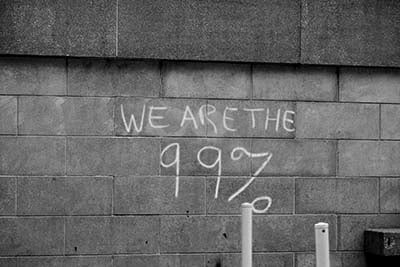
Photo credit: Thinkstock
Despite these movements, previous academic work suggests Americans look down on the poor. The news media perpetuate this message. The Economist claims, “Americans want to join the rich, not soak them,” while The New York Times published an article with the headline, “New Resentment of the Poor.”
But what if previous research and the mainstream media are wrong? What if anti-rich movements better capture the American ethos? Center for Political Studies (CPS) affiliate and Ph.D. candidate in Political Science at the University of Michigan Spencer Piston investigated this issue.
Piston addresses this question with an innovative approach. Previous scholarship measures attitudes with questions about “economic inequality” and “government-led redistribution.” But these are terms that survey respondents rarely use without prompting, and Piston finds reason to believe that many Americans don’t understand what these terms mean.
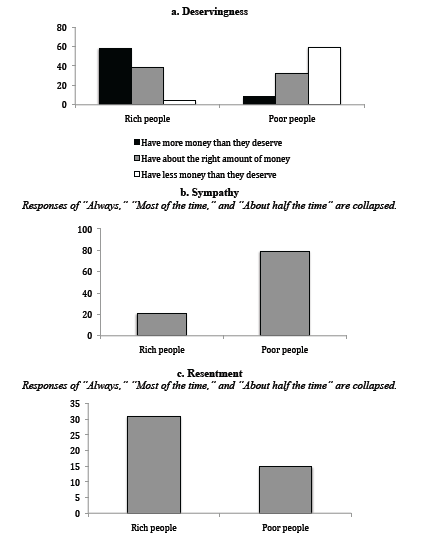
Piston therefore begins with a straightforward but rarely-used survey technique: he asks people how they feel about the poor and the rich. Piston examines answers to these questions using an original survey, and supplemented with American National Election Studies (ANES) data. The graphs below depict feelings of (a) deservingness, (b) sympathy, and (c) resentment toward and the rich and the poor. As we can see, people tend to see the rich as deserving less and the poor deserving more. They also see the poor as more sympathetic than the rich, and the rich as objects of more resentment than the poor.
Feelings toward the Rich and Poor
a. Do the (rich, poor) have more or less money than they deserve?
b. How often have you felt sympathy for (rich, poor) people?
c. How often have you felt resentment toward (rich, poor) people?
What effect might these Robin Hood attitudes have on elections? Piston tested this with several survey experiments. He finds that that a candidate who supports the poor garners more support among voters than an otherwise identical candidate who hurts the poor, regardless of the candidate’s party.
Effects of Candidate’s Record on Mean Support for the Candidate
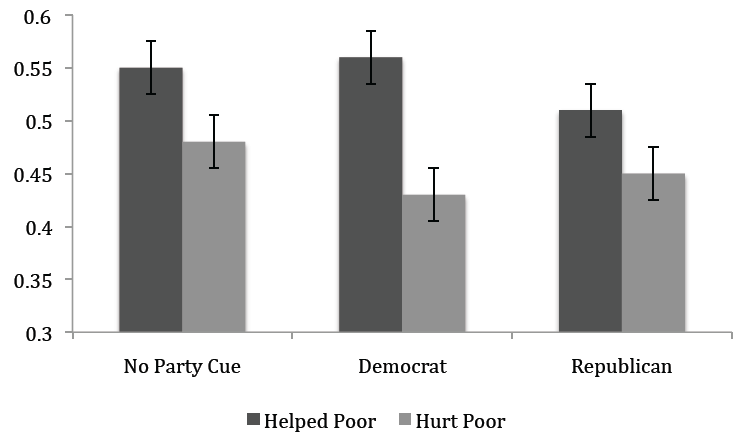
Taken together, these results suggest that previous research has overestimated public support for economic inequality and public opposition to downward redistribution. When survey questions are worded using terms that survey respondents more commonly use, it appears that many Americans want government to give more to the poor – and to take from the rich.
Spencer Piston will join Syracuse University in the fall as an Assistant Professor of Political Science.
May 22, 2014 | ANES, Elections, Innovative Methodology, International
Post developed by Katie Brown and Ioannis Andreadis.
Voting Advice Applications (VAAs) are web platforms that help voters determine the candidate or the political party that best matches their own political ideology. Visitors answer a series of questions to gauge their political positions. The VAA platform then estimates the similarity or dissimilarity of these positions to those of candidates or parties.
There are various ways to present these estimates. One option is to display a list of the candidates or parties along with a number indicating the similarity or dissimilarity of each. Another option is a graph like the one below from Greece, where issues from the election are represented on each axis, and users can visualize their ideological position relative to that of the parties.
-
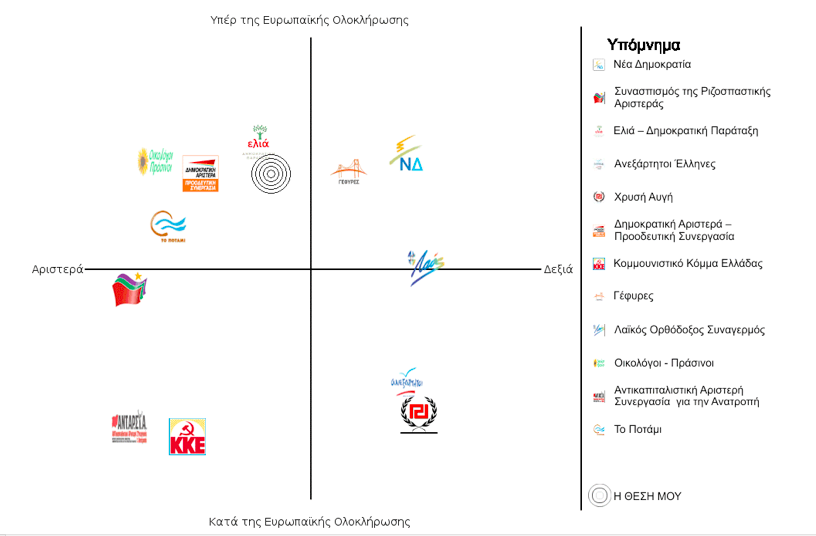
Example of diagram from the Greek VAA www.votematch.gr from the elections for the European Parliament. Left/Right is represented by the horizontal axis and Pro-Europeanism/Euroscepticism is represented by the vertical axis. The political party logos indicate their ideological position and the center of the concentric circles indicates the position of the user.
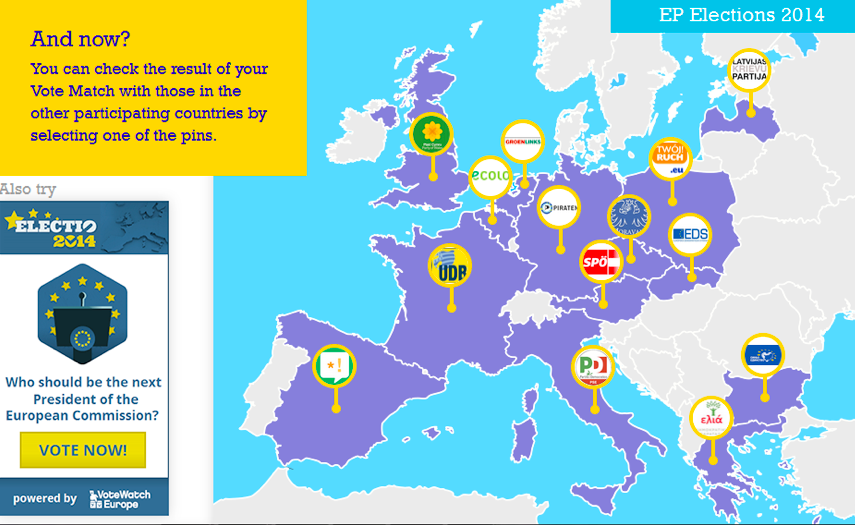
Another example of VAAs in action is Vote Match Europe, an international network of VAAs for the 2014 European Parliament elections across fourteen EU countries. The Vote Match Europe website allows users to see the parties closest to them across all of the countries in the network, and to learn more about the parties and their policies. A goal of the Vote Match Europe website is to promote European citizenship and better inform citizens about the elections for the European Parliament at large.
Ioannis Andreadis is Assistant Professor of Quantitative Methods in the Department of Political Sciences at Aristotle University Thessaloniki. This semester, he is a scholar in residence at the Center for Political Studies (CPS), seeking to learn more about the American National Elections Studies (ANES) and the Comparative Study of Electoral Systems (CSES) under a grant from the Fulbright Program.
In his capacity as a researcher, Andreadis has studied and written about VAAs, and he also both designs and studies VAAs. In particular, he created and oversees the Voting Advice Application HelpMeVote. HelpMeVote was used by more than 480,000 voters during the May 2012 Greek Parliamentary Elections. The application was also used in Iceland and Albania, and is currently being used for the 2014 European Parliament election.
In a recent paper, Andreadis tackles the question of utility of VAAs. He suggest that VAAs must be built to high academic standards, and realize the following benefits:
- VAAs help voters should become more knowledgeable about party positions, allowing the voters to make better choices.
- VAAs help political parties not covered in traditional media to connect with voters who agree with their values.
- VAAs generate data that researchers can use to better understand voting behavior.
VAAs are growing in popularity in places with multi-party systems and high Internet availability – for example, in Western Europe.
In electoral systems with only two parties, VAAs may be less useful given the limited choice set. If a VAA had been used for the 2009 Greek elections or earlier – when two major Greek political parties dominated national politics – it probably would not have been as popularly used. But in the 2012 elections, the Greek parliament featured seven parties, making way for a new VAA market.
With this in mind, adaptation to America’s two party system poses challenges. VAAs could be used in American primaries, where many candidates from the same party compete against each other, but only if candidates running in the same primary have very different positions on enough issues.
May 13, 2014 | Elections, Innovative Methodology, International
Post developed by Katie Brown in coordination with Brian Min.
With six weeks of phased voting, 80% of potential voters are expected to cast ballots in India, making it the world’s largest election. Already marked by political posturing and violence, the elections also include the politics of light.
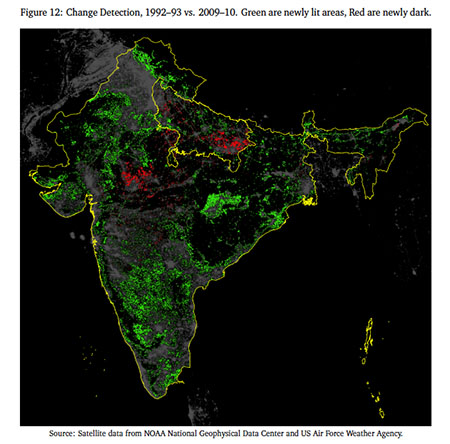 CPS researcher Brian Min developed an innovative way to track energy emissions. Min tracks images from the Defense Meteorological Satellite Program’s Operational Linescan System (DMSP-OLS). In orbit since 1970, these satellites record high resolution images of light on Earth every night. Min uses these images to track energy consumption over time.
In a recent paper, Min applied this methodology to elections in India. Some of the country remains isolated from a consistent supply of electricity. Using data from 1992 to 2010, Min finds that otherwise dark villages are often illuminated during election cycles. When elections come around, politicians promise light and often deliver power leading up to votes. These areas are then returned to darkness as election promises literally fade from the spotlight.
It remains to be seen if the 2014 election will change power grids. Min will be ready to measure using the satellite images. Look out for future posts about Min’s state-of-the-art research based on the same satellite imaging in other areas.
Apr 23, 2014 | Innovative Methodology, International
Post developed by Katie Brown and Arun Agrawal.
This semester, the University of Michigan’s College of Literature, Science, and Arts is sponsoring a theme semester: India in the World. India was selected as a focus for many reasons: its vibrant economy, its middle class is the world’s largest, and its government is the world’s largest democracy. The theme semester seeks to “emphasize the ways that India is a part of everyday life in our increasingly globalized world.”
In this post, we celebrate both the theme semester and yesterday’s Earth Day by featuring the work of Center for Political Studies Faculty Associate and School of Natural Resources and Environment Professor Arun Agrawal. Agrawal studies environmental policy. A recent article in Environmental Science and Policy by Agrawal, Daniel G. Brown, Gautam Rao, Rick Riolo, Derek T. Robinson, and Michael Bommarito focuses on research in India to help us understand how we can use networks to curb resource use.
Research usually focuses on formal institutions as being the difference between successful and unsuccessful resource allocation. But Agrawal and his colleagues argue that institutions are only important in the context of informal networks, or the social interactions between neighbors. Networks are a pervasive part of life. They also change rapidly. But they are little studied in the context of natural resources.
Agrawal and his colleagues examine how institutions and networks interact to influence natural resource use. The authors conducted extensive fieldwork in northern India to investigate how firewood harvesting was influenced by organizations and local social networks. Firewood is critical for cooking food in India so is an important resource to study.
Individual Agents and Social Networks
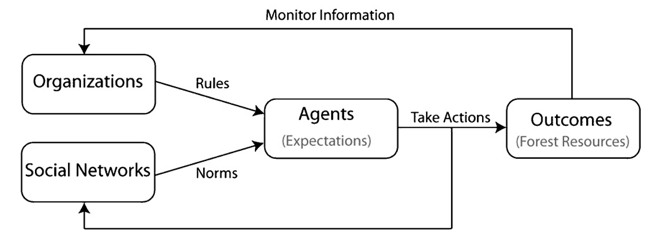
The authors created the above model to consider changes in behaviors and changes over time. Their focus was on how people make decisions – in particular, on the amount of firewood to harvest from the forest. The changes in these decisions are affected by both institutions and networks.
Based on the results of their modeling work, the authors conclude that effective organizations leverage existing social networks. Specifically, they build on existing norms and interactions to change resource use. If institutions make small investments in changing norms, this can have a disproportionately positive impact in reducing resource use, because network interactions amplify the changes across people. That is, small changes in social networks can translate into large savings in resource use.
Connecting back to the theme semester of India in the World, Agrawal’s research in northern India holds intriguing lessons for how policy making can lead to more sustainable resource use practices: institutional changes should build on local social network effects.
Apr 9, 2014 | Current Events, Elections, Innovative Methodology, National
Post developed by Katie Brown and Timothy Ryan.
There are political issues and then there are moral political issues. Often cited examples of the latter include abortion and same sex marriage. But what makes a political issue moral?
Timothy Ryan, a Ph.D. candidate in the department of Political Science and affiliate of the Center for Political Studies (CPS), explored this question in a recent article in The Journal of Politics. An extensive literature already asserts a moral vs. not moral issue distinction. Yet, there is no consensus in how to distinguish between moral and non-moral political issues. Further, trying to sort issues into these categories proves challenging. Many people assume that same-sex marriage is a moral issue, but does everyone see the issue in moral terms? Do people vary in terms of whether they see economic issues, such as Social Security reform and collective bargaining, with morality at stake?
In an attempt to define the divide between moral and non-moral, Ryan turned to the psychology literature. In particular, Ryan applies moral conviction to morality in politics. Moral conviction refers to topics that tap into an individual’s sense of right and wrong. According to the psychology literature, moral conviction leads to a different type of information processing. Moral conviction involves negative emotions, hostile opinions, and potential punitive actions.
Ryan then tests this concept as it relates to political issues with two studies. In both studies, he measures the emotions stimulated by moral conviction. He finds that moral conviction evokes negative emotions toward political disagreement. He also finds that both traditionally moral issues (like abortion or same sex marriage) and traditionally non-moral issues (like labor relations or Social Security) can both illicit moral conviction.
The graph below displays the mean (the squares), the middle 50% (the bars), and the middle 80% (the dots) of moral conviction for five different political issues. As we can see, moral conviction varies a lot for both economic and non-economic issues. Of course many people see same-sex marriage as a matter of right and wrong, Yet, many also see Social Security reform in the same way. The upshot is that, when it comes to deciding which issues are moral, an important part of the answer depends on the individual.
Distribution of Moral Conviction Variable
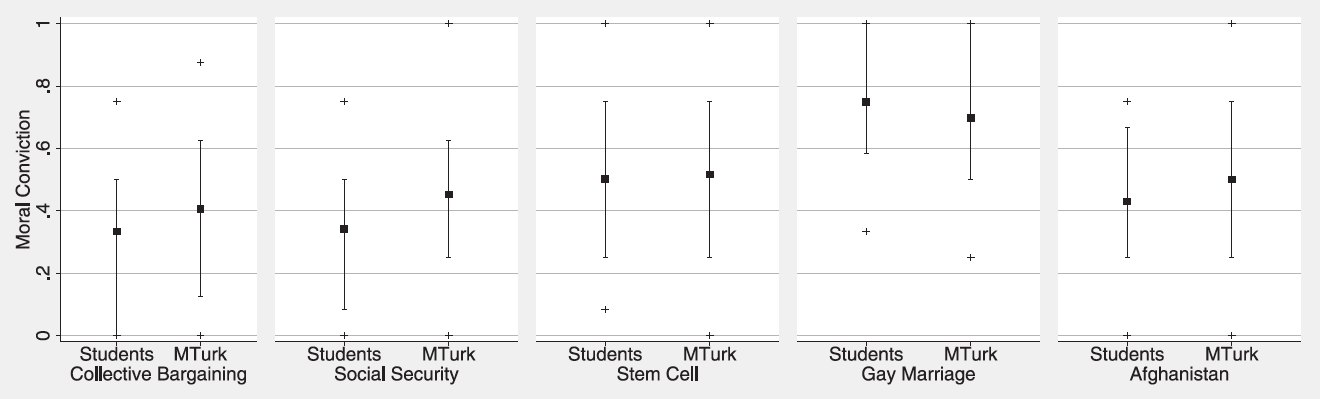
Ryan’s article also challenges a common assumption: the assumption that moral fervor in politics comes more from the right than the left. In the article, he examines propensity to moralize several political issues. The result? Liberals and conservatives moralize in equal measure. The figure below illustrates this with three separate samples: students, Amazon’s Mechanical Turk respondents, and Evaluations of Government and Society Study (EGSS) respondents.
Moral Conviction by Partisanship
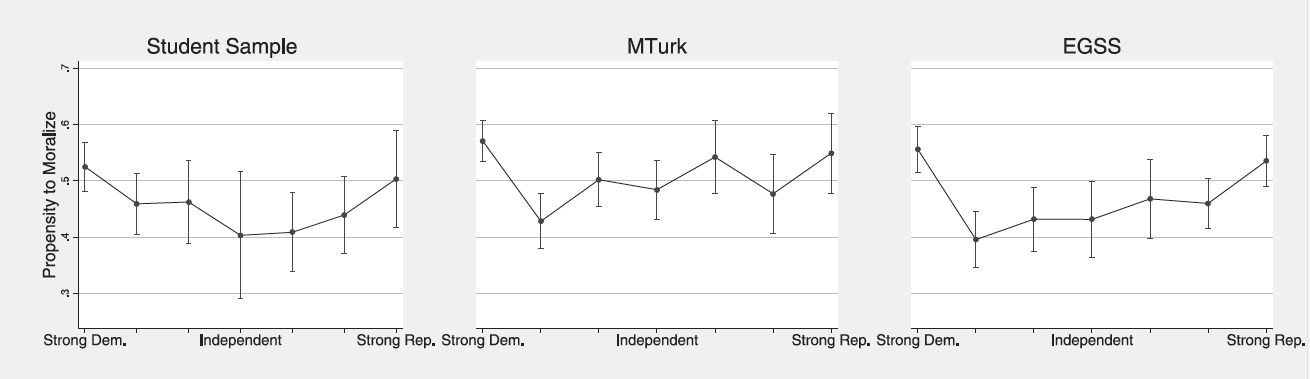
Taken together, Ryan’s findings suggest that the response of moral conviction may be more important than distinguishing between inherently moral and non-moral political issues. Rather, all issues can produce a moral conviction response, depending on the person. Ryan concludes that, “in terms of the underlying psychology, Social Security is just as moralized for some people as Abortion is. Morality is in the eye of the beholder.”
In the fall, Ryan will continue his research on morality in politics when he joins the faculty at the University of North Carolina at Chapel Hill as Assistant Professor of Political Science.