Select Page
Three Lessons from the Brazilian Election Results

Three Lessons from the Brazilian Election Results

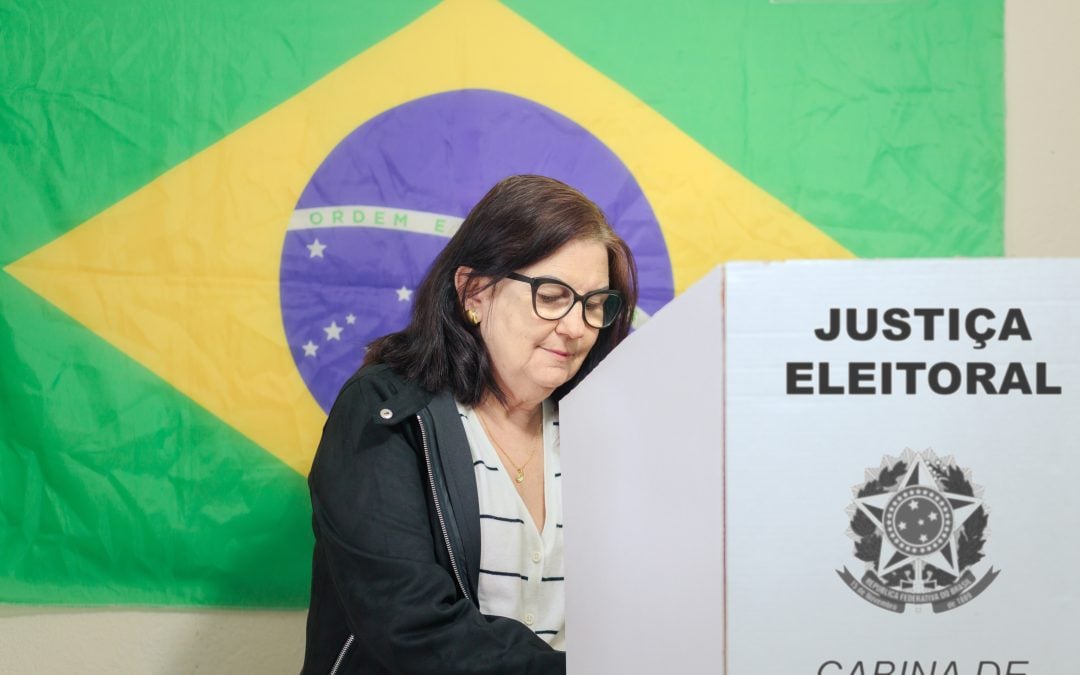
On Sunday, Oct. 25, Luiz Inácio Lula da Silva was reelected in the second round of Brazil’s presidential election. It was a historic comeback. Since direct presidential elections resumed in 1989, no candidate who finished second in the first round had gone on to win the runoff. Lula’s victory also interrupted a regional trend that had begun to look like an unstoppable conservative tsunami. What happened? 

In recent years, conservative candidates have won seven consecutive presidential elections across Latin America. These leaders come in many flavors: From conservatives like José Antonio Kast in Chile to radical libertarians such as Javier Milei in Argentina; from lifelong political figures such as Keiko Fujimori in Peru to newcomers like Abelardo de la Espriella in Colombia. Despite their differences, many have made crime, corruption, and distrust of established institutions central to political debate. Some offer a more direct promise, personified by El Salvador’s Nayib Bukele: give us power, remove the obstacles, and we will deliver results. Several have also embraced Trump or drawn on MAGA politics, although their relationships with Washington differ. And yet Lula just broke this emerging regional narrative.

The first lesson is that political trends are reversible.

Brazil is not an isolated case. Lula’s comeback echoes Poland’s 2023 change of government, Orbán’s defeat in Hungary this April, and the student-backed opposition’s victory in Serbia on the same day Brazilians voted. These movements differ considerably, but each shows that political dominance can be challenged. Lula’s election gives the Latin American left a breath of fresh air. Lula himself first came to power during the pink tide, whose later decline is another reminder that political trends are not set in stone. 

Brazil also shows how a reversal can happen: Through changes in the message and in the means of reaching voters.

Labor unions and college campuses were once crucial spaces for the left. Today political identities are also formed in neighborhood networks, WhatsApp groups, podcasts, and social media feeds. In Brazil, evangelical churches are another important space. The right has invested heavily in some of these networks. The paradigmatic voter for the left might once have been a union worker; today, a driver in the service economy might encounter politics through a podcast during a long shift. A message built for the first worker may not address the second worker’s concerns or carry the same urgency.

After a disappointing first round, Lula’s campaign expanded its digital outreach and intensified its efforts to bring voters to the polls. Its comeback suggests that these spaces remain open to political competition, even where the right has built a strong presence.

The second lesson is that election results can be a poor measure of a society’s ideology.

A large part of the electorate is polarized, but election results also depend on turnout and the choices voters face.

Lula lost the first round by roughly 2.2 million votes and won the second by roughly 4.4 million. Nearly three million additional people voted in the runoff, while blank and null votes also fell. These numbers cannot tell us why many individual voters changed their minds, much less why some may have voted for Lula for the first time, while others chose him over Flávio after supporting a different candidate in the first round. Yet, these numbers reveal an electorate more open to mobilization than the first-round result suggested.

That uncertainty matters for the larger question surrounding recent elections. Are voters becoming more conservative? Or have right-wing candidates been more effective at responding to people who feel that established politicians cannot control violence, improve their lives, or explain those failures?

Recent research offers a clue. The 2026 AmericasBarometer, conducted by Vanderbilt University’s Center for Global Democracy and LAPOP Lab, finds mostly modest increases between 2023 and 2026 in the share of Latin Americans placing themselves on the political right. Electoral outcomes appear to be moving faster than ideological self-identification.

That leaves room for another explanation: the right has been more effective at channeling discontent over crime, living costs, and the failures of incumbents. Lula’s victory shows that this advantage can be contested.

The third lesson is that an election does not settle how a country will be governed.

Flávio Bolsonaro lost, but his Liberal Party remains the largest in the Chamber of Deputies, and the incoming Congress is strongly conservative. Lula will have to govern with opponents who retain electoral strength, organizational power, and influence over legislation and appointments. Winning the presidency gives him another term but putting his policies into practice will require negotiation with parties whose priorities differ from those of Lula and his party.

That distinction between winning office and exercising power extends across the region. Peru’s and Colombia’s recent presidential races were exceptionally close, and neither Fujimori nor de la Espriella commands a congressional majority. Their ability to deliver on their promises will depend on building coalitions. Where leaders face fewer effective constraints, the risk is different. El Salvador shows the stakes: in 2025, Bukele’s allies removed presidential term limits, weakening a basic constraint on executive power. But we need to remember that Latin American institutions differ greatly in their capacity to hold leaders accountable.

For governments of both the left and the right, the test comes after election day. Can they deliver security and opportunity? Can they do so while accepting opposition, independent courts, and the possibility of losing the next election?

For Lula, those questions are now immediate. His comeback interrupted the right’s regional momentum, but he must answer voters’ concerns about crime and living costs while negotiating with a Congress in which his opponents have gained power. And can the left offer credible answers to the problems voters are asking it to solve?

Whether Lula can do that will determine if his victory becomes a durable alternative to the right’s recent successes or merely a pause. What he does next will tell us more about Latin America’s political future than the color we assign to its electoral map.

This post was written by Edgar Franco-Vivanco, Assistant Professor of Political Science and a faculty associate at the University of Michigan Center for Political Studies and the Michigan Institute for Data Science. His research interests include Latin American politics, historical political economy, criminal violence, and Indigenous politics. He is a co-PI of the Historical Institutions Lab and the director of LATAM-EH.

3 Takeaways: What the Polls Are Telling Us About the 2026 Midterms

3 Takeaways: What the Polls Are Telling Us About the 2026 Midterms

With Election Day less than two weeks away, University of Michigan public opinion researchers Michael Traugott and Josh Pasek provided an overview of what the data currently tell us about the upcoming midterms.

The talk was presented as part of the ISR Insights series held at the Institute for Social Research, where Center for Political Studies experts present analyses in panels before and after US elections. Three takeaways: 

1. Every indicator political scientists watch is pointing the same direction

Political scientists typically treat midterms as a referendum on the sitting administration, and they measure that referendum several ways. Right now, those measures agree:

  • Presidential approval: Trump’s approval sits at roughly 39% against 59% disapproval — about 20 points “under water,” and the lowest reading for an incumbent president at this point in the era of modern public polling.
  • The generic congressional ballot: Aggregated polling shows roughly 51% preferring a Democratic candidate to 42% preferring a Republican — about an eight-point gap that has widened over the course of the term.
  • Historical base rates: Since the 1930s, the president’s party has almost always lost House seats at the midterm. Only three times has it gained seats. In 2018, Republicans lost 40.
  • Issue concerns: Recent Fox News polling found three in four Americans or more are extremely or very concerned about corruption in government (the top issue), inflation and prices, gas prices, health care, and government leadership.

When the fundamentals and the polling converge, Pasek noted, that agreement itself suggests the environment is tilted meaningfully in one direction, rather than reflecting noise in a single data source.

2. The Senate is the real contest

Republicans currently hold narrow majorities: roughly 219–214 in the House (with two vacancies) and 53–45 in the Senate, with two independents caucusing with Democrats. A four-seat shift would flip either chamber — not a big lift in the House, but a heavy one for the Senate.

House: Seat-translation models built on the generic ballot suggest that an eight-to-nine-point Democratic popular vote advantage would produce a Democratic pickup in the neighborhood of 26 to 28 seats. Alan Abramowitz’s model for Sabato’s Crystal Ball produces a comparable estimate (about 192 Republican seats at a minus-eight Republican margin). Aggregators are broadly confident Democrats take the chamber.

Senate: Senate forecasting works differently — it’s done state by state, with heavy weight on candidate quality and well-funded statewide advertising. The Cook Political Report identifies seven toss-ups: Alaska, Iowa, Kansas, Maine, Ohio, Texas (all currently Republican-held), and Michigan (an open seat). Nate Silver’s simulation model puts Democratic control at roughly a three-in-four chance. A caveat: The 2026 Senate map was long considered unfavorable for Democrats, because competing at all requires winning in territory with a partisan voter index of R+5 or greater. The current polling suggests they may be there — but it’s a harder map than 2028.

3. Election polling is genuinely hard, but this margin is larger than typical polling error

Pasek, who led the AAPOR Task Force on 2024 Pre-Election Polling, spoke on the challenges that election polls face, including low response rates, participation bias, and the burden of predicting future behavior. “Polls are excellent at telling you which races are competitive,” said Pasek. “They are not precise enough to tell you who wins a race decided by a point.”

That said, larger margins make contests easier to call, and recent polls have a decent track record of predicting Senate races within a 5-point margin of error, Pasek said. An open question is whether something specific was going wrong in ballot years when Trump was on the ballot — distrust of pollsters among his supporters, for example, leading them to hang up. If so, it’s unclear whether that carries into a midterm where he isn’t a candidate but is working hard to make the election about himself. “Not obvious,” Pasek said. No one really knows.

A referendum on democracy

Both presenters argued that how people want to vote may be a less decisive factor this year than usual, because of pressures on the process itself. 

Pasek flagged claims about placing federal officers at polls, attempted changes to how the Postal Service handles ballots, and a growing number of officials who denied the 2020 results now administering elections. The presence of these issues in the media alone can impact voter turnout, Traugott noted, since uncertainty about federal officers at polling places, registration rules, or mail handling can depress participation on its own. Most concerning to Pasek: Apparent degradation of losers’ willingness to concede.

But U.S. elections are run locally, across nearly 200,000 polling locations. That decentralization is a real check against any single national intervention.

On Election Day, we may see an enthusiasm gap that drives more Democrats to the polls, and a potential shift away from Trump among Hispanic and younger voters.

Questions about how the process unfolds, how accurately polls predicted behavior, and who shows up to vote will only be knowable on election day. Several toss-ups sit in the Eastern time zone, so early returns from Maine, Michigan, and Ohio will offer an unusually good early read for East Coast viewers on the night.

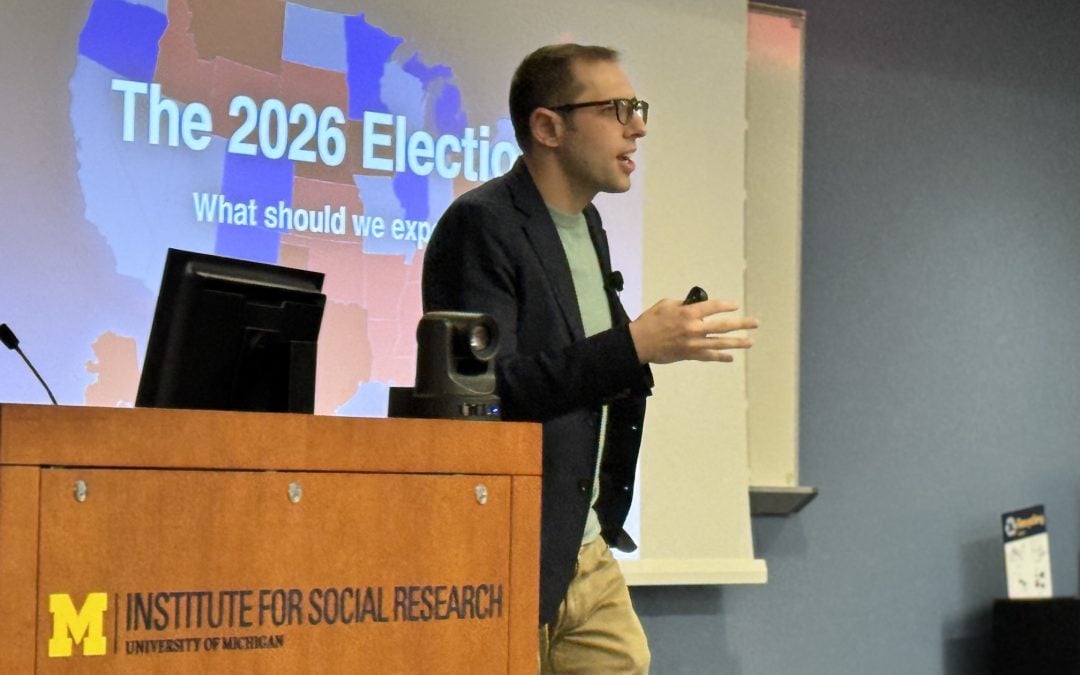
Michael Traugott at the ISR dais

Michael Traugott is a political scientist who studies campaigns and elections, voting behavior, and the impact of mass media on American politics, and is the author of A Voter’s Guide to the Election Polls, now in its 6th edition. 

Josh Pasek is Professor of Communication & Media and Political Science, Research Professor at the Center for Political Studies, Institute for Social Research, and Core Faculty of the Michigan Institute for Data Science at the University of Michigan. 

This post was developed by Tevah Platt, communications manager for the Center for Political Studies. Recordings of past and upcoming talks are available through ISR.

Watch the full talk:


How Pervasive is the US Public Shift on Israel?

How Pervasive is the US Public Shift on Israel?

Dr. Shibley Telhami—the Anwar Sadat Professor for Peace and Development at the University of Maryland and an influential scholar on foreign affairs and American public opinion on the Middle East—presented a sweeping historical picture yesterday of how American attitudes toward Israel and the Israeli-Palestinian conflict have evolved in recent decades.

“What we’re witnessing is a paradigmatic shift that’s likely to last that sees Israel as a villain and perhaps even a genocidal villain,” Telhami said in a seminar presented to the Center for Political Studies at the University of Michigan Institute for Social Research. “We have something that I think is more than just a short-term shift in public opinion, and that is much deeper than people may assume.”

Telhami’s central argument, based on his work polling American attitudes toward the Israeli-Palestinian conflict since 1989, is that Americans’ support for Israel– waning gradually over the past 15 years– experienced a dramatic crash following the Oct. 7, 2023 Hamas attack and the Israeli assault on Gaza. Telhami: “The dam finally broke in Gaza once the scale of the Israeli assault became clear.”

A Paradigm Shift

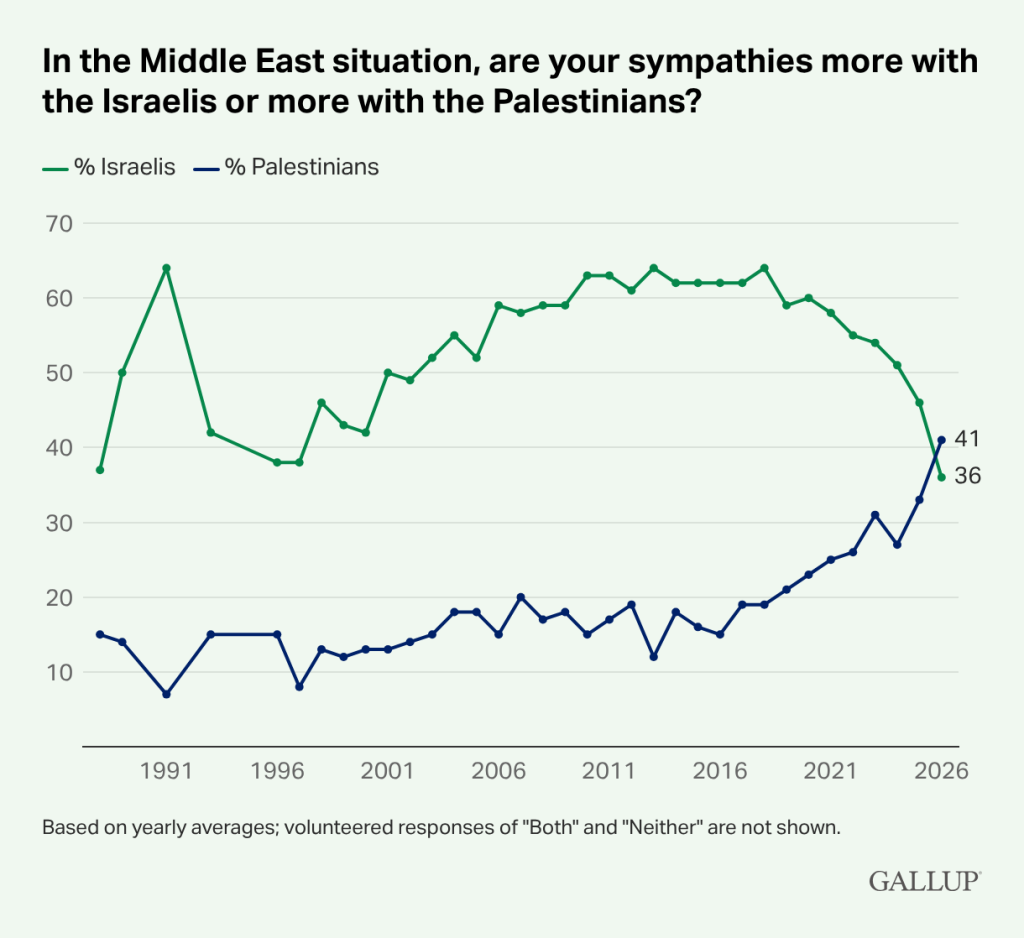
Gallop Poll: In the Middle East situation, are your sympathies more with the Israelis or the Palestinians? The longitudinal data that excludes "both" or "neither" responses shows sympathies have leaned significantly in favor of Israel until 2023, with the largest gap in 1991. The gap narrows gradually until recent years, when the trends make a rapid reversal, with 41% most recently leaning toward Palestians compared to 36% toward Israelis.

Telhami emphasized that this transformation did not begin with the war in Gaza, but was building over time. Telhami’s polling data of past decades showed that a majority of Americans have consistently said they want the U.S. to take “neither side” in the conflict. Among the minority who did express a preference, support for Israel outweighed support for the Palestinians by wide margins—often five or six to one. Telhami has seen that gap close over time, with fewer Americans choosing “neither side,” and among those who do take sides, a narrowing—and eventually reversing—preference, especially among Democrats.

It was a shift Telhami tracked and anticipated. In 2014, Telhami published an op ed in Foreign Policy entitled “America Has a Plan, and No, It Isn’t One That Israel Would Like,” and in 2015, his widely cited Monkey Cage blog for the Washington Post, “How to (almost) eliminate the partisan divide on the Middle East,” explored the widening partisan gap between Republicans and Democrats regarding Israel-Palestine. The divide was largely driven by evangelical Christians, and fanned by Netanyahu’s criticism, before Congress, of Obama’s Iran nuclear deal.

Under Biden, Telhami’s University of Maryland Critical Issues Poll confirmed that half of young Democrats (under 35) disapproved of the new U.S. president’s handling of the May 2021 Gaza conflict. Writing for the Brookings Institution, Telhami argued that the data underscored a generational shift that would prove to be a warning sign of a widening fracture within the Democratic coalition, and anticipated that could impact Biden’s reelection.

Telhami’s polling data showed an initial, dramatic spike in sympathy for Israel in the immediate aftermath of the October 7, 2023 attacks—the largest poll-to-poll increase he has measured in decades of surveying. But this reversed within roughly two weeks, even before the full scope of Israel’s military actions was apparent. Young Democrats did not shift in attitudes during this initial spike– and as the war intensified, their sympathies moved decisively toward the Palestinians.

Telhami used Gallup Poll data to illustrate the scale of the overall reversal: Sympathy for Israel among all Americans fell from roughly 50% to 36%, while sympathy for Palestinians rose to 41%. Among Democrats specifically, the shift was described as “stunning”—support for Israel plummeted from over 50% in 2001 to roughly 17% in recent polling, while sympathy for Palestinians rose to 65%. Republican attitudes, by contrast, remained largely stable or even slightly strengthened in favor of Israel—with one critical exception.

A Generational Gap in Both Parties

Telhami’s data show a narrowing generational gap among Democrats and growing gap among Republicans. 

Pew polling cited by Telhami showed that among Democrats, the gap between younger and older cohorts on unfavorable views of Israel has nearly disappeared (71% vs. 66%). Between 2022 and 2025, younger and older Democrats turned more negative toward Israel, but negative views among younger Democrats grew by 9 percent, compared with a 23-point increase among older Democrats.

Even more notable is movement among younger Republicans: Unfavorable views of Israel in this group rose from 35% to 57% in a short span—a shift Telhami called evidence that this is “spreading to more segments of society,” not confined to the political left.

Telhami’s research on evangelicals demonstrated that younger evangelicals, unlike their elders, were “walking away” from unconditional support for Israel.

When asked whether Israel’s actions in Gaza were “justified” as self-defense, only 22% of young Republicans responding to Telhami’s poll agreed, compared to 52% of older Republicans.

Why Now? Drivers of the Shift

Telhami outlined several interlocking explanations for why this issue has moved from the margins to the center of American political consciousness:

  1. Rising priority for those attuned to the issue: Drawing on decades-old research with colleague Jon Krosnick, Telhami explained that policy influence depends less on broad public opinion than on “issue publics”—segments who rank an issue as a top priority. Historically, this issue public was small but overwhelmingly pro-Israel. Now, younger Democrats increasingly rank Israel-Palestine as a high concern, possibly because they view it as emblematic of broader commitments to human rights and democracy.
  2. Perceptions of genocide and American complicity: Telhami’s polling shows substantial and growing numbers of Americans—including a plurality of the general public and majorities of Democrats—describing Israel’s actions in Gaza as “genocide” or “major war crimes akin to genocide.” More than 60% of respondents said U.S. military and diplomatic support actively enabled these actions, tying the issue directly to American foreign policy rather than treating it as a distant humanitarian concern.
  3. The Iran War as an accelerant: Telhami argued that the U.S. strike on Iran transformed the issue from a foreign policy question into what he called a “pocketbook issue,” linked tangibly to energy prices and inflation. Public discourse increasingly framed the war as one the U.S. entered on behalf of Israel and Netanyahu.
  4. A “permission structure” for criticism: Telhami theorized that a social and psychological threshold had been crossed: Once enough people began publicly criticizing Israel, others who privately held similar views felt emboldened to speak out, having previously assumed they were in the minority. Telhami’s polling of the public and of scholars of political science has directly asked whether and why Americans have self-censored in sharing their views on Israel-Palestine. Pre-war, more than 60% of scholars reported feeling the need to self-censor when discussing Israel-Palestine professionally, with the overwhelming majority citing fear of appearing critical of Israel. That figure rose above 80% after October 7. Extending this research to the general public, Telhami found that 42% of Americans say they feel the need to be “careful” discussing the Israeli-Palestinian conflict in public—compared to only 29% who say the same about Russia-Ukraine.

Looking Ahead: Fragility, Wild Cards, and Electoral Consequences

Telhami closed with reflections on the durability of this shift and its political stakes:

  • Israeli elections: While some observers hope a new Israeli government might ease American concerns, polling data suggests dissatisfaction with Israel runs deeper than opposition to Netanyahu personally.
  • Islamophobia as a “wild card”: Telhami highlighted dramatically rising unfavorable views of Muslims among Republicans—now at a 12-year high—which could continue to anchor pro-Israel sentiment within the GOP even as other factors erode it.
  • Trump and Republican fragility: Telhami argued that Republican support for Israel is more fragile than commonly assumed, and that anchoring this support in this moment is is President Trump’s personal backing of Israel. A political shift in course from the GOP might not result in major backlash from the evangelical base that supports Trump for reasons unrelated to Israel.
  • Electoral consequences: Telhami argued that the Israel-Palestine issue contributed to Democratic losses in 2024, including Kamala Harris’s defeat, citing both polling data and firsthand knowledge of internal campaign dynamics. He suggested the upcoming midterms will reveal how durable this electoral effect proves to be, with races like those in Texas potentially offering more revealing tests than reliably Democratic states like Michigan.

While acknowledging uncertainty about how this shift will translate into concrete policy outcomes that are never purely a function of public opinion, Telhami asserted: “Public opinion will matter more on this issue than it has in the past. I have no doubt about that.”

This post was written by Tevah Platt, who manages communications for the Center for Political Studies at the University of Michigan Institute for Social Research. It is based on Telhami’s presentation on Oct. 14, 2026 in the CPS Interdisciplinary Workshop on Politics and Policy. 

Learn more: Telhami’s newly released 2026 Critical Issues Poll data tracks prejudice toward Jews and Muslims among the American public, and also measures change in how Americans define antisemitism and the extent to which they differentiate attitudes against Jews and Judaism from attitudes against Israel and Zionism.

What are the Implications of the 2026 Brazil Election?

What are the Implications of the 2026 Brazil Election?

Português

On Oct. 4, over 100 million Brazilians headed to the polls to elect a president, state governors, two-thirds of the Senate, federal and state deputies and, in the Federal District, district deputies.  The top two presidential candidates, President Luiz Inácio Lula da Silva and former President Jair Bolsonaro, will go to a run-off election on Oct. 25. The new leader will take power on Jan. 5, 2027. Fernanda Pires of Michigan News sat down with University of Michigan experts Edgar Franco-Vivanco and Raphael Nishimura on the eve of the first-round election that ended in a 47-45% split between Bolsonaro and Lula. Her Q&A follow:

The election is taking shape amid divisions over President Luiz Inácio Lula da Silva and the political legacy of former President Jair Bolsonaro. Bolsonaro’s son, Flávio Bolsonaro, is Lula’s main rival in the presidential race. Voters’ concerns about the economy, public security, the Supreme Court crisis and the country’s future are also central to the race.

University of Michigan assistant professor of political science Edgar Franco-Vivanco, director of the Latin American Elections Hub, and Raphael Nishimura, sampling operations director at the Institute for Social Research, discuss voter sentiment, polling and the election’s potential implications for Latin America and the world.

What could Brazil’s election mean for the region and the world?

Franco-Vivanco: Latin America has shown a clear political shift to the right. Four countries in the region—Chile, Colombia, Ecuador and Peru—have recently moved toward right-wing governments. In Brazil, voters are disappointed with previous left-leaning incumbents and increasingly frustrated by rising crime and persistent corruption scandals. As Latin America’s largest democracy, Brazil will determine whether the region’s rightward shift gains momentum or faces a major counterweight.

The election holds major stakes for domestic life and the regional balance of power. A rightward turn would leave Mexico as the only major regional democracy outside this trend.

For international powers such as the United States and China, the outcome will determine how the next government balances crucial trade relationships and foreign influence. Domestically, everyday life hinges on how the incoming administration addresses public security, economic performance and persistent corruption.

This major election in Brazil will test the strength and stability of the region’s democratic institutions. Smaller Latin American nations are closely monitoring the outcome as they consider how to align their regional policies with the region’s leading power.

Brazil must balance its primary economic relationship with China with heavy diplomatic pressure from the United States. A close final vote raises the risk of postelection conflict and increases pressure on candidates to respect democratic norms by accepting the official results.

Right-wing candidates are capitalizing on public security concerns by making crime reduction their primary focus. Meanwhile, many voters remain deeply apathetic and disappointed with democracy because candidates have failed to address these issues directly.

How do voters split across key demographics in this race?

Franco-Vivanco: Gender is a primary dividing line in voter support, according to previous research. Women have traditionally backed Luiz Inácio Lula da Silva, while men have tended to support Jair Bolsonaro and right-wing parties.

Recent polling shows this gender gap narrowing as candidates’ campaigns seek to alter those trends. Meanwhile, young voters are exhibiting shifting political behavior. Unlike in previous election cycles, when young voters aligned closely with left-wing causes, current polling indicates a more divided electorate among younger voters.

What post-election challenge threatens the stability of the result?

Franco-Vivanco: The core danger is whether the losing candidate accepts the final result without conflict. A tight margin increases the likelihood of postelection disputes, particularly if Flávio Bolsonaro suffers a narrow defeat. Experts view candidates’ adherence to democratic norms as the primary test for maintaining peace after voters cast their ballots.

How do foreign trade and international relations shape the stakes of this election?

Franco-Vivanco: Foreign relations depend heavily on how the incoming leader balances major global economic powers. China remains Brazil’s primary trading partner, making strong economic ties essential to the nation’s financial stability.

At the same time, the government faces direct geopolitical pressure from the United States, which prefers a closely aligned administration in the region. Maintaining this delicate balance between Washington and Beijing presents a complex diplomatic test for any administration. Smaller Latin American nations are closely following the outcome as they consider how to align their foreign policies with regional leadership.

Now, let’s talk about polls. What insights can we expect from the final eight presidential polls scheduled for release on Saturday, the day before Brazil’s election?

Nishimura: We will have polls of various sizes and methodologies, so each will look at the same question from a different angle. We can expect some of them to disagree, but, on average, they will present a snapshot of the Brazilian electorate moments before voters go to the polls.

Do the final polls tend to provide a more accurate picture of voter intentions, or can last-minute changes still significantly affect the results?

Nishimura: While the final polls might provide a closer look at what voters are thinking as the election approaches, we should not expect them to necessarily reflect the election results. Factors such as turnout, last-minute decisions and strategic voting might alter the snapshot taken days or even hours before the election.

What should voters look for when comparing the findings of different organizations?

Nishimura: Different methodologies might lead to different results. Polling methodology involves many aspects, from sample and questionnaire design to postdata-collection statistical adjustments. One of the main drivers, however, is the mode of data collection—whether in person, by phone or online.

This will most likely account for the main differences in the results. Also, in Brazil, all publicly released election polls must be registered with the Superior Electoral Court. Anyone can consult the court’s system to review the methods used in each poll.

What are the biggest methodological challenges in accurately measuring voter intentions in Brazil’s presidential race?

Nishimura: Although voting is mandatory in Brazil, one of the main methodological challenges for pollsters is measuring turnout, especially because nonparticipation is not random and affects candidates differently. This challenge is aggravated by the fact that, as in the United States and other countries, voters tend to overreport turnout in polls.

Moreover, Brazil does not have a database—such as the voter file in the United States—that contains each voter’s turnout history and could enable pollsters to estimate likely-voter models. The lack of such a list, coupled with the country’s continental size, also makes it very difficult to collect data efficiently without relying on telephone sampling. Telephone sampling has its own problems, as fewer people answer calls because of telemarketing and scams.

Edgar Franco-Vivanco is an affiliate of the Center for Political Studies, and Raphael Nishimura is an affiliate of the Survey Research Center at the University of Michigan Institute for Social Research.

Need an accessible version of content on this page? Request an accessible resource . Accessibility Statement