
The 2026 midterm elections are less than a year away, and they will have a powerful influence on the future of American politics. Currently, the Republican party has a “trifecta,” meaning they control the presidency, the House, and the Senate. This suggests they should be able to be able to implement their policy agenda through concerted action.
However, their majorities are slim, and there is a very good chance that the Democrats will gain control of the House after the midterm elections. Republicans currently hold a three-seat majority in the House; if the Democrats gain the majority, there will be increased scrutiny of Trump administration activities through the hearing process, with a high probability of another impeachment of Donald Trump, even if it is unlikely to result in a conviction in the Senate.
How the Midterms Work
Every two years all 435 seats in the House, and one-third of the seats in the Senate, are up for election. Political scientists have developed two distinct models for estimating the outcome of the midterms, based upon evaluations of the current president and the quality of the candidates contesting the election. It is important to note that the participation of incumbents remains unclear in all cases; while 47 House members have indicated they plan to retire so far, for example, there is still time for others to get out. There are slightly more Republicans than Democrats in this group. There are also 11 incumbent Senators who have announced their retirement or intent to run for another office as well (PBS Newshour Analysis).
While there are 435 seats in the House, not all of them are at risk of flipping. Because of redistricting, most districts are safe for one party or the other. In fact, only 36 seats are considered competitive (typically decided by 10 percentage points or less), with half of these considered tossups (New York Times Midterm Elections House Maps). Because of mid-decade redistricting efforts in some states, there are 26 districts with new boundaries and no prior electoral history, although only 11 are considered likely to be competitive.
History Disfavors Incumbent Parties
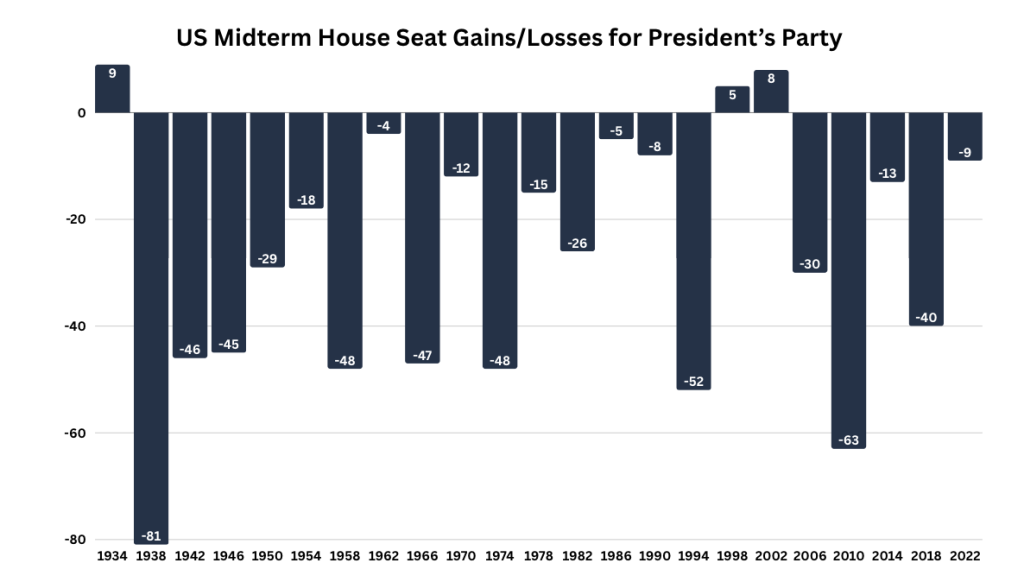
The historical pattern in the House is that the incumbent president’s party loses seats in the midterm election. There have been 20 midterm elections in the post-World War II period, and the president’s party has lost seats in 18 of them. The exceptions were in 1998 when Bill Clinton was being impeached and 2002 after the 9/11 attacks when George W. Bush was in office. The range of losses was from 4 in 1962 in John F. Kennedy’s presidency after the Cuban missile crisis to 63 in 2010 during Barack Obama’s second term, after dissatisfaction with the economy and the debates and passage of the Affordable Care Act. In the 2018 midterm election during Donald Trump’s first term, the Republican party lost 40 seats in the House.
Forecasting
Lewis-Beck and Tien (2025) have developed a model for estimating House seat losses in a midterm election based upon the president’s net approval rating in a Gallup poll (% Approving – % Disapproving) and the change in personal disposable income from the Bureau of Economic Analysis in the previous six months. When this calculation is made in August of the election year, it provides a good estimate of the seat losses in November. Lewis-Beck and Tien made an estimate in October of last year for a seat loss of 28. Since then, Donald Trump’s approval rating has declined, and the model in February now suggests a seat loss of 49. August is still six months away, and both Trump’s approval rating and Americans’ personal disposable income could increase. But it is virtually certain that the Democrats will gain control of the House.
 Michael Traugott is a political scientist who studies campaigns and elections, voting behavior, and the impact of mass media on American politics He is the interim director of the Center for Political Studies (CPS) and the author of A Voter’s Guide to the Election Polls, now in its 6th edition. CPS communications manager Tevah Platt assisted in the development of this post.