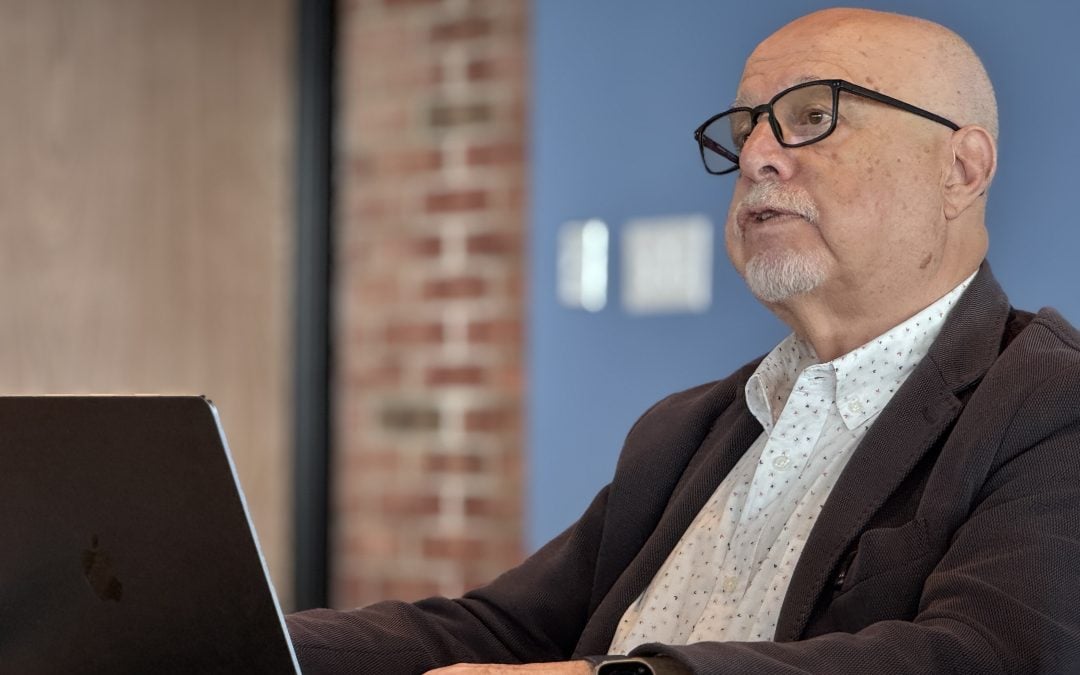
Dr. Shibley Telhami—the Anwar Sadat Professor for Peace and Development at the University of Maryland and an influential scholar on foreign affairs and American public opinion on the Middle East—presented a sweeping historical picture yesterday of how American attitudes toward Israel and the Israeli-Palestinian conflict have evolved in recent decades.
“What we’re witnessing is a paradigmatic shift that’s likely to last that sees Israel as a villain and perhaps even a genocidal villain,” Telhami said in a seminar presented to the Center for Political Studies at the University of Michigan Institute for Social Research. “We have something that I think is more than just a short-term shift in public opinion, and that is much deeper than people may assume.”
Telhami’s central argument, based on his work polling American attitudes toward the Israeli-Palestinian conflict since 1989, is that Americans’ support for Israel– waning gradually over the past 15 years– experienced a dramatic crash following the Oct. 7, 2023 Hamas attack and the Israeli assault on Gaza. Telhami: “The dam finally broke in Gaza once the scale of the Israeli assault became clear.”
A Paradigm Shift
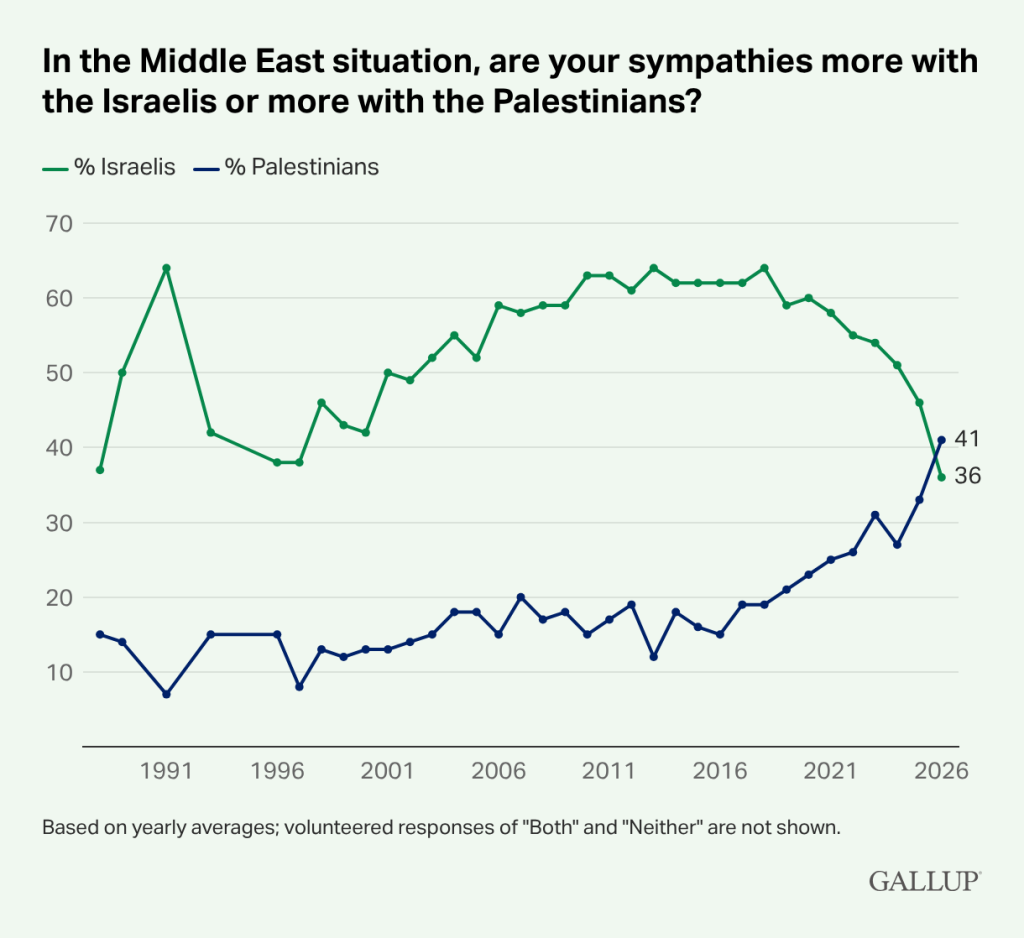
Telhami emphasized that this transformation did not begin with the war in Gaza, but was building over time. Telhami’s polling data of past decades showed that a majority of Americans have consistently said they want the U.S. to take “neither side” in the conflict. Among the minority who did express a preference, support for Israel outweighed support for the Palestinians by wide margins—often five or six to one. Telhami has seen that gap close over time, with fewer Americans choosing “neither side,” and among those who do take sides, a narrowing—and eventually reversing—preference, especially among Democrats.
It was a shift Telhami tracked and anticipated. In 2014, Telhami published an op ed in Foreign Policy entitled “America Has a Plan, and No, It Isn’t One That Israel Would Like,” and in 2015, his widely cited Monkey Cage blog for the Washington Post, “How to (almost) eliminate the partisan divide on the Middle East,” explored the widening partisan gap between Republicans and Democrats regarding Israel-Palestine. The divide was largely driven by evangelical Christians, and fanned by Netanyahu’s criticism, before Congress, of Obama’s Iran nuclear deal.
Under Biden, Telhami’s University of Maryland Critical Issues Poll confirmed that half of young Democrats (under 35) disapproved of the new U.S. president’s handling of the May 2021 Gaza conflict. Writing for the Brookings Institution, Telhami argued that the data underscored a generational shift that would prove to be a warning sign of a widening fracture within the Democratic coalition, and anticipated that could impact Biden’s reelection.
Telhami’s polling data showed an initial, dramatic spike in sympathy for Israel in the immediate aftermath of the October 7, 2023 attacks—the largest poll-to-poll increase he has measured in decades of surveying. But this reversed within roughly two weeks, even before the full scope of Israel’s military actions was apparent. Young Democrats did not shift in attitudes during this initial spike– and as the war intensified, their sympathies moved decisively toward the Palestinians.
Telhami used Gallup Poll data to illustrate the scale of the overall reversal: Sympathy for Israel among all Americans fell from roughly 50% to 36%, while sympathy for Palestinians rose to 41%. Among Democrats specifically, the shift was described as “stunning”—support for Israel plummeted from over 50% in 2001 to roughly 17% in recent polling, while sympathy for Palestinians rose to 65%. Republican attitudes, by contrast, remained largely stable or even slightly strengthened in favor of Israel—with one critical exception.
A Generational Gap in Both Parties
Telhami’s data show a narrowing generational gap among Democrats and growing gap among Republicans.
Pew polling cited by Telhami showed that among Democrats, the gap between younger and older cohorts on unfavorable views of Israel has nearly disappeared (71% vs. 66%). Between 2022 and 2025, younger and older Democrats turned more negative toward Israel, but negative views among younger Democrats grew by 9 percent, compared with a 23-point increase among older Democrats.
Even more notable is movement among younger Republicans: Unfavorable views of Israel in this group rose from 35% to 57% in a short span—a shift Telhami called evidence that this is “spreading to more segments of society,” not confined to the political left.
Telhami’s research on evangelicals demonstrated that younger evangelicals, unlike their elders, were “walking away” from unconditional support for Israel.
When asked whether Israel’s actions in Gaza were “justified” as self-defense, only 22% of young Republicans responding to Telhami’s poll agreed, compared to 52% of older Republicans.
Why Now? Drivers of the Shift
Telhami outlined several interlocking explanations for why this issue has moved from the margins to the center of American political consciousness:
- Rising priority for those attuned to the issue: Drawing on decades-old research with colleague Jon Krosnick, Telhami explained that policy influence depends less on broad public opinion than on “issue publics”—segments who rank an issue as a top priority. Historically, this issue public was small but overwhelmingly pro-Israel. Now, younger Democrats increasingly rank Israel-Palestine as a high concern, possibly because they view it as emblematic of broader commitments to human rights and democracy.
- Perceptions of genocide and American complicity: Telhami’s polling shows substantial and growing numbers of Americans—including a plurality of the general public and majorities of Democrats—describing Israel’s actions in Gaza as “genocide” or “major war crimes akin to genocide.” More than 60% of respondents said U.S. military and diplomatic support actively enabled these actions, tying the issue directly to American foreign policy rather than treating it as a distant humanitarian concern.
- The Iran War as an accelerant: Telhami argued that the U.S. strike on Iran transformed the issue from a foreign policy question into what he called a “pocketbook issue,” linked tangibly to energy prices and inflation. Public discourse increasingly framed the war as one the U.S. entered on behalf of Israel and Netanyahu.
- A “permission structure” for criticism: Telhami theorized that a social and psychological threshold had been crossed: Once enough people began publicly criticizing Israel, others who privately held similar views felt emboldened to speak out, having previously assumed they were in the minority. Telhami’s polling of the public and of scholars of political science has directly asked whether and why Americans have self-censored in sharing their views on Israel-Palestine. Pre-war, more than 60% of scholars reported feeling the need to self-censor when discussing Israel-Palestine professionally, with the overwhelming majority citing fear of appearing critical of Israel. That figure rose above 80% after October 7. Extending this research to the general public, Telhami found that 42% of Americans say they feel the need to be “careful” discussing the Israeli-Palestinian conflict in public—compared to only 29% who say the same about Russia-Ukraine.
Looking Ahead: Fragility, Wild Cards, and Electoral Consequences
Telhami closed with reflections on the durability of this shift and its political stakes:
- Israeli elections: While some observers hope a new Israeli government might ease American concerns, polling data suggests dissatisfaction with Israel runs deeper than opposition to Netanyahu personally.
- Islamophobia as a “wild card”: Telhami highlighted dramatically rising unfavorable views of Muslims among Republicans—now at a 12-year high—which could continue to anchor pro-Israel sentiment within the GOP even as other factors erode it.
- Trump and Republican fragility: Telhami argued that Republican support for Israel is more fragile than commonly assumed, and that anchoring this support in this moment is is President Trump’s personal backing of Israel. A political shift in course from the GOP might not result in major backlash from the evangelical base that supports Trump for reasons unrelated to Israel.
- Electoral consequences: Telhami argued that the Israel-Palestine issue contributed to Democratic losses in 2024, including Kamala Harris’s defeat, citing both polling data and firsthand knowledge of internal campaign dynamics. He suggested the upcoming midterms will reveal how durable this electoral effect proves to be, with races like those in Texas potentially offering more revealing tests than reliably Democratic states like Michigan.
<
While acknowledging uncertainty about how this shift will translate into concrete policy outcomes that are never purely a function of public opinion, Telhami asserted: “Public opinion will matter more on this issue than it has in the past. I have no doubt about that.”
This post was written by Tevah Platt, who manages communications for the Center for Political Studies at the University of Michigan Institute for Social Research. It is based on Telhami’s presentation on Oct. 14, 2026 in the CPS Interdisciplinary Workshop on Politics and Policy.