CPS Blog
The Center for Political Studies (CPS) is a non-partisan research center. Posts are not endorsements.

Reflections on the American National Election Studies: An Interview with Nicholas Valentino
This year marks the 75th anniversary of the American National Election Studies– the definitive study of American political attitudes and behavior. The ANES has run national surveys of citizens before and after every presidential election since 1948, providing a...

How do Americans react to the racial wealth gap?
Information about the wealth gap between Blacks and whites increases Americans’ awareness of disparity, but does little to increase their support for affirmative action, reparations Since the “racial reckoning” of 2020, Americans have become increasingly aware of the...

How Do White Churches Talk about Racism?
After the murders of George Floyd and Breanna Taylor by the police in 2020, the United States witnessed what was arguably the largest protest movement in that nation's history. Millions of Americans marched in protest of racist police violence and in pursuit of...

Meet Megan Stewart: Expert on inequality and political violence has joined the Center for Political Studies
As an undergraduate, associate professor Megan Stewart took a class on Middle East politics and became interested in how a political movement, like the Muslim Brotherhood, was providing social services. She pursued that inquiry by going to Egypt herself to do...
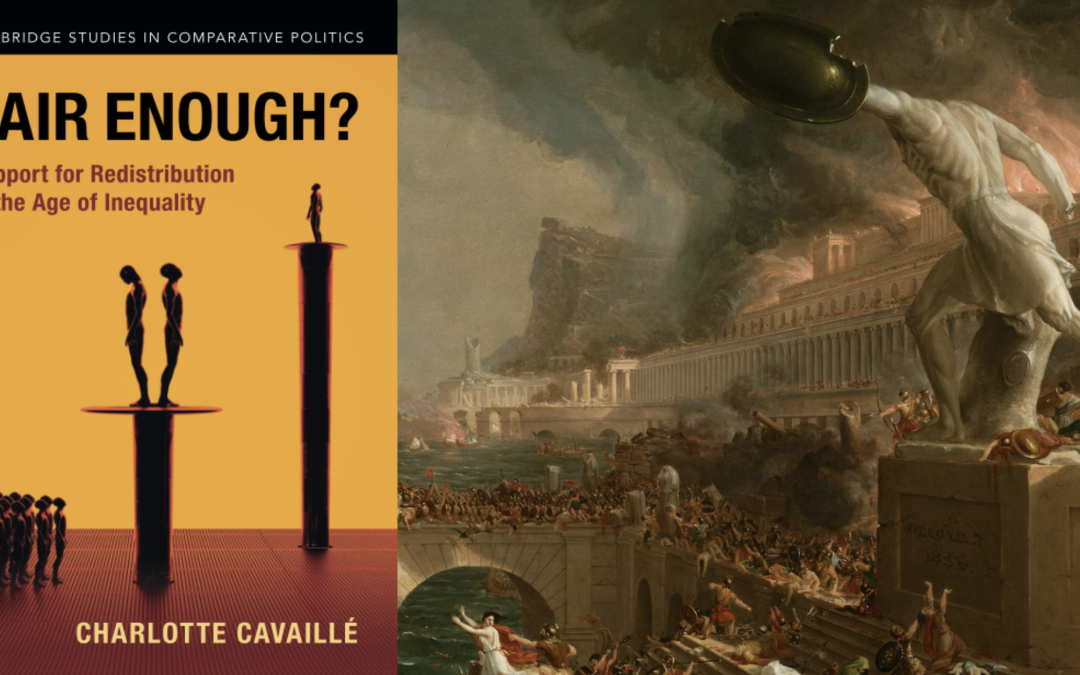
Rising inequality isn’t driving mass public support for redistribution: Charlotte Cavaillé’s ‘Fair Enough? explains why not.
In the past, excessive economic inequality has ended… badly. As Charlotte Cavaillé points out in her new book that studies the public’s reaction to rising inequality, “only mass warfare, a state collapse, or catastrophic plagues have significantly altered the...
CLEA Provides Student Opportunities for Impact and Growth
Housed in the Center for Political Studies at the Institute for Social Research, The Constituency-Level Elections Archive (CLEA) is a repository of detailed results from lower and upper house elections from around the world. The project provides opportunities for students to be involved at all stages of the data collection process, providing a valuable training experience.
Does Disability Shape Political Identity?
Joshua Thorp finds that disability is an important dimension of political identity for many disabled Americans; a sense of belonging to the disability community is associated with ideological liberalism and support for redistributive policies.
How Voter Loyalties Change
Partisanship is sticky. People tend to vote like their parents and to maintain their partisan leanings over time. But to understand partisanship, we need a model that can explain why people change party loyalties when they do. This is what Ken Kollman and John E. Jackson of the University of Michigan Center for Political Studies (CPS) provide in Dynamic Partisanship: How and Why Voter Loyalties Change.
Could Balanced Coverage Improve Public Trust in Fact-Checking Sites?
About half of Americans believe fact-checkers are biased. Two decades after its emergence, why has fact-checking failed to get traction among the public? What changes can help?
Latinos for Trump in 2020
Latinos continue to surprise with their sustained and increased support for former President Trump, a candidate who often seems an unlikely advocate for the group. After numerous episodes during his campaign for president and time in office espousing what was seen as anti-Latino and anti-immigrant rhetoric and policies, it is puzzling to many that almost one in three Latinos voted for him during the 2020 presidential election. So why did Latinos support Trump in 2020?