Oct 29, 2015 | International, Law, Profile
Post developed by Yioryos Nardis in coordination with Barbara Koremenos.
 Barbara Koremenos, Center for Political Studies faculty member and Professor of Political Science at the University of Michigan has recently begun a Visiting Research Fellowship at the Kroc Institute for International Peace Studies at the University of Notre Dame. The Kroc Institute is devoted to the study of the causes of violent conflict and strategies for sustainable peace. She was awarded the Fellowship to spend the 2015-2016 year studying the relationship between Islamic states and international law, and to examine how this affects Islamic states’ participation in international agreements and ultimately the peaceful resolution of differences.
Koremenos was inspired by looking at a random sample of international agreements in the issue areas of economics, environment, human rights, and security drawn from the United Nations Treaty Series (UNTS), which is by far the most popular place to register international agreements. She was struck by the fact that not a single agreement in her sample was composed solely of Islamic states. Within the sample, Egypt participated in the most agreements (25 agreements) while Oman had the lowest participation rate (seven agreements). With the exception of Malaysia, every other state in the sample participated in at least as many (usually more) human rights agreements than agreements in any of the other three issue areas. Within the sample, Lebanon participated more than any other Islamic state in environmental agreements at a quite low number of five.
Even more striking, participation in multilateral agreements seemed to far outweigh participation in bilateral agreements, even though bilateral cooperation is more prevalent worldwide when looking at the entire UNTS population. This is also true when looking at the sample featured in Professor Koremenos’ Continent of International Law (COIL) research program.
In the UNTS sample, over half of the Islamic states participated in no bilateral agreements; Egypt was the state that participated in the most bilateral agreements (six agreements) followed by Oman and Indonesia at two bilateral agreements each.
Koremenos will use her fellowship this year to examine whether:
- Islamic states simply participate in fewer international agreements than non-Islamic states
- With respect to participation in international agreements, there is variation within Islamic states that can be explained by whether Shari’a is officially adopted in a state’s constitution
- Islamic states participate in international agreements that are not registered with the UNTS;
- Islamic states participate in relatively more informal international agreements
Answers to these questions will give a sense of the amount of “failed cooperation” in those states – that is, cooperation that is precluded because certain institutional design tools, that might be key to solving the cooperation problems facing states, are disallowed by Shari’a Law – and, to begin to suggest larger relationships that might impact key factors in the world of peace and conflict like economic growth.
Sep 5, 2015 | Elections, Innovative Methodology, International
Post developed by Yioryos Nardis in coordination with Walter Mebane.
ICYMI (In Case You Missed It), the following work was presented at the 2015 Annual Meeting of the American Political Science Association (APSA). The presentation, titled “Election Frauds, Postelection Legal Challenges and Geography in Mexico,” was a part of the session “Detecting and Concealing Patterns in Data” on Saturday September 5th, 2015.
Political Science and Statistics Professor and Center for Political Studies faculty member Walter Mebane previously examined electoral fraud in Russia. Professor Mebane, in collaboration with Research Assistant Jonathan Wall, now turns his focus to Mexico and the Presidential elections of 2006 and 2012.
This new research by Mebane and Wall investigates if the numbers of casillas (i.e. ballot boxes) and votes challenged and nullified in Mexico reflect political strategies or genuine election irregularities. In the 2006 elections in Mexico, nullification petitions by runners up were filed against 21% of ballot boxes (27,109/130,788), even though only .56% of votes (237,736/41,791,322) were actually nullified. Similarly, in the 2012 elections, 22% of ballot boxes (32,151/143,132) were challenged and .38% of votes nullified (184,725/49,087,466).
Mebane and Wall examine how the types of nullification claims relate to ballot-box level measures of election fraud and whether the reasons cited for the challenges are uniform across the two elections and/or geography. That is, are complaints geographically clustered or does a complaint depend on geographically clustered frauds?
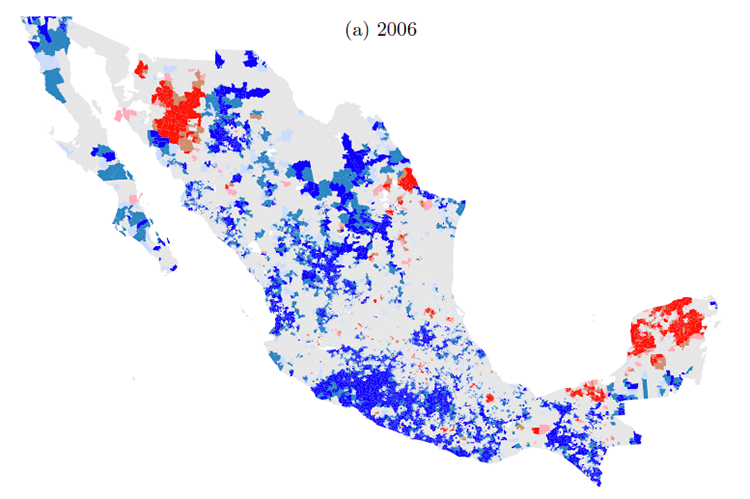
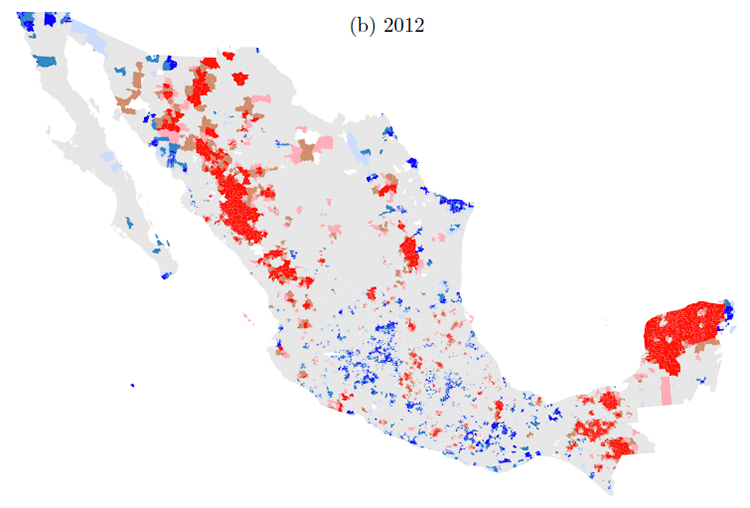
Ballot-box level measures of election fraud are estimated using casilla vote count data. Hotspot analysis is used to show how nullification petition challenges to casillas are distributed across geography. This technique identifies which locations have local means that are higher than the overall average values and which have local means that are lower than the overall average. A redder color indicates a cluster of locations with higher than average values, and a bluer color indicates a cluster of locations with lower than average values. Grey indicates a cluster of locations that does not differ significantly from the overall mean.
Figure 1 represents nullification complaints of type corresponding to willful misconduct or error in the vote count in the two Presidential elections, and Figure 2 represents incremental fraud probabilities for nullification complaints. Comparing Figure 2 to Figure 1 indicates that the pattern of geographic clustering for the incremental fraud probabilities does not correspond well with the pattern for nullification complaints.
Figure 1: Nullification complaints of type corresponding to willful misconduct or error in the vote count, Mexico, 2006 and 2012 Presidential election Casillas.
Seccion (precint) geographic cluster hotspots
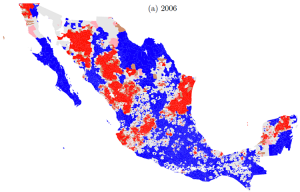
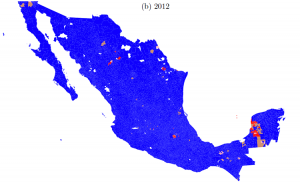
Figure 2: Incremental fraud, Mexico, 2006 and 2012 Presidential election casillas.
Seccion (precint) geographic cluster hotspots
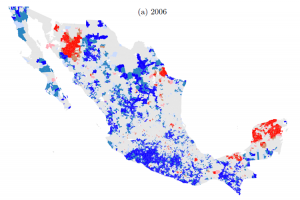
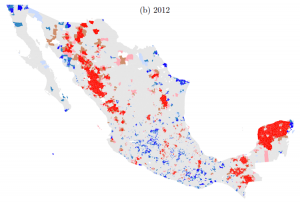
In 2006 there are more widespread regions with clusters of casillas having above average frequencies of complaints than there are regions in which there are clusters of casillas with above average incremental fraud probability values. Some of the above average type clusters overlap with above average incremental fraud clusters, but more than half do not. In 2012 on the other hand, we observe the opposite. Clusters of casillas with above average incremental fraud probabilities are much more prevalent than are clusters of casillas with above average frequencies of complaints.
Such patterns indicate that it is unlikely that the relationship between incremental fraud probabilities and the incidence of complaints are positively related. This therefore suggests that the occurrence of nullification petitions is related to the strategic and tactical incentives of political parties.
To read the full paper please visit: https://drive.google.com/open?id=0By8J0EDg6IC3MDgxOWlUVGdfakE
Sep 3, 2015 | International
Post developed by Linda Kimmel in coordination with Elisabeth Gerber.
ICYMI (In Case You Missed It), the following work was presented at the 2015 Annual Meeting of the American Political Science Association (APSA). The presentation, titled “Mobilizing or Demobilizing Political Participation,” was a part of session “The Public Policy Process in Comparative Perspective” on Thursday September 3rd, 2015.
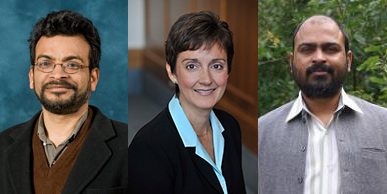 Sustainable development (SD) policies seek to shape economic and environmental behavior by providing households with benefits, rewards and incentives. But does engagement in SD interventions change individuals’ propensities to engage in political activities? This is the question Center for Political Studies faculty members Arun Agrawal and Elisabeth Gerber, and their colleague Ashwini Chhatre of the Indian School of Business, seek to answer.
Agrawal, Chhatre, and Gerber note that in new and emerging democracies the challenges of political participation are daunting due to such factors as a lack of education and weak democratic traditions. Can the skills, resources, and experiences gained through participating in SD interventions transfer to the political sphere by lowering barriers? Or, does participation in an SD intervention create additional barriers?
The authors test two hypotheses, one based on social choice theory and the other on resource theory on data collected in a SD intervention in Himachal Pradesh state in northern India, the Mid-Himalayan Watershed Development Project. The project sought to improve the livelihoods of poor households, conserve natural resources, and increase local governance capacity. Participating panchayats (a local government unit) received benefits to enhance residents’ incomes and reduce their dependency on forest resources. In exchange, participants were required to attend information meetings and participate in environmental education training.
Argrawal, Chhatre and Gerber selected five participating panchayats (treatment group) and five matched non-participating panchayats (control group). One member of each household was selected to complete a pre- and post-treatment survey. Key questions included measures of engagement with the SD project and two measures of political participation: (1) days campaigning in local panchayat elections and (2) number of times attending gram sabha meetings (essentially town hall meetings).
Average estimated treatment effect (ATE) is measured as the difference between paired treatment and control respondents in their change in behavior (number of meetings attended and days campaigning) between 2006 (pre-treatment) and 2011 (post-treatment). When respondents in treatment panchayats are compared to those from control panchayats (Table 1, first row), there is a negative ATE both for days campaigning and attending gram sabha meetings, indicating respondents in treatment panchayats became less likely to spend days campaigning and attending meetings than those in control panchayats. Thus, the project seems to demobilize political behavior.
When the analysis is limited to comparing those who actually participated in the project to their counterparts in control panchayats (Table 1, second row), the results differ, with those who participated in the project becoming more likely to attend more gram sabha meetings.
Table 1: Effect of Project on Campaigning and Attending Meetings, Average Treatment Effects with Alternative Treatments. N=1432
| |
Days Campaigning |
Attending Gram Sabha |
| Treatment |
ATE |
ATE |
| Project Village |
-1.57*** |
-0.16* |
| Participation |
-1.51*** |
0.45*** |
*p<.10, **p<.05, ***p<.01, two-tailed test
When the authors reran the data limiting comparison respondents to those who lived in treatment villages but did not participate (Table 2), they found that those who participated in at least one project activity (Table 2, first row) and in each of three types of activities (Table 2, second through fourth row) became more likely to attend gram sabha meetings and to spend more days campaigning than their neighbors who did not.
Table 2: Effect of Project on Campaigning and Attending Meetings, Average Treatment Effects Comparing Respondents within Treatment Villages with Alternative Treatments. N=799
| |
Days Campaigning |
Attending Gram Sabha |
| Treatment |
ATE |
ATE |
| Participation |
0.99** |
1.22*** |
| Attended environmental education Meetings |
0.94** |
1.55*** |
| Received material benefits |
1.16** |
0.72** |
| Participated in construction of small-scale public good |
0.86 |
1.49*** |
*p<.10, **p<.05, ***p<.01, two-tailed test
But why do those who directly participated in the project report greater levels of political participation post-treatment? Argrawal, Chhatre and Gerber suggest one possibility – consistent with resource theory – is that they gained additional resources through their project experience and now find political participation less costly. They plan to explore alternative explanations, including reverse causality, in future analyses.
Feb 20, 2015 | Foreign Affairs, International, Profile
Post developed by Katie Brown in coordination with Ugo Troiano.
This post is part of a researcher profile series that explores how Center for Political Studies (CPS) researchers came to their work. Today we profile Ugo Troiano, Faculty Associate in CPS and Assistant Professor in the Department of Economics.
 Growing up in Taranto, Italy, Ugo Troiano became fascinated with debate over the local steel factory. He followed discussions of how dormant policies could influence economics. This opened Troiano to a bigger question: How can policies improve the life of the people?
Troiano already loved the social sciences and math. In economics, he found a fusion of the two and a toolbox to tackle this big question. He studied economics at Bocconi University. During his junior year, Troiano studied abroad at the University of Pennsylvania. This experience opened his eyes to the fruitful research environment of U.S. universities. After graduating from Bocconi, he enrolled in Harvard University’s Department of Economics to pursue a Ph.D.
For his dissertation, Troiano continued to explore the question of how policies can improve lives. In particular he looked at (1) how fiscal restrains can reduce government debt, (2) how a government program to combat tax evasion impacted vote choice, and (3) how maternity leave policies reflect gender equality.
Troiano continues to explore the central question of his research, studying how political incentives shape the implementation and consequences of public policies, using both traditional economic tools and tools from other social sciences, especially psychology, linguistics, sociology and political science. He joined the Department of Economics at the University of Michigan in 2013. He joined the Center for Political Studies, which he sees as reflecting the political science underpinnings of his work, in the fall of 2014.
Feb 11, 2015 | Elections, International
Post developed by Katie Brown and Nahomi Ichino.
In many new democracies in developing countries, political parties are identified with particular ethnic groups, and voters tend to vote for the parties identified the same ethnicity as themselves – but not always.
Assistant Professor of Political Science and faculty associate of the Center for Political Studies (CPS) Nahomi Ichino addresses this issue in a recent article with Noah Nathan published in American Political Science Review.
Voters tend to believe that politicians will reward their co-ethnic supporters by building schools and health facilities and providing other services that benefit a limited local area. For voters who live among mostly people of their own ethnic group, it makes sense to vote for the party of their own group.
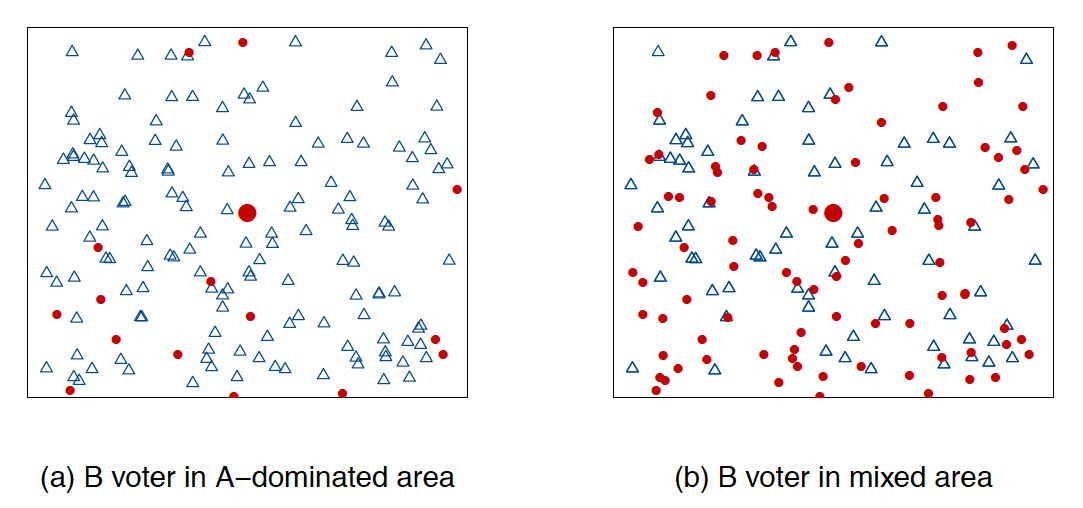
But voters sometimes find themselves living in an area dominated by another group or in a mixed area, and the calculation is more difficult. Take for example the first visualization (a) offered by the authors. A voter (circle) is surrounded by others of a different ethnicity (triangles). That voter might do better if a party of the other group (triangles) won the election and directed more benefits like schools to this area than if the party of her own group (circles) won the area and directed benefits to a different area with many of her own group (circles). If that same voter were in (b), where she is surrounded by more members of her own group (circles), then she becomes more likely to vote for the party of her own group than if she were in (a).
Voter Ethnicity Illustration
Ichino and Nathan tested these predictions Ghana. First, the authors mapped ethnic concentration and diversity with data from the 2000 Ghana Population and Housing Census. Then, they geocoded polling stations results to look at how elections results vary with local ethnic composition in rural areas.
Ichino and Nathan first focused on the 2008 presidential election results in Ghana’s Brong Ahafo, a region that is both rural and ethnically diverse and find support for their ideas. Polling stations in areas surrounded by more Akans had higher vote shares for the political party associated with the Akan. The authors also tested their hypothesis with survey results from the Afrobarometer. They similarly find that Ghanaians were more likely to intend to vote for a political party associated with an ethnic group when they were surrounded by more members of that group.
The authors believe their findings nuance the generally accepted idea that people in new democracies simply vote for candidates who share their ethnicity. Ichino and Nathan conclude that their study “demonstrates how local community and geographic contexts can modify the information conveyed by ethnicity and influence voter behavior.”
Dec 9, 2014 | Innovative Methodology, International, Profile
Post developed by Katie Brown.
Growing up in Palestine during a period of political tension, Khalil Shikaki became fascinated with politics. After completing a BA in Political Science at the American University of Beirut, Shikaki pursued these questions with a PhD in Political Science from Columbia University. Two core questions drive his research: What direction is Palestinian society taking? How do Palestinians view the relationship with Israel?
After finishing in 1985, he began teaching at An-Najah National University in the Northern part of the West Bank. Shikaki designed and taught his first course (the same course he is teaching here this semester): Palestinian Politics & Society. At that time, he realized there were no data to support and test theories. Even politicians relied on word of mouth to gauge public opinion.
So Shikaki set out to collect this data with Palestine’s first survey. But he faced a major roadblock. At the time, Palestine was under Israel occupation, and the Israeli military forbid the proposed survey. After the Madrid Peace Conference in 1991, things started to calm, which created an opening for data collection. In 1992, Shikaki started training survey administers and opened the Palestinian Center for Policy and Survey Research (PCPSR) in Nablus (PCPSR moved to Ramallah in 2000). And the first survey ran in 1993. Results of the survey, which explored public attitudes toward the Oslo agreement, were published in the same day the agreement was officially signed in Washington DC.
If the first challenge to data collection was Israeli occupation, the second was building trust with Palestinians. In particular, Shikaki and his team had to convince citizens that they could trust the interviewers enough to speak their mind. The initial response rate to a pilot study came in at just 50%. The team underwent additional training over the course of a year to project and inspire confidence and did not enter the field officially until this dropped to 10%. Once out in the field they found the opposite of their initial fear: if anything, people wanted to talk too much.
The surveys rolled out in both the West Bank and Gaza. When Hamas took over Gaza in 2007, the researchers faced some new issues as Hamas now wanted to control the data. But the survey continued. And while some field workers have faced arrest, they are usually released the same day.
Data collection also becomes difficult when battles rage with Israel. This past summer, the survey stopped in areas under bomb and rocket attack. But the day before the ceasefire, interviewers tackled the embattled regions. Aside from timing, the researchers also had to adjust for areas now decimated by war, citizens displaced. This allowed for timely and valuable data on opinions about how the latest fighting impacted Palestinian views.
With more than 20 years experience investigating his driving questions — What direction is Palestinian society taking? How do Palestinians feel about the relationship with Israel? – Shikaki sees a few trends. Over the first ten years, the Palestinian public was moving in a politically moderate direction with greater support for diplomacy and compromise with Israel. The most recent decade, though, has witnessed greater support for Islamists and violence with Israel. The fate embodied in these questions are linked. Shikaki remains hopeful, as a change in either would enact change in the other.
We are extremely pleased to have Khalil Shikaki in residence at the Center for Political Studies (CPS). During his time at CPS, he has also been continuing his collaborations with the Arab Barometer, the Aggression Research Program, and Scott Atran.