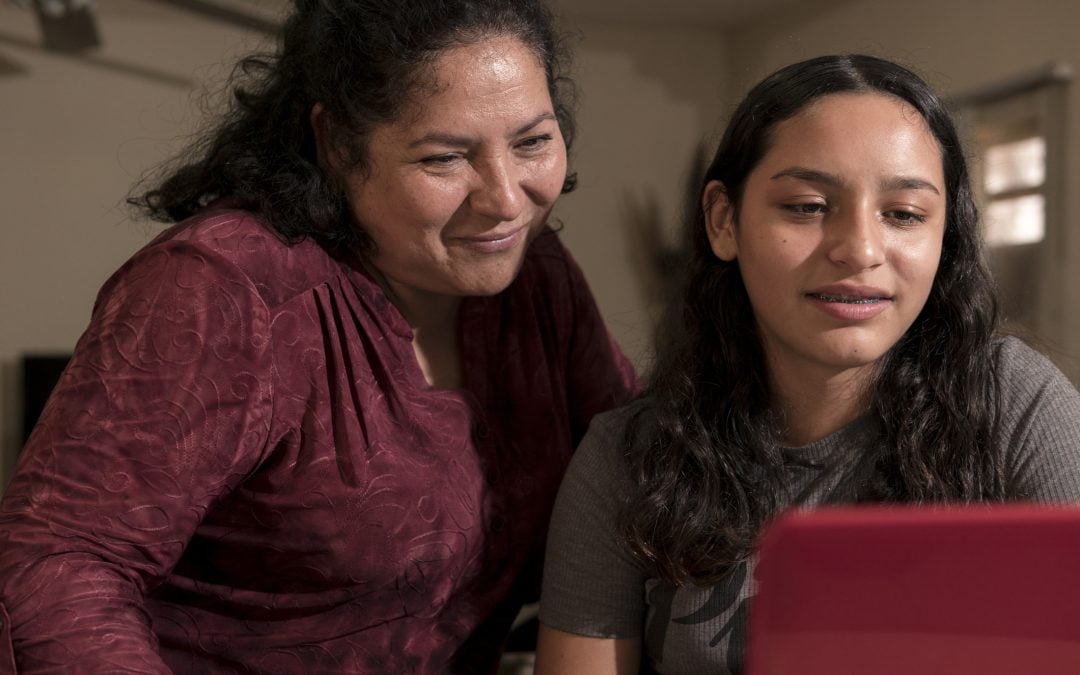
When we think about how political beliefs are formed, conventional wisdom points to parents as the primary teachers—passing down party loyalties, civic values, and political knowledge to their children from an early age. But what happens when parents themselves are navigating an unfamiliar political landscape?
In his forthcoming book Information Brokers: Political Socialization in Latino Immigrant Families (University of Chicago Press, July 2026), political scientist Roberto F. Carlos upends traditional assumptions by investigating a reversal of roles that unfolds in many Latino immigrant households: It is the children who teach the parents about American politics.
When children influence political engagement
“Young children, particularly in immigrant households, often help their parents navigate life in the United States by acting as key sources of information,” writes Carlos, who rigorously provides evidence that this responsibility grants children influence over their parents’ political engagement, “with children shaping their immigrant parents’ political perspectives and decisions.”
These dynamics may be key to understanding political engagement and disengagement among Latinos, the largest ethnic minority group in the United States. Two-thirds of this population are either immigrants or the children of immigrants.
Carlos’s previous research examined the “prolonged partisan socialization process” experienced by second-generation Americans; in his 2018 article “Late to the Party,” he demonstrated that children of immigrants often grow up without the parental partisan transmission that mainstream theories take for granted. Because many immigrant parents arrive in the United States without deep familiarity with the American party system—hindered by language barriers, economic pressures, fear of deportation, and lingering ties to the politics of their home countries—they are frequently unable to map their values onto U.S. political parties early enough to pass a partisan identity along to their children. Information Brokers asks what happens to children who lack parental political guidance, but also what happens when those children become the guides themselves.
‘Information brokers’
The book’s central argument is that children of Latino immigrants function as “information brokers”—active agents who translate, interpret, and mediate the American political world for their parents. As immigrant parents navigate unfamiliar institutions, they often turn to their U.S.-educated children for help with everything from understanding government paperwork to making sense of elections and civic engagement. This brokering role places unique responsibilities on young people, granting them an unusual degree of influence over major household decisions, including political ones. When children advocate, explain, or intervene on behalf of their parents, Carlos argues, they are engaging in politically consequential behavior that shapes the attitudes and actions of both generations.
Carlos’s research draws on six original surveys and multiple survey experiments; he also gives a descriptive account of two young Latina women brokering information in response to the imminent passage of the Texas Senate Bill 4, which targeted undocumented immigrants for deportation in 2017. Their experiences illustrate how “information, obligation, and agency, often working in tandem, can serve as catalysts for immigrant households’ participation in the political sphere.” Often, the children of immigrants step up to fill an important informational void, out of necessity.
Political Implications
Countering a narrative that portrays lower rates of partisan identification and voter turnout as signs of apathy or disengagement, Carlos’s research suggests these patterns reflect a socialization process that unfolds differently—and often more slowly—in immigrant communities. Children who broker political information for their families are not disengaged; they are learning politics through direct, high-stakes experience. This could be a valuable insight for activities, politicians, and party strategists who can direct their attention to mobilizing the second generation, says Carlos. “I believe this book provides a significant cause for optimism when it comes to engaging the Latino community.”
This book also says something about today’s political climate as it relates to immigration and the way it is enforced. As Carlos recently noted in the Midwest Political Science Association (MPSA) town hall roundtable on rising authoritarianism in the U.S., children– especially those with mixed-status families– are forced to learn politics because they are helping their parents manage risk. They learn how state power works because they are the ones explaining it, translating it, and sometimes trying to protect their families from it. “That is political socialization under conditions of enforcement,” said Carlos. “It is not civics as we usually imagine it. It is not learning about voting or Congress or the three branches of government in a classroom. It is learning that the state can enter your family’s life through a traffic stop, a workplace raid, a court notice, a school absence, or a rumor that ICE is nearby. It is learning that politics is not distant. It is not abstract. It is protection or vulnerability.”
Carlos provides two striking statistics citing Vox journalist Christian Paz: One out of five people living in the United States is Latino, and every 30 seconds, a member of the Latino community becomes eligible to vote. As the 2026 midterm elections loom, Carlos’s new book provides a fresh perspective on a powerful voting bloc whose engagement could play a decisive role in election outcomes.
 Roberto Carlos is an Assistant Professor in the Department of Political Science at the University of Michigan, and an affiliate of the Center for Political Studies at the Institute for Social Research. His research lies at the intersection of race, ethnicity, and politics, focusing on Latinx political behavior, immigration, and political socialization.
This post was developed by Tevah Platt, who manages communications for the Center for Political Studies.