Aug 19, 2014 | International, Social Policy
Post developed by Katie Brown and Arun Agrawal.

Photo credit: Thinkstock
Center for Political Studies (CPS) faculty associate and Professor in the School of Natural Resources and the Environment (SNRE) Arun Agrawal studies environmental policy.
Professor Agrawal and the International Forestry Resources and Institutions (IFRI) program he coordinates just received a grant of 1.9 million pounds (about $3.2 million) over four years from the United Kingdom’s Department for International Development (DFID).
Agrawal’s proposed research seeks to improve measurement of the outcomes of forest investments. Forest investments try to minimize the negative impacts of forest-related changes: by influencing land use, agriculture, institutions, migration, and commodity production. Substantial forest investments have occurred in the past few years, driven in part by concerns about climate change and the role of land changes in contributing to global emissions. Assessing the impacts of these programs, therefore, and improving their effectiveness is urgent. As Agrawal explains, “there is a lack of rigorous and generalizable empirical analyses of the effectiveness of past forest investments. Existing knowledge is often anecdotal, based on non-systematically selected indicators, usually supported only by information from a small number of unrepresentative cases, and through studies without rigorous counterfactual analysis.”
With this grant, Agrawal and his collaborators will methodically study the impact of forest investments with empirical data and quantitative analysis. In particular, Agrawal will seek answers to three key questions:
- What is the impact of specific types of forest interventions across different policy and governance contexts?
- Where and under what conditions do forest interventions deliver positive impacts?
- Which forest interventions have resulted in more positive impacts and why?
The research will focus on Brazil, Ethiopia, Ghana, Indonesia, and Nepal, using these countries to generate rigorous, valid, reliable, and generalizable findings.
Aug 6, 2014 | International
Post developed by Katie Brown and Stuart Soroka.

Photo credit: Thinkstock
Public broadcasting is often lauded for its ability to inform citizens. Yet, few empirical studies have tested this common notion. Professor of Communication Studies and Political Science, and Center for Political Studies (CPS) researcher Stuart Soroka – along with Blake Andrew, Toril Aalberg, Shanto Iyengar, James Curran, Sharon Coen, Kaori Hayashi, Paul Jones, Gianpetro Mazzoleni, June Woong Rhee, David Rowe, and Rod Tiffen – test this idea in a recent paper in the British Journal of Political Science.
Specifically, the paper asks: does exposure to public versus commercial news influence citizens’ knowledge of current affairs? The researchers were particularly interested in whether public news had a different relationship with knowledge than for-profit news. To answer this question, they conducted a cross-national survey in six countries: Canada, Italy, Japan, Korea, Norway, and the United Kingdom. The survey gauged citizens’ news consumption with viewing frequency questions and political knowledge with factual items.
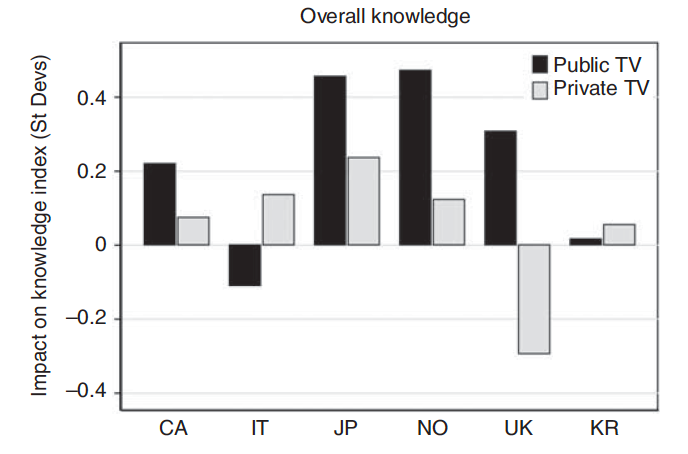
Overall, exposure to public broadcasting correlates more strongly with political knowledge than does exposure to commercial broadcasting. As the graph below shows, however, this varies by country. Indeed, watching public broadcast news in Italy even has a negative correlation with knowledge. In the UK, the general trend is even more pronounced, with private TV having a negative relationship with knowledge. Country-level data suggest that differences come down to the independence of public broadcasters, the amount of public (versus commercial) financing, and audience share.
The authors ultimately conclude that, “Public broadcasting has an important role in supporting full citizenship.” That said, “the more Public Service Broadcasters (PSBs) come to resemble their commercial counterparts in terms of dependence on advertising revenue, the less distinguishable their effect on citizens becomes.”
Jul 17, 2014 | International, Social Policy
Post by Rosemary Sarri.
This post was written by Center for Political Studies, School of Social Work and Women’s Studies Professor Emerita Rosemary Sarri, after her visit to the Philippines in the spring of 2014.
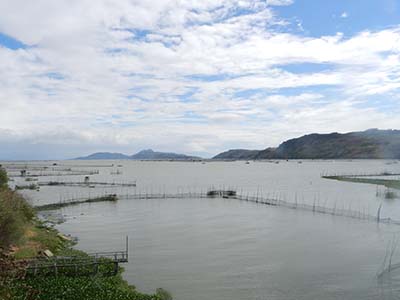
A fishing project in the Philippines
As covered in an earlier post, the population of the Philippines has skyrocketed from just 26,272,000 people in 1960 to 98,734,000 people in 2014, a growth rate of 254%. The limited size and resources of the Philippines limits employment opportunities for the adult population. Even professionals educated as teachers, nurses, physicians, and other health workers struggle to find work. Today, nearly 50% of the adult population is employed overseas in the Middle East, several Asian countries, and the United States. Young parents often leave their children with extended family and work overseas for many years.
Fishing is an important occupation in the Philippines for men and women. I visited a cooperative fishing community in Rizal Province and was impressed by the active participation of local community people in developing the fishing industry in Laguna Lake, home to fishing ponds for developing and testing fish for a variety of purposes. Several in this community were active in advancing legislation to promote the industry in a variety of ways.
The response to the weed menace of water lilies showcases the creativity and ingenuity of this community. They now cut the water lilies, dry them, and make them into a variety of projects such as mats for sleeping, slippers, and bags. They also have promoted the planting of mangroves along the ocean coasts of the Philippines to control water damage from typhoons.
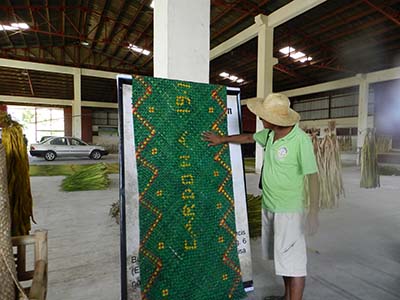
A mat woven with dried water lilies
The fisher people’s association shows one avenue for securing better employment for the Philippines’ growing population. Another activity of the fisher people is the promotion of the planting mangroves in many the shoreline communities. These mangroves have been shown to be effective in reducing the water damage that these communities suffer because of typhoons.
Jul 2, 2014 | ANES, Elections, Innovative Methodology, International
Post developed by Katie Brown and Ioannis Andreadis.
Ioannis Andreadis, a member of the Political Science faculty at Aristotle University of Thessaloniki, studies elections in Europe. With a grant from the Fulbright Scholar Program, Andreadis was recently in residence at the University of Michigan’s Center for Political Studies (CPS) to learn more about the American National Elections Studies (ANES).
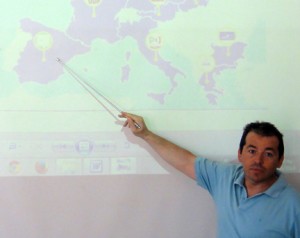 Andreadis started his academic career in 2007, after working as a computer scientist in his hometown’s municipality. His research focuses on elections, but the lack of a centralized database of election history in Greece presents obstacles to his work. With this in mind, Andreadis is interested to create a Greek version of the ANES – not only for the benefit of his own work, but for the benefit of other political scientists. Andreadis also plans to develop a centralized repository so that the data themselves can be easily disseminated to researchers.
A Greek version of the ANES faces some special challenges. Funding is limited in light of the country’s recent financial crisis. But this challenge has led to methodological innovation. Instead of relying on traditional data collection methods such as phone surveys, Andreadis has been developing web-based questionnaires. In 2007, 2009, and 2012, Andreadis ran such a web-based survey for the Hellenic (Greek) Candidate Study, and in 2012 he used his web survey infrastructure to collect data for a voter study which was organized as a mixed mode survey.
Andreadis’ efforts are also part of the True European Voter project, a COST Action to track election data across time and across Europe. Participating countries include Austria, Belgium, Bulgaria, Croatia, Cyprus, Denmark, Estonia, Finland, France, Germany, Greece, Hungary, Iceland, Ireland, Italy, Lithuania, the Netherlands, Norway, Poland, Portugal, Romania, Slovenia, Spain, Sweden, Switzerland, and the United Kingdom.
In addition to his interests in adapting ANES to the Greek political realm, Andreadis also combines his computer programming skills and interest in elections. Anreadis both designs and studies Voting Advice Applications (web-based platforms that aim to inform citizens about the electoral process, with emphasis on the positions of candidates and parties on issues related to electoral competition). In particular, Andreadis created and oversees the Voting Advice Application HelpMeVote, which was used by more than 480,000 voters during the May 2012 Greek Parliamentary Elections. HelpMeVote has also been used in Albania, Iceland, and during the 2014 elections for the European Parliament.
CPS and ANES are thrilled to have have had Andreadis visit, and look forward to the progress of his initiatives in support of election studies and political science research in Greece and beyond.
Jun 18, 2014 | Foreign Affairs, International
Post developed by Katie Brown and Michael Traugott, with input from Ghaydaa Yehia Fahim Ali.
In 2008, Qatar University formed a partnership with the University of Michigan‘s Institute for Social Research (ISR) and Center for Political Studies (CPS) to develop a world-class public opinion research organization at Qatar University, the Social And Economic Survey Research Institute (SESRI). The partnership includes, among other activities, collaboration on organizational structure, recruitment and hiring, design of technical facilities, research, and analysis. As part of the cooperation, University of Michigan researchers also run training workshops in Qatar several times per year. Participants for the workshops come not only from Qatar University, but other private and public organizations from Qatar and throughout the Gulf region. Topics for the workshops have included research design, questionnaire design, cognitive interviewing, data analysis, and sampling. The workshops are structured as lectures, with group exercises integrated into the flow. Between days, participants complete thought exercises to spur discussion the next day.
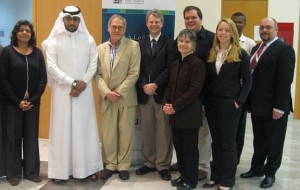
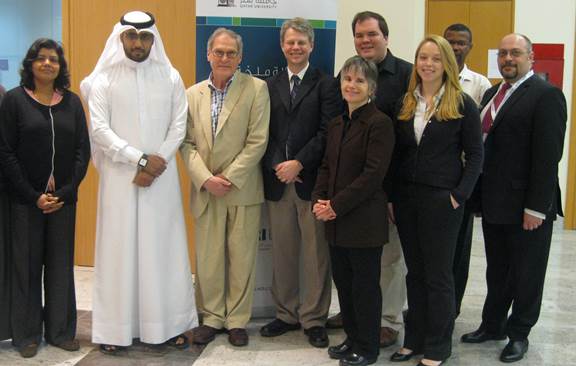
Photograph from first training workshop of 2014
This year, SESRI hosted three workshops. In the first workshop, which was delivered by ISR researchers Nancy Burns, Ted Brader, Kenneth Coleman, Allen Hicken, and Ashley Jardina, trainees were introduced to key SPSS concepts and notions of hypothesis design and formulation. Causal inferences and random sampling were key areas of discussion.
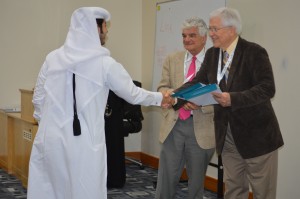
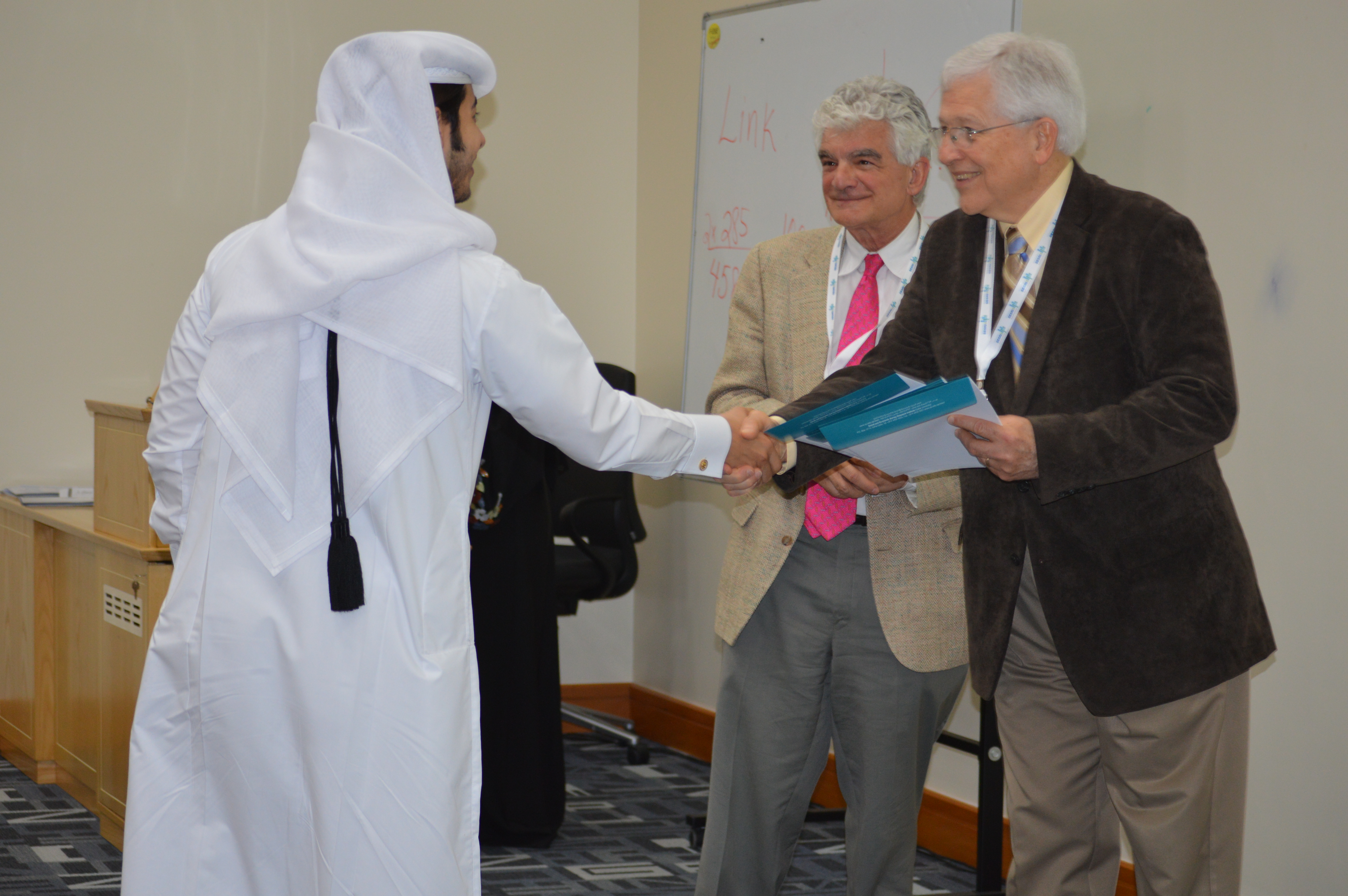
Traugott and Lepkowski shake hands with a workshop participant at “commencement”
Michael Traugott of CPS and James Lepkowski of ISR’s Survey Research Center (SRC) traveled to Qatar to administer the second workshop, a course on sampling and weighting methods and techniques. Arriving Friday, the team took the weekend to adjust to the eight-hour time change and set up for the training. Monday through Thursday, sessions ran from 9:00 a.m. to 2:00 p.m., with a break in the middle for lunch and prayers.
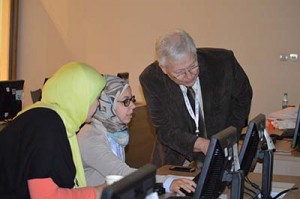
Lepkowski interacts with workshop participants
Materials from sampling courses previously taught by Lepkowski were adapted with consideration of language and culture. Courses are taught in English with an Arabic translator on hand, while all materials are available in both languages. Technical terms associated with social science concepts and principles were provided in a glossary, in which some terms were accompanied by animations created by Rafael Nishimura to illustrate the ideas with video. Furthermore, all exercises were designed to be completed in Excel for reasons of accessibility. At the end of the course, Excel spreadsheets with key formulas were provided to all participants.
Traugott returned in May, along with Elizabeth Gerber, Ann Lin, and Monica Bhatt to facilitate a workshop on policy evaluation and spur debate on the purpose of evaluation in public policy, the primary components of policy and program evaluation, and methods of designing preliminary, defensible program evaluations. Workshop materials were tailored to ensure local relevance, including the identification of public policy issues in the cases of Qatar’s traffic woes and evaluations of changes to the education system in Qatar.
The workshop series has caught the attention of the Qatari press. The Qatar Tribune wrote that “The trainees who came from backgrounds in statistics and other diverse fields found the workshops to be useful in introducing them to concepts outside their direct frame of work.”
More than 100 beginner and intermediate-level researchers benefited from the workshops this year, which continue to grow in popularity. More information about the workshops can be found here.
Jun 11, 2014 | International, Social Policy
Post by Rosemary Sarri.
This post was written by Center for Political Studies, School of Social Work and Women’s Studies Professor Emerita Rosemary Sarri, after her visit to the Philippines in the spring of 2014.
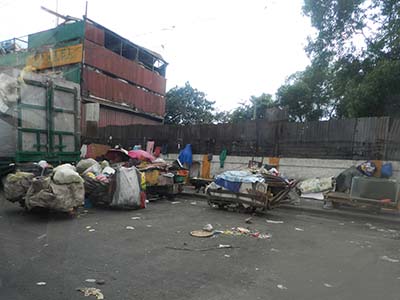
Manila slum from a car window
The island country of the Philippines is the 12th most populous country in the world with a growth rate of 1.89% per year. The population skyrocketed from just 26,272,000 people in 1960 to 98,734,000 people in 2014, a growth rate of 254%. Tremendous cost has accompanied this explosive growth. Most of the population live below the poverty line and reside in urban or metropolitan areas which are extremely crowded. The slums of Manila have become almost inhuman places in which to reside. Because the land prevents the creation of a subway system, the country primarily relies on motor vehicles for transportation, creating terrible pollution that tripled in recent years.
Recently, some local non-profit organizations have organized efforts to foster community development. One of these organizations is Gawad Kalinga, established by a small group of benefactors to work with the people of the slums to provide them with land, food, and housing.
I visited one of their projects in Cavite Province, located a short distance from Manila. They emphasize the restoration of community empowerment and training for gainful employment and active citizenship. Gawad Kalinga gives priority to dismantling the pattern of despair and abandonment that overwhelms the lives of the very impoverished.
Gawad Kalinga believes moving people out of the slums is essential to eradicating poverty. The project that I visited in Cavite provides brightly painted single or duplex housing for about 45 families with a community center, health center, an informal education center and a grocery store. The residents learn to care for their own facilities. Overall the community survey indicated that they received good health care and education for their children. Employment of the men in nearby communities is strongly encouraged, but many, especially women, wanted more assistance in obtaining employment.
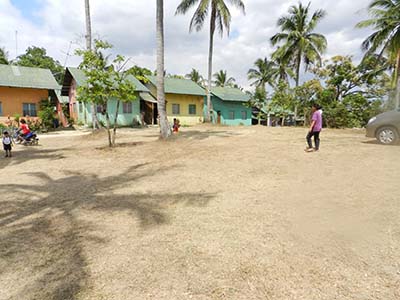
Buildings of Gawad Kalinga
While Gawad Kalinga is making strides in the right direction, birth control and family planning are issues that probably deserve more attention. Families in the community have a median of three children. And over-population is a country-wide problem. The strong influence of the Catholic Church since its colonization by Spain resulted in strong opposition to most methods of contraception or birth control. In 2012, this influence started to wane as the government began to address over-population with the passage of the Responsible Parenthood and Reproductive Health Act. Yet, a recent community survey by the Philippine School of Social Work at The Philippine Women’s University indicates that 69% of Filipinos rely on “natural methods” of family planning or abstinence. Despite a national campaign for vasectomy, few Filipinos opted for the procedure.
Gawad Kalinga embodies the Philippines’ overpopulation problems, both as a solution to the inhuman living conditions of Manila’s slums, a partial answer to unemployment woes, and an underscoring of the country’s population problem.
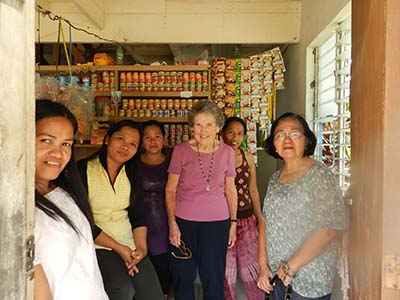
Sarri with some of the women residents of Gawad Kalinga