Empirical Implications of Theoretical Models at U-M: Advancing Political Science through Integrated Training
Why EITM Matters
The scientific study of politics and social dynamics requires extensive interaction between theoretical models and empirical research. Political scientists often use “formal models” of how people act, make decisions, or influence each other: They translate ideas into equations, diagrams, or structured logic so that they can then understand and predict how political actors relate and behave. But these theories only “work” when they are grounded in empirical knowledge. And vice versa: Empirical results may seem to yield clear implications, but we need strong, well-specified theories to ground interpretative claims.
In short, many gaps persist between theory and empirical research in Political Science.
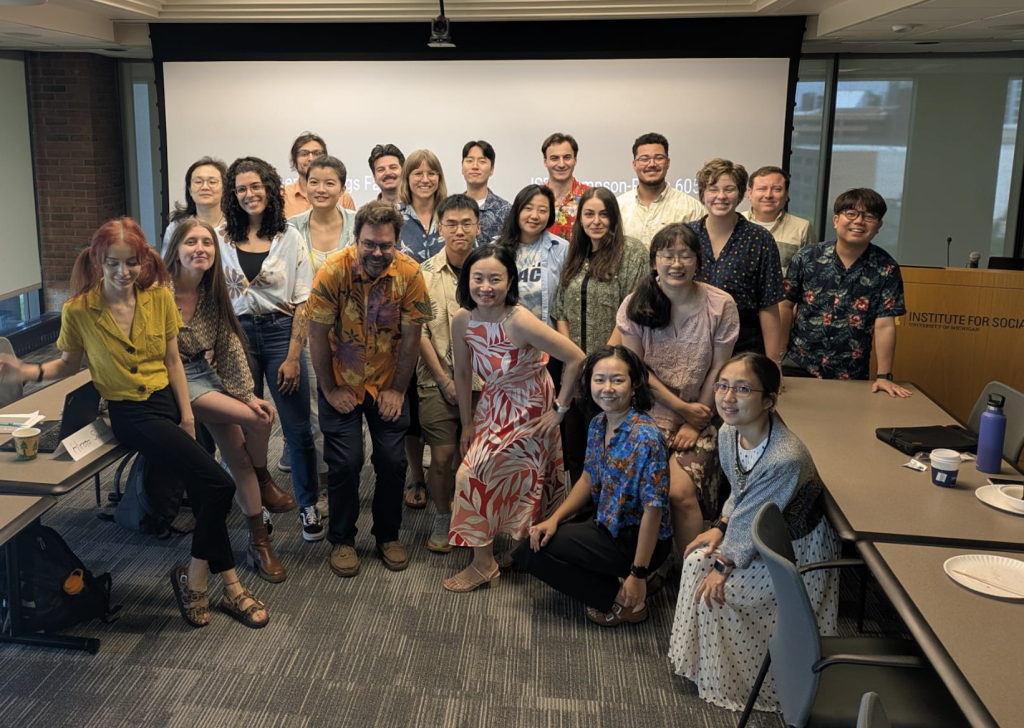
EITM’s 2025 participants gather around EITM PI Christopher Fariss of the Center for Political Studies, wearing Hawaiian shirts and tropical looks in his honor.
For more than 20 years, the Empirical Implications of Theoretical Models (EITM) Institute has gathered cohorts of early-career scholars for an intensive, interdisciplinary summer course that gives participants opportunities to explore innovative research practices linking theoretical models with empirical data.
Hosted by Center for Political Studies at the University of Michigan Institute for Social Research, and funded by the National Science Foundation, EITM’s two-week program is designed to immerse students in the rigorous art of bridging logic and data. Through lectures, workshops, and collaborative projects, participants learn new tools and ways of thinking about their research in fundamentally richer ways.
The EITM Summer Institute offers younger scholars an opportunity to obtain such skills by working with senior scholars who are leaders in advancing theoretical and empirical research. Program participants advance their own research by employing their newly gained knowledge about the integration of theory and method into their own research designs, and in working together, build a lasting network of scholars and collaborators.
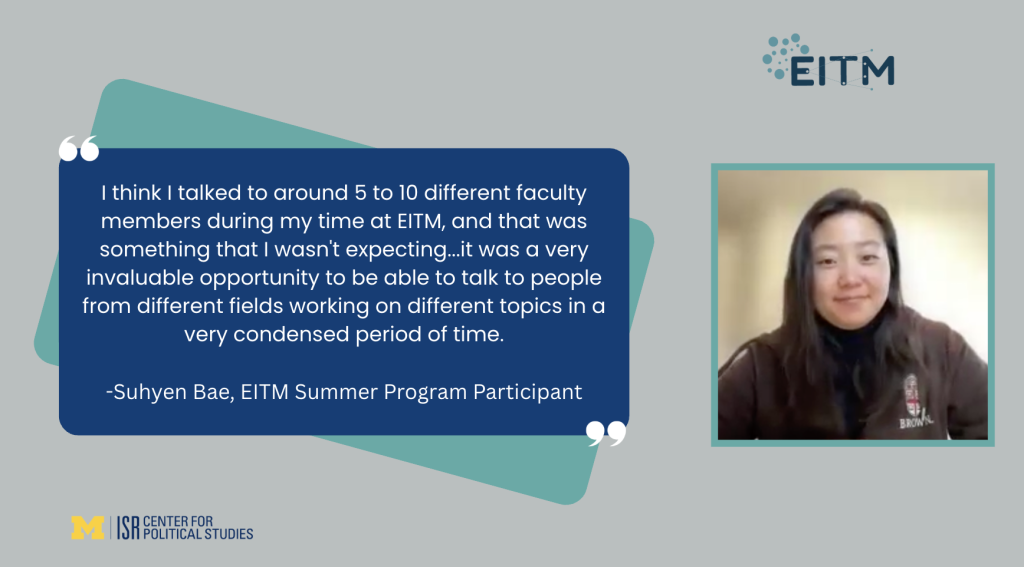
Learning to Build and Test
EITM doesn’t just teach formal modeling or empirical analysis: it’s about integration, and participants spend their two weeks building a tool-kit for approaching their research questions.
Nguyen Ha, a 2025 EITM participant who is a fifth-year PhD candidate at Vanderbilt, spoke of the value of working with others with many different approaches and substantive focuses. “I learned there isn’t only one way to test game theory implications,” said Ha. “Getting a broad set of options from multiple people was really valuable.”
The Center for Political Studies spoke with 19 scholars about their experiences participating in the 2025 EITM program.
Numerous students praised sessions on structural topic modeling, large language models (LLMs), and computational methods, noting that these are rapidly becoming essential tools for modern research. Brandon Stewart’s session on text analysis was cited as “particularly important,” helping students bridge theory with empirical patterns in vast textual datasets.
The Institute fosters pluralistic thinking, exposing students to multiple methods, approaches, and best practices across diverse subfields, from American politics to international relations.
For some, this meant grappling with quantitative models for the first time (“I didn’t know much, almost at all, about formal models,” one empirical researcher shared), while for others, it was about deepening their understanding of how theory can inform and be informed by real-world data.
Small-group projects mix teams of empiricists and theorists, fostering cross-pollination and broadening participants’ perspectives.
These exercises honed research skills and forged new collaborative bonds. More than one participant is currently co-authoring papers with their EITM teammates, preparing for presentations at major political science conferences.
Building a Scholarly Community (Even / Especially in Saline)
Beyond methods, EITM is also about mentoring, networking, and professional development.
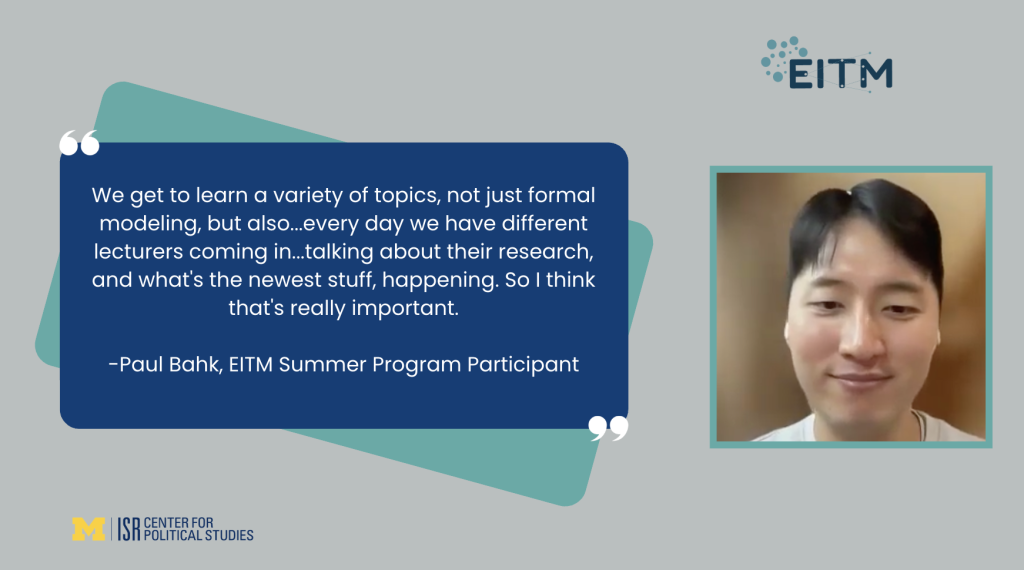
![From all the programs I have attended so far, it was probably one of the most beneficial ones, both in terms of methods and also in terms of professionalization. It was not [just thinking about] theoretical and empirical modeling...but also about how to approach the job market, how to think about publishing, how to think about collaborations. All these other layers played a role in helping me feel better prepared for the job market. -Dagmar Heintze, EITM Summer Program Participant](https://cpsblog.isr.umich.edu/wp-content/uploads/2026/03/Screenshot-2026-03-16-at-8.49.01-AM-1024x575.png)
Participants from the 2025 EITM program highlighted the value of direct, personalized feedback from faculty mentors and visiting speakers, describing how these interactions shaped their dissertation projects, job market papers, and future agendas.
“From all the programs I have attended, this was probably the most beneficial in terms of methods and professionalization,” one respondent summarized, noting that EITM provided advice not only about research, but about job market preparation and career-building. These informal discussions—whether at office hours or late-night group sessions—were “where the real meat was.” They yielded insights and friendships that lasted beyond the two-week workshop.
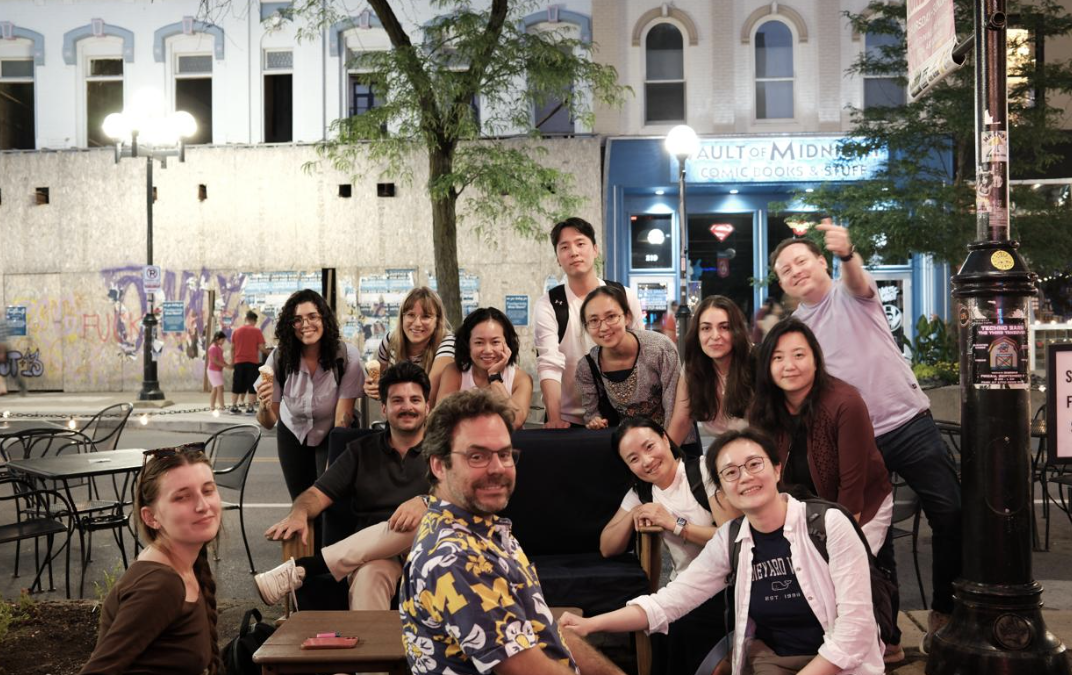
The 2025 EITM workshop happened to coincide with the United Association of Plumbers and Pipefitters training program that fills hotels every August in Ann Arbor. (The location of this convention in Ann Arbor is in fact historically linked to evaluation research conducted by the Research Center for Group Dynamics at the Institute for Social Research.) The logistical hiccup of limited space landed EITM attendees at a hotel outside Ann Arbor last summer– and though it meant less time in town, the downtime in Saline was really beneficial for fostering friendships and collaborations.
Whether in working groups, hotel lobbies, or group dinners, the environment encouraged sustained collaboration and mutual support. As Dot Sawler put it, “the depth of [these] connections… are a function of that intensity.”
The result? Long-lasting networks, a WhatsApp group still buzzing months later, and a community that makes national conferences feel a little less daunting—a kind of “summer camp for nerds,” as one participant put it.
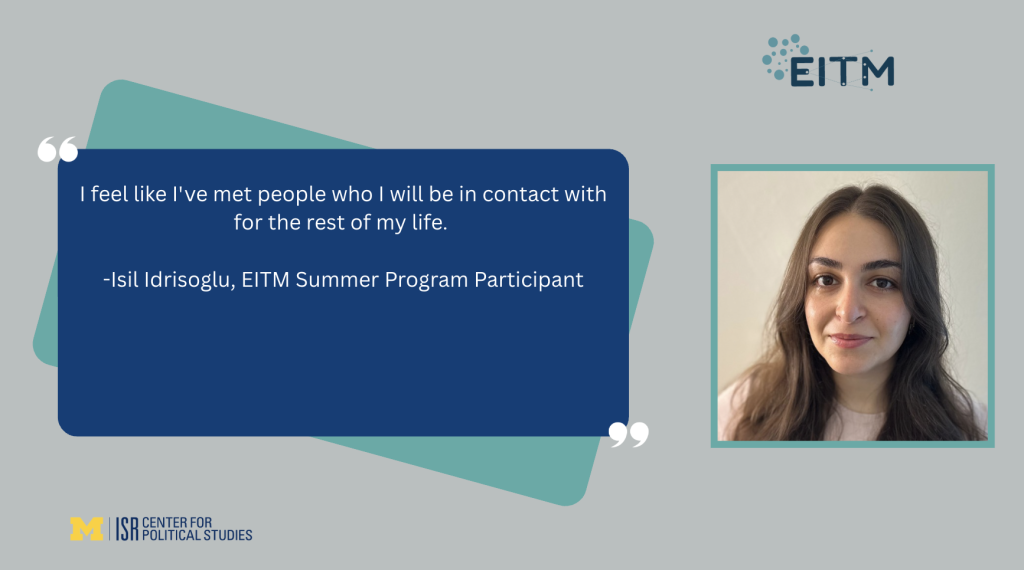
Intellectual Confidence and Community
Ultimately, EITM’s value lies not just in the methodologies learned, but in the confidence gained and the friendships forged. As Lin Xu reflected, “EITM fostered a community of collaboration, not just about methods or models—it’s about building a common language between theorists and empiricists.”
Political science today faces new frontiers—from evolving methods to urgent societal questions. Since 2002, EITM has offered intensive, integrated, and communal training to foster the next generation of scholars.
What advice would EITM students give to future or prospective trainees?
“If you get the chance, do it. You’ll grow as a researcher—and leave with lasting connections.”
EITM may not convene in 2026, but will run future sessions if funding allows. Tevah Platt, Laiyla Santillan, Julia Lippman, and Lauren Guggenheim, all staff of the Center for Political Studies, contributed to the development of this post.
Further Reading & Resources
- For more on EITM and upcoming opportunities, visit EITM Institute website
- Explore the University of Michigan’s Center for Political Studies: CPS
- National Science Foundation Grant #SES-2033912
- PIs of EITM include Christopher Fariss, Monika Nalepa, Tara Slough, Rocio Titiunik, and Scott Tyson.
- EITM Instructors include Tara Slough, Scott Tyson, Monika Nalepa, Zhaotian Luo, Bobby Gulotty, Maggie Penn, John Patty, Brandon Stewart, Emily Sellars, and Chris Fariss.
- EITM Mentors in Residence include Zuheir Desai, Maria Silfa, Cesi Cruz, Kenneth Lowande, Iain Osgood, Deborah Beim, Yuki Shiraito, Tyler Simko, and Ji Yeon Hong.