
Democrats had a big night last week, sweeping key elections and winning by unexpected margins up and down the ballot. Voters showed up in high numbers for an “off” election year and sided with Democrats in the elections’ four major contests: The mayor’s race in New York City, the governors’ races in Virginia and New Jersey, and the redistricting measure Prop 50 in California.
Tyler Simko is an Assistant Professor of Political Science at the University of Michigan, and an affiliate of the Center for Political Studies at the Institute for Social Research. Simko specializes in U.S. state and local politics, political geography, and computational social science. He is applying this expertise as an elections analyst for CBS, and he shared with us about the experience of doing this work and the major takeaways from the 2025 elections.
Expert Q&A with CBS Elections Analyst Tyler Simko
The content has been lightly edited for length and clarity.
1. What were your top takeaways from the 2025 elections?
Two specific trends stick out to me.
First, this was a stronger performance for Democrats than many people expected.
The election outcomes were not especially surprising. For all four major races, the expected result going into election day happened—for example, most polls before election day saw Mamdani, Sherrill, Spanberger, and “yes” on Proposition 50 as the clear frontrunners.
However, the final margins in favor of Democrats were larger than many people expected. For example, most polls placed Mikie Sherrill as the favorite, but polling averages showed a lead of around 3-5 percentage points. The ultimate election was a blowout, with Sherrill ahead with a final margin around thirteen points. Abigail Spanberger won the governor’s race in Virginia by even more.
The second major takeaway for me was that early analysis suggests that some of the “red shift” we saw in 2024 among groups like Latinos may have reverted back toward Democrats.
For example, high-Latino communities in New Jersey saw huge reversals toward Sherrill from the way residents in those same places voted in 2024 for Harris.
Results like these suggest that some of the shifts we saw in 2024 may not be set in stone. Charles Stewart III, another election analyst on the team and a Professor at MIT, has suggested this might be evidence that 2024 was a “deviating election,” rather than a new normal, citing research originally developed at the University of Michigan in the 1960s.
2. Was there anything notable about turnout for this election?
Turnout was unusually high in nearly every race on Tuesday night. In some ways, this is surprising because 2025 is an “off” election year without presidential or congressional midterm elections.
However, this high turnout reflects just how salient politics is for many Americans right now.
For example, early voting and election day turnout in the NYC mayoral election eclipsed the last election in 2021. This continued the trend we saw in the primary, where early voting more than doubled turnout in the last primary that elected Eric Adams. Turnout in other races was high as well, like California’s Proposition 50 measure on redistricting.
Further, it’s especially interesting to see where turnout was higher compared to past elections.
Patterns in turnout changes can offer insight into where voters are particularly energized right now.
For example, I wrote for CBS that many Democratic-leaning areas in New Jersey saw huge surges in turnout (some nearly 40% higher than the last gubernatorial election in 2021). This suggests that Democrats are particularly politically motivated right now, a trend that party leaders will hope continues into next year’s midterm elections.
3. What do you do as an Election Analyst on the CBS News Data Desk?
For this past election night on November 4th, I worked in the CBS Office in New York City alongside a team of other analysts to predict and analyze the elections for NYC Mayor, NJ/VA Governor, and California’s Prop. 50 redistricting referendum.
On election night the Data Desk is focused on forecasting voter turnout and predicting election results. We analyze data like exit polls and election returns as they come in, and look for interesting patterns. As with any network, one of our primary roles is to “call” the election winners.
But beyond calling the races, we’re also actively monitoring other data beyond vote shares. For example, the NYC Board of Elections frequently updates their “check-in” turnout numbers throughout the day. We use these records to help improve our turnout forecasts, which help us identify patterns early in the night. For example, even before election night, strong early voting in New Jersey’s Democratic-leaning areas suggested it would be a good night for Mikie Sherrill.
Finally, a good deal of work happens both before and after the elections too. For example, some members of the team prepare products like the CBS Exit Polls in preparation for election day.
Similarly, after election day there is a ton of new data to analyze. For example, the morning after election day, Kabir Khanna (Director, Election Analytics & Technical Systems at CBS) and I wrote an article for CBS News demonstrating how high turnout in Democratic-leaning counties strongly favored Sherrill. We’ll continue conducting this kind of analysis in the coming weeks.
4. What are the goals of this work, and how do your expertise and skills meet the needs of delivering election results and analysis?
Predicting election results (before they happen) and analyzing returns (after they happen) require knowledge of both electoral systems and statistics. At the University of Michigan, I teach courses on American Politics and Political Methodology in the Political Science department and research topics in political institutions and computational social science, so this kind of work is right up my alley. You know, I used real data from election night for an interactive prediction activity in my graduate-level Machine Learning course this past week.
Calling election results is a classic prediction problem. You don’t have complete information before election night is over, but you would like to use statistical “signals” to make data-driven predictions about what is going to happen. Often, we use statistical models because we want to detect patterns over the course of election night that may not be clear from simply counting returns as they come in.
For example, imagine a hypothetical situation where votes for NYC Mayor from Staten Island all come in first, early on election night. A simple “counting” approach would predict Andrew Cuomo had a large lead in the mayoral election because he had strong support in Staten Island, while in reality Mamdani clearly won overall. Statistical models help account for these patterns like geographic segregation in candidate support. Training in both political science and statistics/data science helps.
5. What are the future implications of the 2025 election results?
I think this set of results has two important implications:
First, this strong Democratic win will change the political dynamics over the next year as we head into the midterms. In the meantime, these results also give national Democrats more leverage in ongoing debates like the government shutdown.
We also might see these results change political rhetoric over the next few months. For example, Mamdani’s campaign focused on affordability and we have already seen Trump adopting this language in recent interviews.
The second major signal comes from the strong passage of California’s Proposition 50. This result greenlights Democratic efforts to push back against the new Texas redistricting plan that made their existing gerrymander even more extreme.
Republicans currently have the lead in this redistricting “war” because they have aggressively gerrymandered maps in several states. But, Prop. 50 will likely embolden Democrats in states like Virginia to try gerrymandering their own favorable plans.
Some of my own research helps clarify the consequences of gerrymanders. My co-authors and I at the ALARM Project—a research group focused on political geography and public policy—have shown that gerrymandering makes congressional elections less competitive and less responsive to the will of voters. Our research also shows that these other states could learn from Michigan, as our independent redistricting commission helps ensure redistricting plans are more fair and less biased.
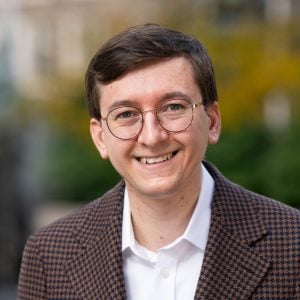
Tyler Simko is an Assistant Professor of Political Science at the University of Michigan, and an affiliate of the Center for Political Studies at the Institute for Social Research. This post was developed by Tyler Simko and Tevah Platt, communications manager for the Center for Political Studies.