Apr 16, 2014 | ANES, Current Events, National
Post developed by Katie Brown and Timothy Ryan

Photo credit: Thinkstock
Partisanship gets in the way of political progress. Hillary Clinton made this common claim last week. The lack of compromise inherent to partisanship is worth investigating. What causes such non-cooperation?
Timothy Ryan, a Ph.D. candidate in the University of Michigan’s Department of Political Science and affiliate of the Center for Political Studies (CPS), seeks to answer this question. In a paper presented at the 2013 meeting of the American Political Science Association – “No Compromise: Political Consequences of Moralized Attitudes” – Ryan ran four studies to understand non-cooperation.
Ryan’s overarching hypothesis boils non-compromise down to morals: a moral mindset orients citizens to oppose political compromises and punish compromising politicians. There are all kinds of issues for which some citizens seem resistant to compromises: tax reform, same-sex marriage, collective bargaining, etc. But who is resistant? Ryan shows that part of the answer has to do with who sees these issues through a moral lens.
Ryan tests moral conviction’s effect on compromise. Data come from the American National Elections Studies (ANES), as well as surveys of undergraduates, participants on Amazon’s Mechanical Turk, and citizens found via GfK Research (his work was made possible by a grant from the National Science Foundation (NSF)). Ryan also considers several types of compromises: hypothetical, actual, positions citizens want their elected officials to adopt, and a willingness to accept a monetary reward only if a disliked group (the Tea Party or the Progressive Change Campaign Committee) also receives a donation.
Participants with moral conviction around an issue are less likely to compromise. Hypothetical and real world compromises were hindered. Compromising politicians received less support. Personal gain was sacrificed to avoid the gain of the Tea Party (if a political adversary). As Ryan concludes, “Different attitude characteristics relate to compromise in different ways, with moral conviction being a particularly potent obstacle to compromise.”
In the fall, Ryan will continue his work on morality when he joins the faculty at the University of North Carolina at Chapel Hill as Assistant Professor of Political Science.
Apr 1, 2014 | ANES, ANES 65th Anniversary
 This post is part of a series celebrating the 65th anniversary of the American National Election Studies (ANES). The posts will seek to highlight some of the many ways in which the ANES has benefited scholarship, the public, and the advancement of science. Do you have ideas for additional posts? Please contact us by email ([email protected]) or Twitter (@umisrcps).
Here we include comments from four prominent political scientists on how ANES has impacted their careers.
Edie Goldenberg, Professor of Political Science and Professor of Public Policy at the University of Michigan:
I used ANES data in several articles early in my career and relied on other findings based on ANES data for the book I wrote with Mike Traugott, Campaigning for Congress. I served on the Board for a while and enjoyed ANES founder Warren Miller’s retreats in Arizona during the cold Michigan winters. We always went out for authentic Mexican cuisine, which was terrific. I met a lot of colleagues through the ANES.
Donald Green, Professor of Political Science at Columbia University:
Scarcely a day goes by in which something I’m reading, debating, or studying is not in some way connected to ANES research. My very first day in graduate school in 1983 featured a lecture by UC Berkeley Political Scientist Merrill Shanks on the insights gleaned from the four-wave 1980 ANES. Today, decades later, I am about to run off to teach a class on political psychology, and our readings for this week include Philip Converse’s “The Nature of Belief Systems in Mass Publics” and Ansolabehere, Rodden, and Snyder’s 2008 American Political Science Review (APSR) article that uses ANES data to show Converse would have come to different conclusions had he used multi-item scales.
Michael Jones-Correa, Professor of Government at Cornell University:
Working with the ANES and the ANES team has been both beneficial for my research and a real learning experience— particularly being part of the ANES advisory board. The intense discussion among the Primary Investigators (PIs) and board during our meetings had the best aspects of sitting in on a seminar on survey design and methods. The ANES itself has inspired me to be part of other survey data collection efforts– notably the Latino National Survey (LNS, 2006), with co-PIs Luis Fraga, John Garcia, Rodney Hero, Val Martinez, and Gary Segura, and the Latino Immigration National Election Survey (LINES 2012-2013), with James McCann. Both of these drew on, learned from, and expanded the scope of the ANES.
Tasha Philpot, Associate Professor of Political Science at the University of Texas – Austin:
I’ve utilized the ANES in almost all of my publications. The most significant point in ANES history for me was when Daron Shaw and I were able to secure National Science Foundation (NSF) funding for the African-American oversample in 2008, a historic election. Using the African-American oversample, we were able to explore the determinants of black turnout in the 2008 election.
Mar 24, 2014 | ANES, ANES 65th Anniversary, Elections, Innovative Methodology, National
This is a guest post written by W. Phillips Shively, Professor of Political Science at the University of Minnesota.
This post is part of a series celebrating the 65th anniversary of the American National Election Studies (ANES). The posts will seek to highlight some of the many ways in which the ANES has benefited scholarship, the public, and the advancement of science. Do you have ideas for additional posts? Please contact us by email ([email protected]) or Twitter (@umisrcps).
First and foremost, I can’t really separate ANES, especially in its earliest and most exciting time, from Philip Converse, Donald Stokes, and Warren Miller. Though the large, ongoing dataset is seen as their legacy, it was actually a byproduct of their greatest contribution (after all, there were other large surveys being done at the time, but only theirs became institutionalized like ANES). Their real contribution was research that was breathtakingly creative and rigorous for its time. In the 1960s, when I was in graduate school, they were my gods; if he had ever had a poster, Phil Converse would have been on my dormitory room wall. They pioneered considering the interaction of data from different levels of social organization, analyzing the interplay of historical change and individual behaviors, and applying data analysis to democratic theory. The ANES data set came to be of such importance in the field because they demonstrated the beautiful things that could be done with it.
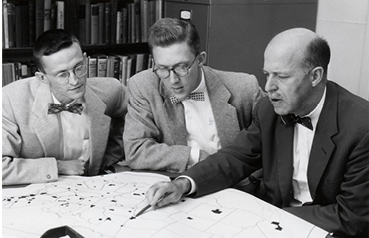
Converse, Miller, and Campbell developing ANES predecessor the Michigan Election Studies
The high point of my graduate studies was a secondary analysis of the 1956 and 1960 national election studies, to test for various processes by which individuals were influenced in their voting by their community (i.e., an early and very primitive study of contextual effects.) This was pre-computer, so I did it all with IBM cards and a card sorter. It was the most exciting thing I did in graduate school, yet all I was doing was imitating Miller, Converse, and Stokes.
In more recent years, ANES made a huge contribution when Steven Rosenstone took the lead in setting up the ambitious Comparative Study of Electoral Systems (CSES), a cooperative study involving roughly fifty national election studies. He was able to build on years of cooperation between the ANES and international scholars, started especially by Stokes and Converse.
While the Inter-University Consortium for Political and Social Research (ICPSR) now serves a broad inter-disciplinary audience, it was initially a spin-off of the ANES. I attended the summer program in its second year, 1965. It consisted of a single class, co-taught by Stokes and Converse. Each day they opened some exciting new window for us. One day, Stokes introduced us to the problem of cross-level inference, which he had just started work on; I had never heard of it before, and it would become an important part of my work over the next fifty years. Another day they invited a young sociology graduate student, Gudmund Iversen, to come in and talk to us about an interesting new kind of statistics he had just learned of – Bayesian statistics.
Mar 18, 2014 | ANES, ANES 65th Anniversary
This is a guest post written by David Redlawsk, Professor of Political Science at Rutgers University and Director of the Eagleton Center for Public Interest Polling.
This post is part of a series celebrating the 65th anniversary of the American National Election Studies (ANES). The posts will seek to highlight some of the many ways in which the ANES has benefited scholarship, the public, and the advancement of science. Do you have ideas for additional posts? Please contact us by email ([email protected]) or Twitter (@umisrcps).
For me, the American National Election Studies (ANES) goes back to my undergraduate days at Duke in the late 1970’s. In my voting behavior class we read The American Voter and The Changing American Voter. I personally did NOT “like” the view of voters from the American Voter, the basic sense that voters were not really competent. So The Changing American Voter, which suggested that voters were more issue-oriented (and thus more competent to hold representatives accountable), appealed to me. Both books were based on ANES data, and I thought it was interesting that they came to different conclusions (of course the argument was that things had “changed” in the late 60’s leading to more issue-oriented voters).
As it turns out, of course, there is a strong critique of The Changing American Voter that comes because the ANES made major question wording and response option changes in 1964 versus prior studies. Bishop, Oldendick, and Tuchfarber (1978a; 1978b), Brunk (1978), and Sullivan et al. (1978) all addressed this issue. For me it made it clear that question design was critical to understanding public opinion.
While my own work has tended to be more experimental, my first journal publication after starting my Ph.D. and after trying other directions for a career, required the ANES in order for us to validate our experimental work. Had we not had the ANES data from which we could construct our Voting Correctly measure, our findings might have remained an interesting (maybe) lab result. Instead they became a core part of our research, both in our APSR paper Voting Correctly (Lau and Redlawsk, APSR 1997) and our book How Voters Decide (Lau and Redlawsk, 2006, Cambridge University Press), both of which have been received with some interest in the discipline.
As I transitioned to doing more survey research and directing the survey center at the Eagleton Institute of Politics, the basic things I learned about question design from the ANES have been important to my work. Overall, ANES has benefited my research and teaching.
Mar 13, 2014 | ANES, ANES 65th Anniversary, Elections
Post developed by Katie Brown and Morris P. Fiorina.
This post is the first in a series celebrating the 65th anniversary of the American National Election Studies (ANES). The posts will seek to highlight some of the many ways in which the ANES has benefited scholarship, the public, and the advancement of science. Do you have ideas for additional posts? Please contact us by email ([email protected]) or Twitter (@umisrcps).
Ahead of the 2012 Presidential election, Morris P. Fiorina, who is the Wendt Family Professor of Political Science at Stanford University and Senior Fellow at the Hoover Institution, wrote an op-ed for the New York Times.
In the article, Fiorina used American National Election Studies (ANES) data to consider the role of the personal qualities of candidates in election outcomes. Fiorina referenced a research report published in the British Journal of Political Science (with Samuel Abrams and Jeremy Pope) after the 2000 presidential election in the United States. The report sought to explain Al Gore’s defeat in the election during a time of peace and prosperity. The report utilized a battery of questions from the ANES that asks respondents to detail what would make them vote for or against each candidate. The authors coded the respondents’ responses to measure candidates’ personal qualities.
What was the relationship between this rating of candidates’ personal qualities and election outcomes? Looking at thirteen elections from 1952 to 2000, Fiorina and his colleagues found that in four elections the electorate gave a noticeable edge to one of the candidates, but the outcomes were not what pundits would have expected. For example, the highest rated Democratic candidate was Jimmy Carter, who lost to the lowest rated Republican candidate, Ronald Reagan, in 1980. And the lowest rated Democratic candidate was Bill Clinton, who won a landslide re-election in 1996.
In the op-ed, based on these findings, Fiorina challenged those citing Romney’s likability deficit relative to Obama as an unlikely cause of the election outcome. As Fiorina wrote, “If Romney loses, it will be because the public believes that Obama has done a good enough job to continue or that Romney has not advanced a credible recovery program. ‘Voters didn’t like my personality’ is a loser’s excuse.”
In subsequent media interviews, Fiorina emphasized how the ANES, funded by the American National Science Foundation (NSF), is far more than another database; it is a 60 year political history of electoral politics in the US. As Fiorina commented, “ANES provides an accurate history of modern American politics, as seen through the eyes of voters at the time, not filtered through the lenses of academic historians or biased journalists.”
Feb 3, 2014 | ANES, Conflict, Current Events, National, Social Policy
Developed by Katie Brown in coordination with Darrell Donakowski.
Source: Thinkstock
On September 16, 2013, a former reservist killed 12 people in a Washington, D.C. Navy Yard. This latest high profile mass American shooting prompted President Obama to urge another push for stronger gun control. Obama first marked the issue as a national priority after a gunman shot and killed 20 first graders and six educators in a Newtown, Connecticut elementary school in December 2013. Obama promised to do everything in his power to prevent another such tragedy. In a Newtown vigil, and referencing the Aurora, Colorado movie theater shooting of the previous summer that killed 12 and injured 70, Obama declared enough.
Obama’s post-Newtown proposals included tougher background checks to purchase arms and the ban of military-style assault weapons used in several high profile mass shooting. But the package stalled in Congress. After the Navy Yard shooting, Obama urged the electorate not to accept mass shootings as a new normal, instead to demand common sense gun laws.
How do the American people feel about gun control?
For 65 years, the American National Election Studies (ANES) have interviewed a representative sample of voting age Americans on a variety of topics, including but not limited to voting and turnout, public policy support, societal values, and demographics. As ANES describes, the resulting data “inform the nation about itself.” Data from the 2012 survey were released at the end of June 2013.
One question in particular from the ANES sheds light on national attitudes toward gun control. The question was asked in 2000, 2004, 2008, and 2012, allowing us to trace responses over time. The graph below displays these trends (leaving out the small fractions who did not know or refused to answer).
Do you think the federal government should make it more difficult for people to buy a gun than it is now, make it easier for people to buy a gun, or keep these rules about the same as they are now?
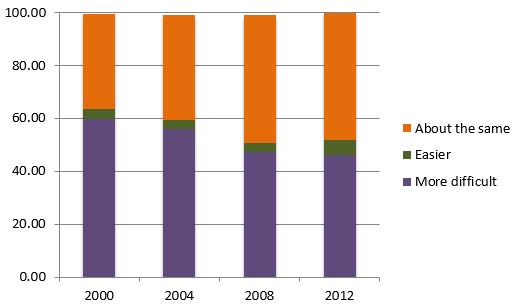
As we can see, the proportion of the public supporting tougher regulation is shrinking over the time period, while satisfaction with current regulations increased. Yet, support for tougher gun laws is the most popular choice in all included years. It is important to note that these data were collected before Aurora, Newtown, and the Navy Yard shootings. The 2016 ANES study will no doubt add more insight into this contentious, important issue.