Nov 19, 2014 | Conflict, Current Events, Foreign Affairs, International
Post developed by Katie Brown and David A. Lake.
ISIL (a.k.a. ISIS, a.k.a. Da’ish) in Syria and Iraq. Al-Shabaab in Somalia. Boko Haram in Nigeria. Al-Qaeda in Pakistan and Afghanistan. All of these insurgent groups have risen to power in failed states, or “ungoverned spaces.” Can we fix these failed spaces?
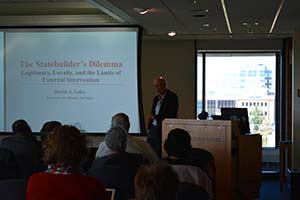 David A. Lake, Distinguished Professor of Political Science at the University of California San Diego and Director of the Yankelovich Center for Social Science Research, addressed this question in a talk titled “The Statebuilder’s Dilemma: Legitimacy, Loyalty, and the Limits of External Intervention” at the annual Harold Jacobson Lecture in International Law which was held on October 23rd, 2014.
Statebuilding seeks to bring stability to unstable regions. Typically, an outside political power, e.g., the United States, will create a new government in a volatile region. In doing so, they attempt to bring a monopoly to legitimate violence. Usually this means supporting a political leader who can build a political coalition to overcome the conflicts. Often, the statebuilder marches in, plants a stake in the ground, and declares a new order. They guarantee this order as long as the different factions honor the new regime.
Statebuilding presents challenges. First, it is very expensive, with the bulk of the cost falling on the failed state. The key to success is balancing legitimacy and loyalty, which proves to be a delicate balance. That is, the new leader must remain loyal to the statebuilder but also seem legitimate to the local population. The more interest the statebuilder has in the region, the more they will require loyalty. Statebuilding fails when the new leader balks at the loyalty. Instead, money meant to be invested in building infrastructure is diverted into building his political coalition.
With the exception of Japan and Germany post-World War II, statebuilding tends to fail. The opening examples exemplify this. So Lake poses the important question: What can be done?
Lake facetiously suggests not engaging in statebuilding as the best solution. Recognizing abstention to be unlikely, he offers a few other guidelines. First, better strategy and implementation is needed, especially around election timing and monitoring. Second, an international coalition should monitor statebuilding and the process of transferring power completely to the new state.
Oct 14, 2014 | Current Events, Elections, National
Post developed by Katie Brown and Josh Pasek.
The Birther movement contends that Barack Obama was not born in the United States. Even after releasing Obama’s short form and long form birth certificates to the public, which should have settled the matter, the rumors to the contrary continued. Some contend Obama was born in Kenya. Others argue he forfeited American citizenship while living in Indonesia as a child.
What drives these beliefs?

Obama’s short form birth certificate, courtesy of whitehouse.gov
Center for Political Studies (CPS) Faculty Associate and Communication Studies Assistant Professor of Josh Pasek – along with Tobias Stark, Jon Krosnick, and Trevor Tompson – investigated the issue.
The researchers analyzed data from a survey conducted by the Associated Press, GfK, Stanford University, and the University of Michigan. The survey asked participants where they believed Obama was born. The survey also asked about political ideology, party identification, approval of the President’s job, and attitudes toward Blacks.
21.7% of White Americans did not think Obama was born in the U.S.; their answers included “not in the U.S.,” “Thailand,” “the bush,” and, most frequently, “Kenya.”
Further analyses revealed that Republicans and conservatives were more likely to believe Obama was born abroad. Likewise, negative attitudes toward blacks also correlated with Birther endorsement. Importantly, disapproval of Obama mediated the connection between both ideology and racism on the one hand and Birther beliefs on the other.
The authors conclude that, “Individuals most motivated to disapprove of the president – due to partisanship, liberal/conservative self-identification, and attitudes toward Blacks – were the most likely to hold beliefs that he was not born in the United States.” Put simply, the key feature of Birthers wasn’t that they were Republicans or that they held anti-Black attitudes, but that they disapproved of the president. It was this disapproval that was most closely associated with the willingness to believe that President Obama was ineligible for his office.
The full Electoral Studies article can be found here.
Sep 10, 2014 | Conflict, Current Events, Elections, Foreign Affairs, International
Post developed by Katie Brown in coordination with Khalil Shikaki and Mark Tessler.
Photo credit: ThinkStock
This summer witnessed intense fighting between Israel and Gaza. With tens of thousands of rockets fired, the conflict killed more than 2,000 Palestinians, mostly civilians, and 80 Israelis, mostly soldiers. How has the most recent conflict affected Palestinian attitudes?
The Palestinian Center for Policy and Research (PCPSR) conducted a survey to gauge this impact. PCPSR is run by Khalil Shikaki. This year, Shikaki is a visiting scholar at the Center for Political Studies (CPS), working closely with CPS Research Professor and expert on the Middle East Mark Tessler. In this post, we offer results from PCPSR’s study along with insight from Tessler to understand the impact of the conflict on Palestinian public opinion.
PCPSR surveyed 1,270 adults in 127 locations across the West Bank and Gaza Strip between August 26 and August 30, 2014, coinciding with the first lasting ceasefire of the conflict. Results suggest that a significant majority (79%) of the Palestinian public views Hamas as the conflict’s winner. Just 3% believe Israel emerged victorious, while 17% believe both sides lost. Likewise, 79% blame Israel for starting this wave of fighting, while 86% support launching rockets at Israel from Gaza when under attack. As for the ceasefire agreement: 63% think it satisfies Palestinian interests.

Photo credit: ThinkStock
In addition to these conflict-specific findings, the PCPSR study also finds increasing support for Hamas among Palestinians to levels not seen since 2006. If elections occurred today, current Hamas deputy political bureau chief Ismail Haniyeh would easily win a presidential race against current president Mahoud Abbas. This is a massive shift in public opinion. Tessler notes that before the most recent conflict, support for Hamas was fading. Shikaki attributes this gain to the conflict, while predicting the Hamas support may wane as time passes. Tessler likewise cautions, “If things do settle down for a reasonable period and there is a new and stable status quo, any spike in Hamas popularity will probably drift back toward its ‘normal’ level based on what people favor and perceive with respect to political Islam, compromise with Israel, corruption and other issues that drive Palestinian politics in normal times.” Thus, the lingering effects of the 2014 Israel-Gaza conflict will depend on whether or not the ceasefire continues.
Khalil Shikaki will give a talk at the CPS Interdisciplinary Workshop on Politics and Policy on September 17, 2014 in Room 6006 of the Institute for Social Research in Ann Arbor, Michigan.
Aug 30, 2014 | Current Events, Foreign Affairs, Innovative Methodology, International, Law
Post developed by Katie Brown and Muzammil M. Hussain.
ICYMI (In Case You Missed It), the following work was presented at the 2014 Annual Meeting of the American Political Science Association (APSA). The presentation, titled “Post-Arab Spring Formations of the Internet Freedom Regime,” was a part of the Political Communication panel “From the Middle East to the Million Man March: The Continuing Digital Revolution” on Saturday August 30th, 2014.
Photo credit: ThinkStock
In early 2011 through 2012, unexpected uprisings cascaded throughout the Arab World. News of this Arab Spring swept across the globe, which inspired several other cascades of political change. Communication systems, especially social media networks, offered an immediate and intimate glimpse into these movements, their successes and failures. So how have state powers and political activists responded to the political capacities of this shared and global digital infrastructure?
Communication Studies Assistant Professor and Center for Political Studies (CPS) Faculty Associate Muzammil M. Hussain studies the political economy of Internet freedom activism. In particular, he is interested in the fate of digital infrastructure in “born digital” states, or states which had successful regime changes that were enabled by digital media. The Arab Spring presents a fascinating and recent moment to consider these “born digital” states. Hussain asks what role governments – both the challenged authoritarian states and the emerging democracies – are playing in shaping communication networks. To address this, he focuses on the transnational activities of political activists promoting Internet freedom.
Hussain conducted fieldwork in the Middle East, North Africa, Western Europe, and North America between 2012-2013, after the Arab Spring protests subsided and a new kind of policy activism took root. Through this international network ethnography of policy makers, communications corporations, and political activists involved in the Arab Spring, Hussain collected a massive array of data. The data includes both interviews and participant-observation, with corroborative evidence of 5,000 individuals and their 84,000 social ties, as well as over 2,000 emails generated through their lobbying and activism work.
This meta-database encompasses the three main stakeholders in Internet freedom promotion: state powers, technology providers, and civil society actors. Hussain argues that Western democracies have been important and successful in launching several major initiatives for securing internet freedom and supporting digital activists currently working within repressive political systems. But these efforts to establish an Internet freedom policy regime are currently gridlocked in competing “communities of practice.”
On the one hand, the community of state-based stakeholders have come to narrowly regard digital media as a critical infrastructure, overvalued its significance as an economic interest and undervalued its significance to democratic activists. On the other hand, since the Arab Spring, the community of tech-savvy political activists has moved rapidly into many new communications policy arenas. Finally, revelations of warrantless surveillance by several advanced democracies have also threatened the viability of this Internet freedom regime. So what are democratic activists and Internet freedom promoters left to do? Stay tuned for Hussain’s next book project: Securing Technologies of Freedom: Internet Freedom Promotion after the Arab Spring.
Aug 29, 2014 | Current Events, Innovative Methodology, National
Post developed by Katie Brown and Yuri Zhukov.
ICYMI (In Case You Missed It), the following work was presented at the 2014 Annual Meeting of the American Political Science Association (APSA). The presentation, titled “Measuring Rape Culture,” was a part of the Political Methodology theme panel “Big Data and the Analysis of Political Text” on Friday August 29th, 2014.
In August of 2012, two high school football players raped a young woman in Steubenville, Ohio. Instead of intervening, witnesses recorded the incident, posting photos and videos to social media sites. The social media trail eventually led to a widely publicized indictment and trial. Yet while the two teenagers were convicted of rape, coverage of the case nonetheless came under fire for perpetuating rape culture. News outlets displayed empathy for the rapists while blaming the victim.
When the media cover sexual assault and rape, empathizing with the accused and/or blaming the victim may send the message that rape is acceptable. This acceptance in turn could lead to an increase in sexual violence, with perpetrators operating with a perceived sense of impunity and victims remaining silent. Yet there exists no systematic study of the prevalence or effects of the media and rape culture.
Center for Political Studies (CPS) faculty associate and Assistant Professor of Political Science Yuri Zhukov, along with Matthew A. Baum and Dara Kay Cohen of Harvard University’s John F. Kennedy School of Government, are filling this gap with a systematic investigation of rape culture reporting in the news media through an analysis of 310,938 newspaper articles published between 2000 and 2014.
The authors first had to operationalize the concept of rape culture, to date a diffuse term. In addition to perpetrator empathy and victim blaming, the authors added implications of victim consent and questioning victim credibility as fundamental dimensions of the concept. The authors then broke down each of these four categories into more detailed content, resulting in 76 descriptors of rape culture. Trained coders analyzed a random subset of some 13,000 newspaper articles. Zhukov and his colleagues then used these manually coded articles to “train” a computer algorithm to detect rape culture in a previously unseen body of text. The algorithm then assigned each of 310,938 articles an overall score on a 6-point Rape Culture index, with higher scores corresponding to articles with more rape culture language.
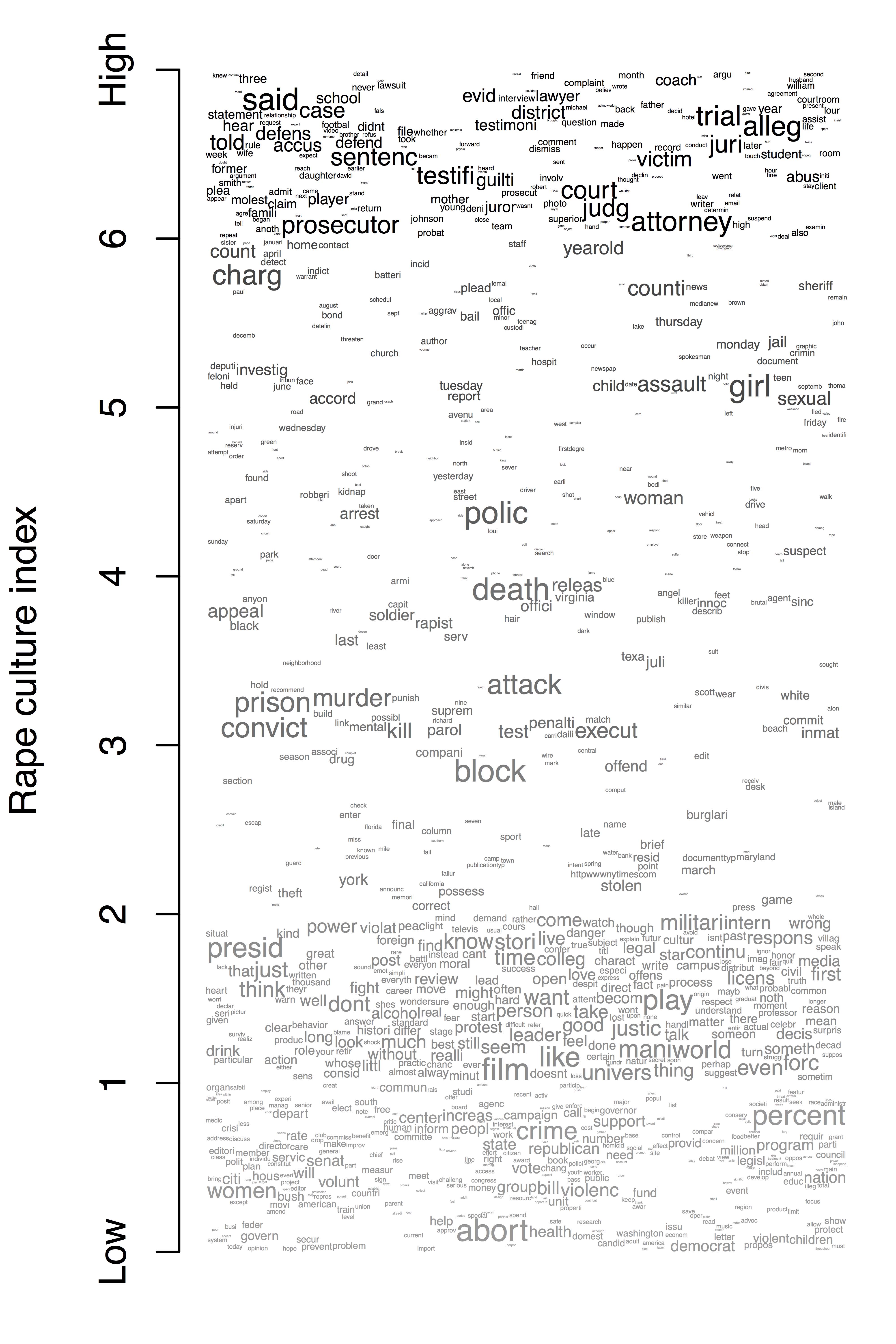
While the study offers many provocative and important findings, we will focus on an innovative and startling result. The authors created a word cloud mapped onto the rape culture index.
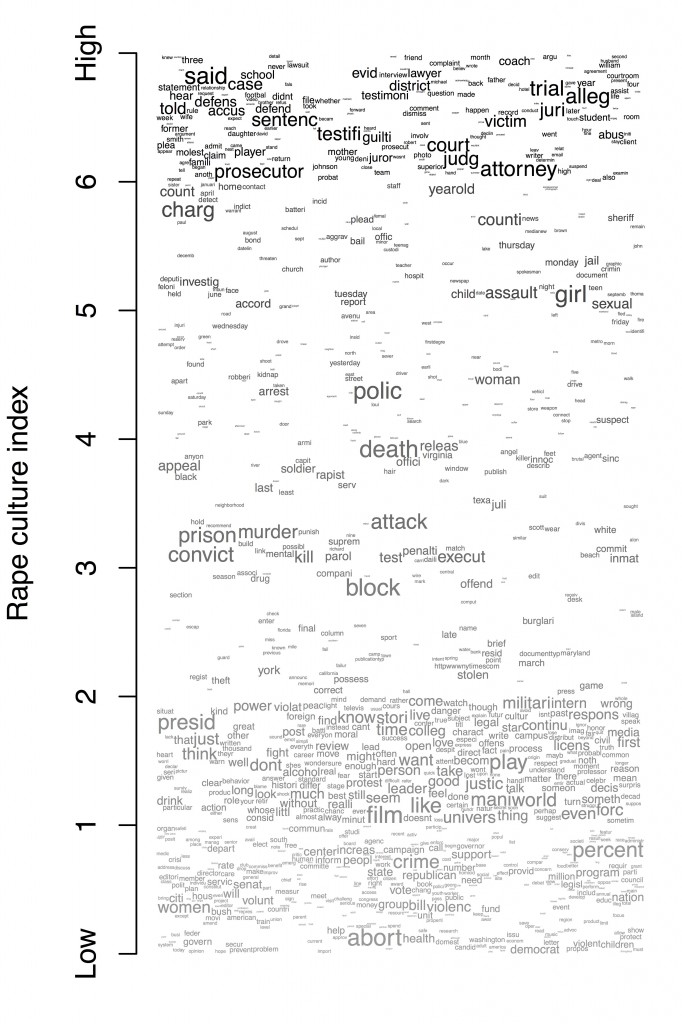
Articles with scores on the lower end of the index tended to discuss rape in the context of crime in general or domestic politics. Articles in the mid-range tended to discuss it in the context of that particular crime, the fate of the accused, and the response of law enforcement. Articles high on the index tended to be about court proceedings (and refer to the victim as “girl,” especially “young girl”) or to athletic institutions. Based on the word cloud graph, the authors conclude that: “Rape culture is less apparent in the initial stages of a case, when news stories are more focused on covering the facts of crimes,” and “Rape culture is strongest when individual cases reach the justice system.”
The authors find that rape culture is quite common in American print media: over half of all newspaper articles about rape revealed information that might compromise a victim’s privacy, and over a third contained language recognized by the algorithm as victim-blaming, empathetic toward the perpetrator, or both. Contrary to popular belief, preliminary findings suggest that rape culture does not depend on the strength of local religious beliefs, or local crime trends. However, the authors find a strong correlation with local politics and demographics: the higher the female share of the population where an article is published, the less likely that article is to contain rape culture language.
Jul 31, 2014 | Current Events, National
Post developed by Katie Brown and Cassandra Grafström
So-called “inflation truthers” – who claim that inflation is actually much higher than reported in the United States – have made recent news waves. Mainstream financial news organizations have debunked the charges of inflation truthers with the simple math of averages. But what if the truthers are just looking in the wrong place? That is, what if there is systematic bias not in reported inflation, but in projected inflation?
Enter the work of Cassandra Grafström, a Ph.D. candidate in the department of Political Science and affiliate of the Center for Political Studies (CPS). Grafström, along with Christopher Gandrud of the Hertie School of Governance, conducted research to trace potential partisan biases in inflation estimates.
In a paper which is forthcoming in Political Science Research and Methods, Gandrud and Grafström began with a widely accepted notion that under more liberal governments, the Federal Reserve tends to predict higher inflation. Why? Democratic administrations tend to try to lower unemployment, which causes higher inflation. Under more conservative governments, on the other hand, the Federal Reserve predicts lower inflation. Yet there exists little empirical support for these ideas. Instead, most work on inflation comes from the field of economics, with a focus on comparing federal predictions with money market predictions.
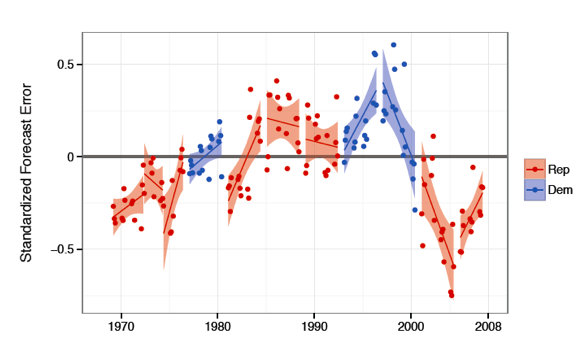
To test these commonly held ideas, Grafström and Gandrud looked at the Federal Reserve’s predictions across time. The authors took Presidential party and actual monetary and fiscal policies into account. They found that, regardless of actual monetary and fiscal policies, under more liberal presidents, the Federal Reserve over-estimates inflation while under more conservative presidents, the Federal Reserve under-estimates inflation.
In the graph below, perfect predictions would create an error of 0. Points above the line correspond to over-estimation and points below the line correspond to under-estimation. The graph shows that when a Democrat is president, estimate errors tend to be above the line, while Republican errors tend to fall below the line.
Errors in Inflation Forecasts Across Time by Presidential Party
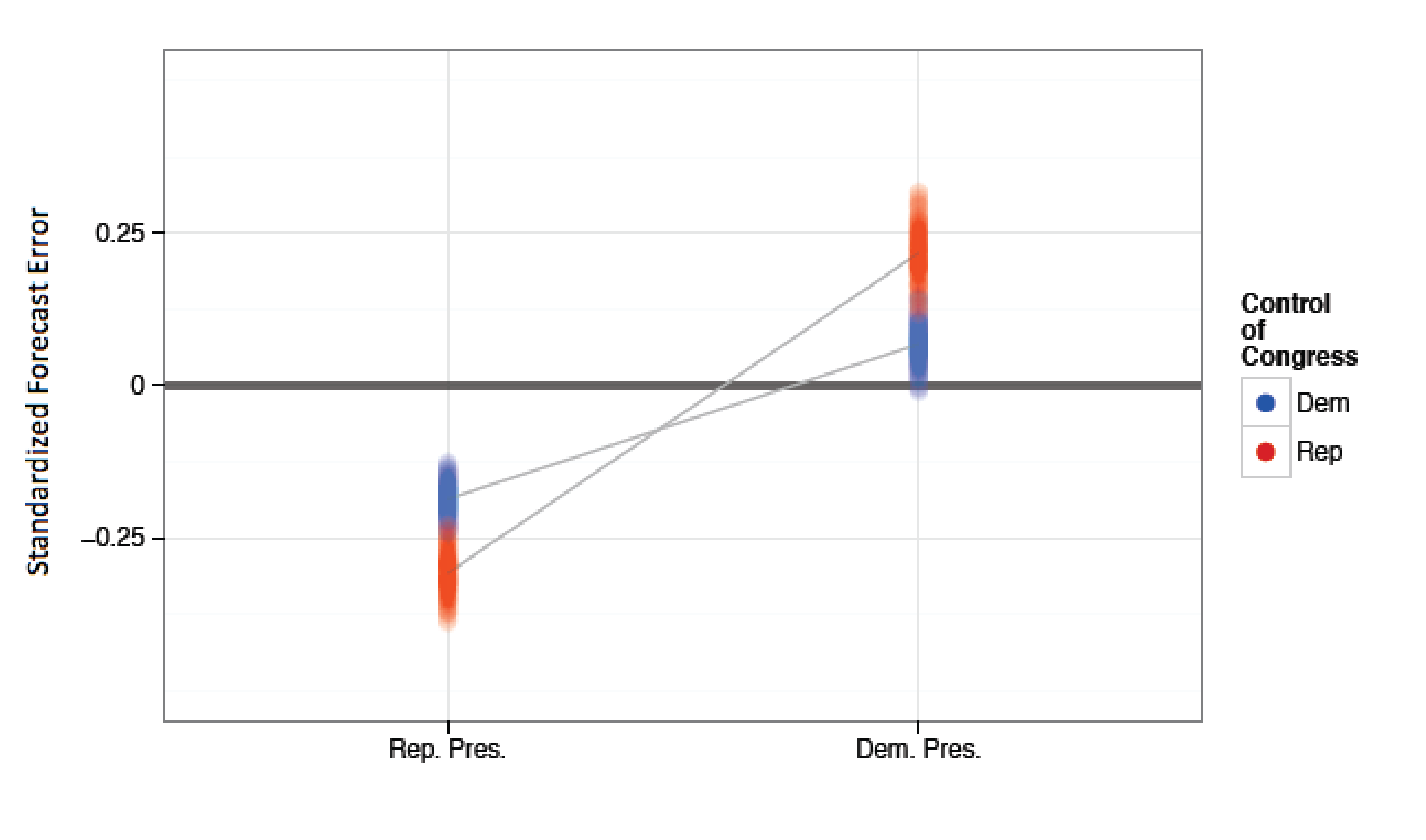
Grafström and Gandrud also wondered if control of Congress plays a role. To test this, they considered the joint influence of presidential party and the majority party in Congress. As the graph below shows, presidential party drives the trend. Interestingly, a Republican controlled Congress makes the original results stronger. That is, with a Democratic president and Republican Congress, there is greater over-estimation of inflation. Likewise, with a Republican president and Republican Congress, there is greater under-estimation of inflation. The graph below illustrates these findings (0 would again represent a match between predicted and actual inflation)
Errors in Inflation Forecasts Across Time by Presidential and Congress Majority Parties
Given the clear links between presidential partisanship and inflation forecasts, the authors worry that this likely translates into biased monetary and fiscal policies. That is, over-estimated inflation under Democratic presidents may lead to more restrictive monetary and fiscal policies. On the other hand, under-estimated inflation under Republican presidents may lead to more expansive monetary and fiscal policies. In both cases, the policy changes would be based on forecasts biased by flawed but accepted rules of thumb about inflation under Democrat vs. Republican presidents.