Post developed by Katherine Pearson and Diana Mutz
Foreign trade is a complex issue, but the public still has strong opinions about the issue. Diana Mutz demonstrated that social psychology can help to understand attitudes about trade when she delivered the 2019 Miller Converse lecture. A recording of her talk “Winners and Losers: The Psychology of Attitudes Toward Foreign Trade” is available below.
Most people rely on small-scale social experiences to understand large-scale interactions such as international trade. From this understanding, people tend to embrace beliefs about trade that are not necessarily accurate. For example, folk beliefs suggest that impersonal transactions are more dangerous than personal ones, that trade is zero-sum, and that trade “deficits” mean that a country is losing more jobs as a result of imports than it gains due to exports. These beliefs are inaccurate, yet understandable, generalizations from the world of face-to-face social exchange.
Contrary to popular wisdom, trade preferences do not reflect people’s economic self-interest. Mutz demonstrates that, surprisingly, these attitudes are not influenced by a person’s occupation, industry of employment, community job loss, geographic location, or individual job loss. Instead, perceptions of what is in the collective economic interest determine attitudes toward trade. Coverage of trade in the media has a large influence on these perceptions. Media coverage of foreign trade was mostly negative until 2016. As media coverage of trade has become more balanced since 2016, support for trade has also increased.
Politicians from all parties have been unwilling to champion trade when running for office because foreign trade is seen as a political liability in the United States. As the world economy changes, Mutz asserts that leaders will need to advocate for trade and for safeguards against its negative effects. She cautions that it’s unhelpful to leave the public out of that conversation altogether as has been common in the past.
For an additional perspective, Mutz compares attitudes about trade in the United States and Canada. She finds that attitudes about trade in the two countries are different due to differing attitudes toward competition. Americans value competition more, and believe in the fairness of unequal outcomes. In the U.S., nationalism reduces support for foreign trade, but in Canada the opposite is true. Canadians who hold the strongest beliefs about national superiority want to promote more trade and immigration.
Differing perspectives on trade in these countries can be explained by variation in two different types of ingroup favoritism. First, Americans in Mutz’s studies systematically preferred trade agreements in which their fellow Americans benefited more than trading partners. In fact, there was no level of job benefits to foreign countries that would justify the loss of even a single American job. This was not the case among Canadians. In addition, Americans demonstrated their competitive attitudes toward trade by demonstrating greater support for trade agreements that not only benefit their country but also disadvantage the trading partner. Canadians, in contrast, preferred the kind of “win-win” trade agreement that economists suggest benefits all countries involved.
Attitudes about race drive attitudes about trade and Mutz finds that the reverse may also be true. In a study that asked respondents to select which students should be admitted to college, participants who had just watched an ad against foreign trade were less supportive of admitting Asian-American students, as well as students from Asia.
Mutz concludes that, while many of these results are distressing, attitudes remain malleable. Efforts to change opinions toward trade that emphasize similarity and shared values are more effective than efforts emphasizing pocketbook gains. Since 2016, her data shows that there has been an increase in support for foreign trade and a realization that it comes with benefits as well as negative consequences.
White conservatives who not only have racial animus but are also knowledgeable about politics were the most likely group to believe that former President Barack Obama was not born in the United States, according to a University of Michigan Institute for Social Research study.
Michael Traugott and Ashley Jardina
The study, published in the Journal of Race, Ethnicity and Politics, teased out motivations of white voters for believing the so-called birther rumor. It found that white conservatives who ranked as having a high amount of knowledge were most likely to support the idea that Obama was not born in the U.S.
“This is a piece of social science research about biased perceptions in the political world and what their consequences might be,” said the study’s co-author Michael Traugott, a researcher at the Center for Political Studies at ISR. “It’s relevant because the whole concept of fake news is about devaluing information that doesn’t conform to either what you believe or what you want other people to believe, therefore suggesting a basis upon which it can be discounted or thrown away.”
Traugott and co-author Ashley Jardina, a former U-M doctoral student and now an assistant professor of political science at Duke University, say politically knowledgeable conservatives may be more likely to believe the rumor because they may follow what’s called a “motivated reasoning model.”
“One of the most interesting things about the motivated reasoning model is that the more resources the person has—which could be political information—the better they are able to argue against new information that doesn’t fit their worldview,” said Traugott.
Traugott and Jardina explored a portrait of a birther among white Americans using data from the 2012 American National Election Study. The ANES, conducted in person among a nationally representative sample of respondents, asked several questions assessing belief in contemporary conspiracy theories.
As recently as 2017, nearly a third of U.S. adults believed it was possible Obama was born outside the U.S., according to the researchers.
The survey also assessed participants’ knowledge by asking them to identify the office held by several political figures. A respondent’s score on the scale was the proportion of correctly answered questions.
The researchers found that 62 percent of very strong Republicans reported that Obama was born in the U.S. compared to 89 percent of very strong Democrats. Thirty-eight percent of very strong Republicans reported that Obama was probably born in another country, while 11 percent of very strong Democrats reported the same.
To estimate the impact of racial attitudes on the birther rumor, the researchers compared two conspiracy theories detailed in the 2012 ANES survey: the Obama birther rumor and the existence of the Affordable Care Act “death panels,” or, the idea that the ACA authorized government panels to make end-of-life decisions for people on Medicare.
Additionally, the researchers found:
Strong Republicans with higher levels of racial animus are more inclined to believe the birther rumor, but not the death panel rumor.
Republicans both low on resentment and low on knowledge are also more inclined to believe the birther rumor.
Democrats with higher levels of racial resentment are not significantly inclined to adopt either rumor.
Democrats low on knowledge and high on resentment are more likely to adopt birther beliefs.
High-knowledge Democrats with high levels of racial resentment are less likely to believe the rumor.
“Until recently, the relationship of party identification to things like voting behavior had weakened, but it has strengthened again,” Traugott said. “We expected partisanship would play a role in attitudes about Barack Obama, and because he was an African American, racial attitudes would play a role as well. These things are now increasingly important because of this kind of tribalism that’s infecting contemporary politics.”
Elections experts Ken Goldstein, Walter Mebane, and Vincent Hutchings analyzed the results and key lessons of the 2018 Midterm Elections at a round table discussion hosted by the Center for Political Studies on November 13, 2018. A recording of the event is available below.
Ken Goldstein, Professor of Politics at the University of San Francisco
Ken Goldstein began his presentation by noting that there are still races that do not have a clear winner a week after the election, including the Senate and Governor’s races in Florida and the Governor’s race in Georgia.
Leading up to the Midterm Elections, some observers anticipated big wins for the Democratic Party. Goldstein observed that while there was a general lack of exuberance on the part of Democrats on election night, further reflection reveals that there were meaningful shifts in this election. Although the “blue wave” of Democratic wins didn’t materialize, the number of congressional seats changing away from the President’s party was of similar magnitude to past midterm elections.
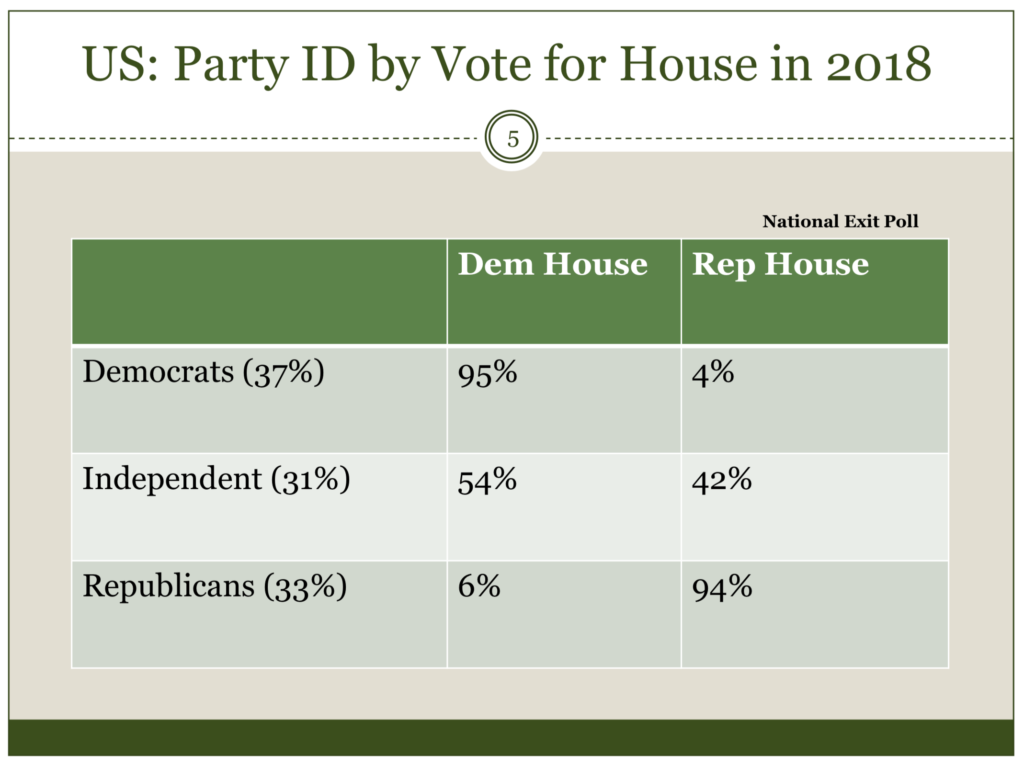
Goldstein drew attention to the behavior of independent voters. Exit poll data show that independents favored Republican candidates for the House of Representatives in the past two midterm elections, as well as the 2016 General Election. In contrast, independent voters were more likely to vote for Democratic House candidates in 2018 by a margin of 12 percentage points.
Were the polls leading up to the election predictive of the actual outcome? Goldstein said they were fairly accurate, but reminded the audience that many congressional seats were not in play in this election. There are few high-quality state-level polls, which makes forecasting less accurate. More probability-based surveys that weight responses for education and race of the respondent would improve the accuracy of predictions.
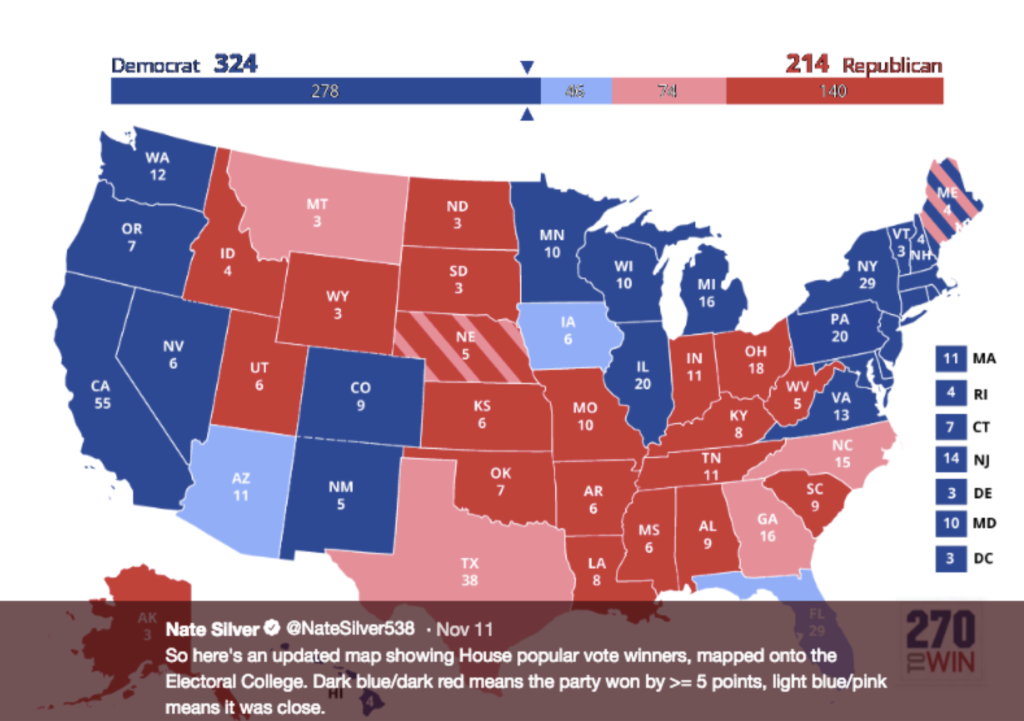
Looking at the big picture trends, Goldstein observed that there was a substantial increase in the number of women running for office and winning, as well as large increases in non-white voters. He shared a map showing what the results of the presidential election would look if votes followed the same partisan break-down as the 2018 midterms. However, Goldstein cautioned that presidential campaigns are very different from congressional campaigns, and that a presidential candidate running a nation-wide campaign will face challenges in changing districts, especially in the Midwest.
Walter Mebane, Professor of Political Science and Statistics at the University of Michigan
Next, Walter Mebane presented analyses he has conducted using election forensics. Mebane coined the term “election forensics” to describe a set of statistical methods he developed to determine whether the results of an election accurately reflect the intentions of the electors.
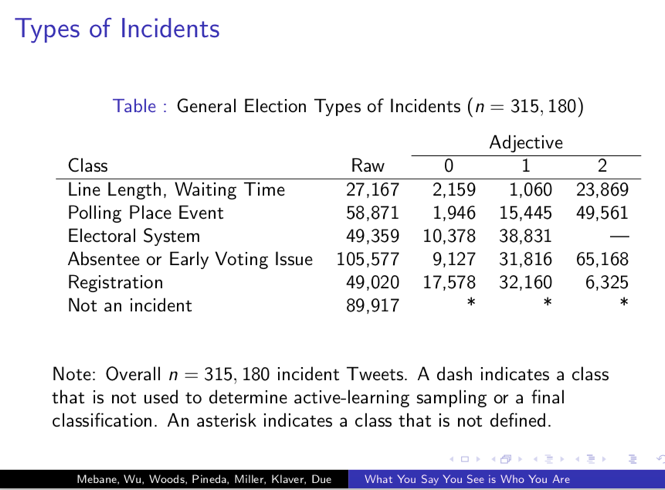
Using Twitter data from the 2016 General Election Mebane analyzed reports of election incidents, including wait times and problems with voting. During the 2016 General Election people used Twitter to report different kinds of election incidents depending on their partisan affiliation. These incidents tended to be reported in replies to people with similar partisan affiliations.
Mebane discovered that there are partisan differences in the types of incidents that Twitter users shared during the 2016 General Election. For example, Republicans were less likely to report a long line to vote, but more likely to report registration problems. A significant conclusion from this finding is that such observational biases and communication silos suggest partisans tended to form different impressions of how the 2016 election went, supported by the divergent reported experiences. These patterns will probably continue in 2018, according to Mebane.
Vincent Hutchings, Professor of Political Science at the University of Michigan
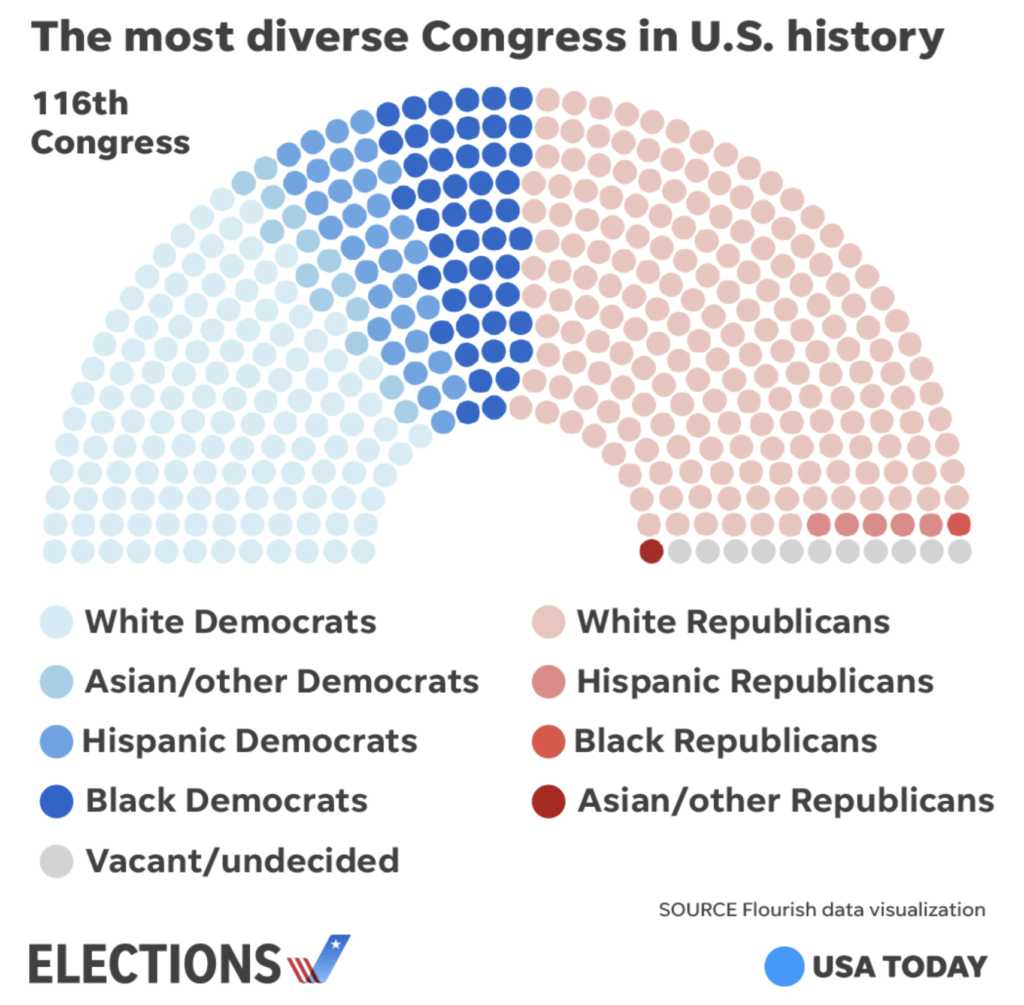
Vincent Hutchings analyzed the shifting demographics of the American electorate. Hutchings presented data showing that Democratic voters have become more racially diverse in the past 20 years, while Republican voters have remained predominately white. Similarly, the Congress elected in 2018 is the most diverse in the history of the United States, but the increase in diversity has been primarily among Democrats elected to Congress.
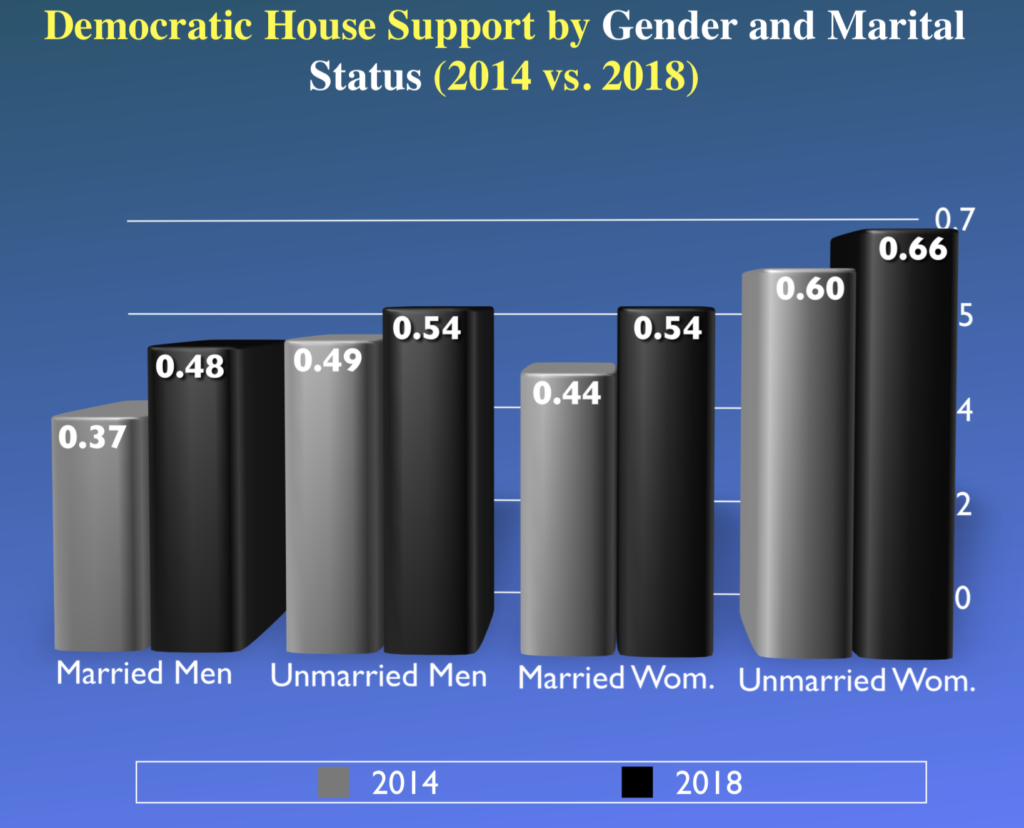
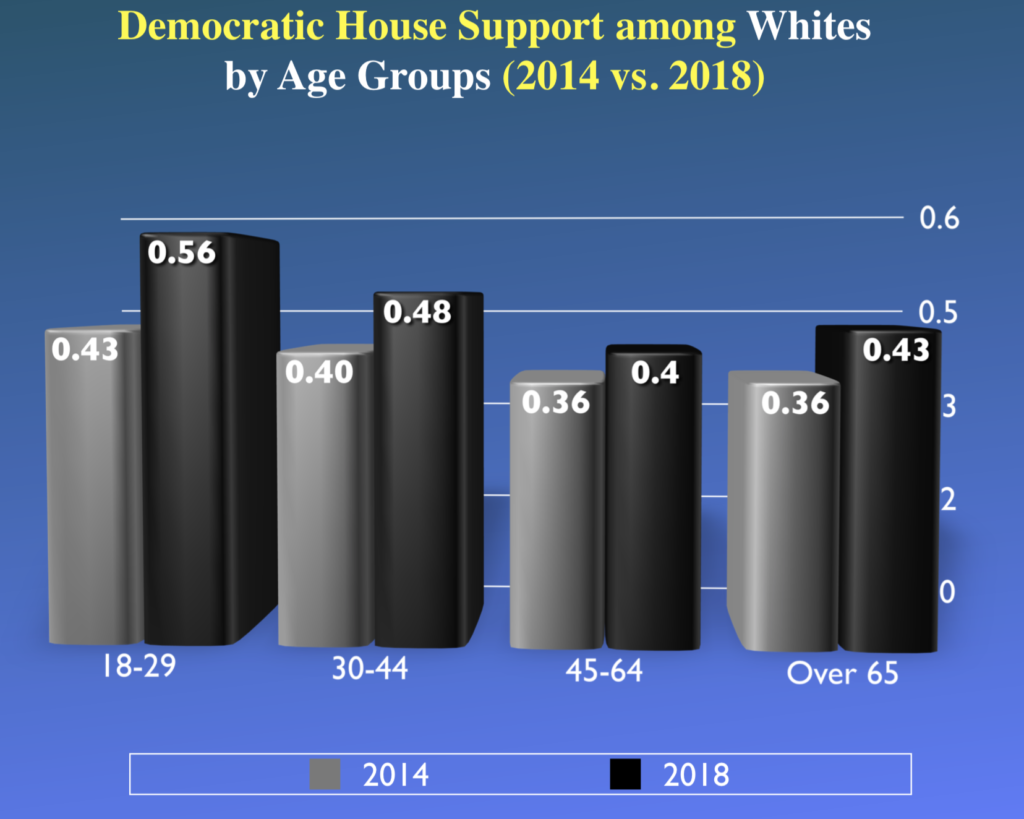
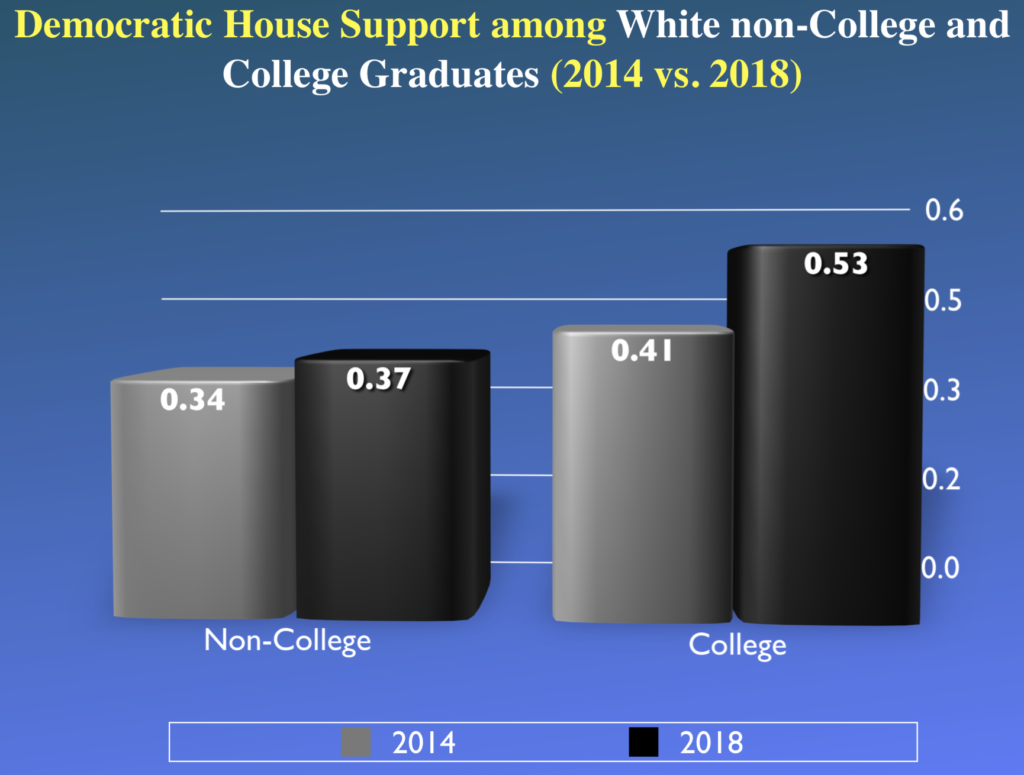
Reviewing voting data by race, gender, age, marital status, and education, Hutchings notes that each demographic group voted for Democrats at a higher rate than they did in the 2014 Midterm Elections. However, the magnitude of change was different for each group.
Some elections experts wondered whether women would vote for Democrats at higher rates in 2018 in response to the #MeToo movement, the contentious confirmation of Justice Kavanaugh, and controversial remarks about women made by President Trump. Hutchings showed that, among white voters, men and women both shifted toward Democratic candidates, but the gender gap didn’t change. Married men and married women both moved toward the Democratic Party House candidates at roughly equal rates in 2018 compared to 2014. No matter how Hutchings examined gender, he found no evidence that white women behaved differently than comparable men, relative to their preferences four years ago.
Similarly, Hutchings observed meaningful trends related to generation and education. Voters under 30 years old voted for Democrats at a higher rate than voters under 30 in 2014. Democrats also increased gains among college-educated white voters compared to the 2014 Midterm Elections. Hutchings concluded that, while media may focus on gender differences between Democratic and Republican voters, more important differences are emerging along generational and educational lines, and these are trends to watch
“Gerrymandering”— when legislative maps are drawn to the advantage of one party over the other during redistricting—received its name in 1812, when Massachusetts Governor Elbridge Gerry signed off on a misshapen district that was said to resemble a salamander, which a newspaper dubbed a “gerrymander.”
But although the idea of gerrymandering has been around for a while, proving that a state’s legislature has deliberately skewed district lines to benefit one political party remains challenging.
The problem is that the mere presence of partisan bias in a district map tells us very little about the intentions of those drawing the districts. Factors such as racial segregation, housing and labor markets, and transportation infrastructure can lead to areas where one party’s supporters are more geographically clustered than those of the other party. When this happens, the party with a more concentrated support base achieves a smaller seat share because it racks up large numbers of “surplus” votes in the districts it wins, while falling just short of the winning threshold in many of the districts it loses.
Further, there are many benign reasons that legislatures may seek to redistrict voters—for example, to keep communities of interest together and facilitate the representation of minorities—that may have the unintended consequence of adding a partisan spin to the map.
The research of political scientists Jowei Chen and Jonathan Rodden is helping to differentiate cases of deliberate partisan gerrymandering from other redistricting efforts. Chen, Faculty Associate at the University of Michigan’s Center for Political Studies, and Rodden, Professor of Political Science at Stanford University, have devised a computer algorithm that ignores all partisan and racial considerations when drawing districts, and instead creates thousands of alternative district maps based on traditional districting goals, such as equalizing population, maximizing geographic compactness, and preserving county and municipal boundaries. These simulated maps are then compared against the district map that has been called into question to assess whether partisan goals motivated the legislature to deviate from traditional districting criteria.
We first wrote about Chen and Rodden’s work back in December 2016, detailing a 2015 paper in the Election Law Journal, which used the controversial 2012 Florida Congressional map to show how their approach can demonstrate and unconstitutional partisan gerrymander. Now, this work is back in the spotlight: Chen’s latest research has been cited in several cases of alleged gerrymandering that are currently working through the courts in Pennsylvania, North Carolina, Wisconsin and Maryland.
In January, Chen’s testimony as an expert witness was cited when the Pennsylvania Supreme Court threw out the state’s U.S. House of Representatives district map. In its opinion, the court said the Pennsylvania map unconstitutionally put partisan interests above other line-drawing criteria, such as eliminating municipal and county divisions.
The Pennsylvania districts in question were drawn by the Republican-controlled General Assembly in 2011. Immediately, the shape of the districts was an indicator that at least one traditional criterion of districting—compactness—had been overlooked.
Though few states define exactly what compactness means, it is generally taken to mean that all the voters within a district should live near one another, and that the boundaries of the district should be create a regular shape, rather than the sprawling polygon with donut holes or tentacles that characterized the Pennsylvania district map.
In particular, District 7—said to resemble Goofy kicking Donald Duck—had been called into question. “It is difficult to imagine how a district as roschachian and sprawling, which is contiguous in two locations only by virtue of a medical facility and a seafood/steakhouse, respectively, might plausibly be referred to as compact,” the court wrote.
Although there are more registered Democrats than Republicans in Pennsylvania, Democrats hold only five of the state’s 18 congressional districts. In the 2016 election, Democrats won each of their five House seats with an average of 75 percent of the vote while Republicans’ margin of victory was an average of 62 percent across their 13 districts. This is an indicator of “packing,” a gerrymandering practice that concentrates like-minded voters into as few districts as possible to deny them representation across districts.
Chen’s expert report assessed the district map and carried out simulations to generate alternative districting plans that strictly followed non-partisan, traditional districting criteria, and then measured the extent to which the current district map deviates from these simulated plans.
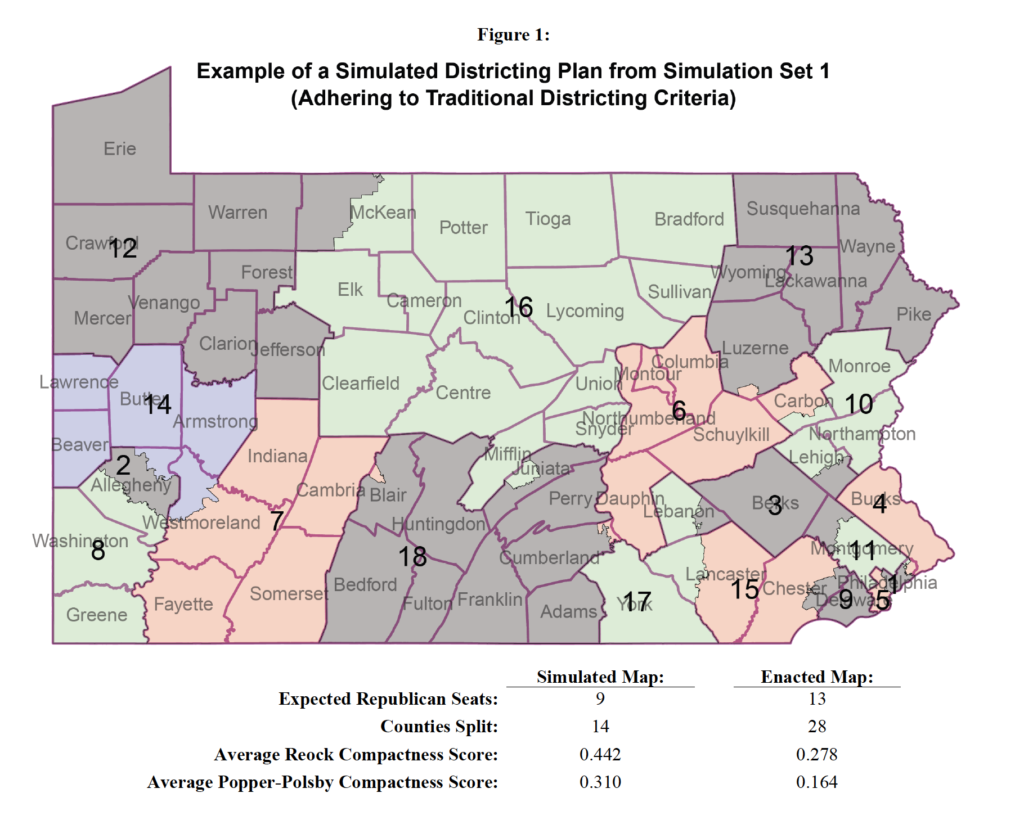
To measure the partisanship of the computer-simulated plans, Chen overlaid actual Pennsylvania election results from the past ten years onto the simulated districts, and calculated the number of districts that would have been won by Democrats and Republicans under each plan (see Figure 1).
The districting simulation process used precisely the same Census geographies and population data that the General Assembly used in creating congressional districts. In this way, the simulations were able to account for any geographical clustering of voters; if the population patterns of Pennsylvania voters naturally favor one party over the other, the simulated plans would capture that inherent bias.
Generally, the simulations created seven to ten Republican districts; not one of the 500 simulated districting plans created 13 Republican districts, as exists under the Republican-drawn district map. Thus, the map represented an extreme statistical outlier, a strong indication that the enacted plan was drawn with an overriding partisan intent to favor that political party. This led Chen to conclude “with overwhelmingly high statistical certainty that the enacted plan created a pro-Republican partisan outcome that would never have been possible under a districting process adhering to non-partisan traditional criteria.”
This table compares the simulated plans to the 2011 Pennsylvania district map with respect to these various districting criteria.
Following its ruling, on February 20 the Pennsylvania Supreme Court released a new congressional district map that has been described in a Washington Post analysis as “much more compact”. In response, the state’s Republican leadership announced plans to challenge the new map in court.
Post developed by Mara Ostfeld and Catherine Allen-West
The effectiveness of America’s system of democratic representation, in practice, turns on broad participation. Yet only about 60 percent of voting eligible Americans cast their vote in presidential elections. This number is nearly cut in half in off-year elections (about 36 percent), and participation in local elections is even lower. This lack of electoral engagement does not fall equally across racial and ethnic subgroups. Latinos, for one, are particularly underrepresented at polling booths across the country. In 2016, eligible Latino voters were about 20 percentage points less likely to vote than their White counterparts, and about 13 percentage points less likely to vote than their Black counterparts.
This fall, a group of 24 University of Michigan undergraduate students sought to explore this disparity and pinpoint what, if anything, works to increase Latino political participation. In the class, entitled The Politics of Latinidad, CPS Faculty Associate and U-M Political Science ProfessorMara Ostfeld taught her students how to measure public opinion and challenged them to analyze the factors that affect Latino political participation.
Today, more than 50,000 Latinos live in Detroit and a majority of them reside in City Council District 6 in Southwest Detroit which is precisely where this course focused. The students began by studying the history of Latinos in Southeast Michigan and exploring how Latinos played critical roles in the city’s development dating back to before World War I. They analyzed broad trends in Latino public opinion, and considered how and why these patterns might be similar or different in Detroit. Students then designed their own pre-election polls to take into the field.
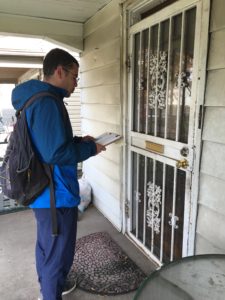
In order to understand what affects voter turnout, students surveyed over 300 residents of Southwest Detroit to measure the issues that were most important to them.
Students pictured here: Storm Boehlke, Mohamad Zawahra, Alex Tabet , Hannel So, Sion Lee.
The results illustrate some powerful patterns. Among the issues that the residents found most important, immigration and crime stood out. Forty-nine and 45 percent of Latinos listed immigration and crime, respectively, as issues of particular concern, with only 31 percent of residents saying that they felt safe in their own home.
Latinos in Southwest Detroit feel extremely high levels of discrimination. Seventy percent of Latinos surveyed said they felt Latinos face “a great deal” of discrimination. This significantly exceeds the roughly half of Latinos nationwide who say they have experienced discrimination.
Student Alex Garcia visits residents in Detroit.
Local issues were also at the forefront of residents’ minds. Latinos had mixed views on the city’s use of blight tickets to combat housing code violations, with one third of respondents supporting them and one third opposing them.
As local organizations, like Michigan United, continue trying to get a paid sick leave initiative on the ballot in 2018, they can expect strong support among Latinos in Southwest Detroit. About two out of every three Latinos in the area indicated they would be more likely to support a candidate who supports the paid sick leave requirement.
The students then followed up with the residents a month later to see if they planned to vote in the upcoming city council election. At this point, the students implemented some interventions that have been used to increase political participation like, evoking emotions that have been shown to have a mobilizing effect, framing voting as an important social norm, and speaking with voters immediately before an election. With the election now over, students are back in the classroom analyzing the effectiveness of these interventions and will use their first-hand experience to better understand public opinion and political participation.
On January 21, 2017, nearly half a million people flocked to Washington D.C. for the Women’s March. They carried various signs about reproductive rights, anti-Trump sentiment, and intersectionality amongst feminists. The event hosted several celebrities who spoke about women’s empowerment and stressed the need for resistance against the new administration. Just one day earlier, Donald Trump had been sworn into office as the 45th President of the United States, and a different crowd of protestors organized a Counter-Inaugural protest to display their concern. Michael Heaney, a political sociologist at the University of Michigan, collected data on the participants at both protests, shedding light on the types of people who attended and their reasons for doing so. Heaney recently presented this work at the Center for Political Studies at the University of Michigan.
The foundation of Heaney’s research centers on the theory of “mesomobilization” – an explanation for how protests form and become organized. Typically, a central group decides to take action and declares a frame for the movement. The central group then brings other people together that would be motivated by this specific frame. Therefore, the theory suggests that all protestors share certain commonalities. In this case, the protestors were all highly motivated by women’s rights. Heaney aimed to further explore participants’ identities and compare them to that of the Counter-Inaugural protest, which advantageously occurred in the same city.
Heaney hired a team to sample the two crowds. Stationed at different places throughout the protests, the team would look out over the crowd and select an individual. To reduce bias, the sampler would count five people away from their selected individual then approach this person to participate in a six-page survey. After asking three people in the surrounding area to complete their survey, the team member would begin a different round at a new location and select another random protestor. This cycle repeated until the team gathered about 180 responses at the Counter-Inaugural protest and roughly 320 at the Women’s March.
The survey produced some interesting results:
The two crowds showed no difference in ideology. When asked if they leaned left, right, or center, nearly every respondent answered “left.” However, protestors at the Women’s March were much more partisan. When asked about their partisan identification (i.e. independent, independent who leans Democrat/Republican, moderate Republican/Democrat, strong Republican/Democrat, or third party), they answered they leaned more towards the Democratic Party.
Counter-Inaugural protestors were more inclined than Women’s Marchers to believe that the current political atmosphere justified violence.
Demographically, the crowd at the Women’s March was significantly older than the Counter-Inaugural, but the two groups did not vary in white versus nonwhite respondents.
Next, the survey focused on how respondents framed their participation. Participants were asked why they attended their respective event. The researchers then coded these responses in terms of gender. For example, if the person said they were there to protest for reproductive rights their answer was considered gendered. If they responded that they protested on the premise of healthcare, it was coded as non-gendered. Results show that about 15 percent of the Counter-Inaugural and 35 percent of Women’s March attendees gave a gendered reason for attending their respective protest. Furthermore, people who had organizational attachments (i.e. involvement with Planned Parenthood) were far more likely to provide a gendered response at both events. This suggests evidence of the mesomobilization theory at each protest. Heaney asserts that people brought their cohorts to participate in politics based on the frame that a central group created.
The researchers also examined the group of people who attended both the Counter-Inaugural protest and the Women’s March. One would expect that people observed at the Counter-Inaugural, who planned on attending the Women’s March, would be more likely to provide a gendered reason for attending the Counter-Inaugural. Remarkably, this was not the case. However, people observed at the Women’s March who also attended the Counter-Inaugural very commonly provided a gendered reason. Could the event itself play a role in the protestor’s participation or even explicitly introduce a frame? Heaney plans to investigate this curious paradox.
Michael Heaney’s data from the Counter-Inaugural protest and Women’s March gives insight on the mesomobilization theory, along with demographic data on the protestors. He continues to work on connecting evidence from both movements then plans to compare it with other data from the 2016 Democratic and Republican National Conventions and a Right to Life protest.


.jpg)
_03.jpg)