On Sunday, Oct. 25, Luiz Inácio Lula da Silva was reelected in the second round of Brazil’s presidential election. It was a historic comeback. Since direct presidential elections resumed in 1989, no candidate who finished second in the first round had gone on to win the runoff. Lula’s victory also interrupted a regional trend that had begun to look like an unstoppable conservative tsunami. What happened?
In recent years, conservative candidates have won seven consecutive presidential elections across Latin America. These leaders come in many flavors: From conservatives like José Antonio Kast in Chile to radical libertarians such as Javier Milei in Argentina; from lifelong political figures such as Keiko Fujimori in Peru to newcomers like Abelardo de la Espriella in Colombia. Despite their differences, many have made crime, corruption, and distrust of established institutions central to political debate. Some offer a more direct promise, personified by El Salvador’s Nayib Bukele: give us power, remove the obstacles, and we will deliver results. Several have also embraced Trump or drawn on MAGA politics, although their relationships with Washington differ. And yet Lula just broke this emerging regional narrative.
The first lesson is that political trends are reversible.
Brazil is not an isolated case. Lula’s comeback echoes Poland’s 2023 change of government, Orbán’s defeat in Hungary this April, and the student-backed opposition’s victory in Serbia on the same day Brazilians voted. These movements differ considerably, but each shows that political dominance can be challenged. Lula’s election gives the Latin American left a breath of fresh air. Lula himself first came to power during the pink tide, whose later decline is another reminder that political trends are not set in stone.
Brazil also shows how a reversal can happen: Through changes in the message and in the means of reaching voters.
Labor unions and college campuses were once crucial spaces for the left. Today political identities are also formed in neighborhood networks, WhatsApp groups, podcasts, and social media feeds. In Brazil, evangelical churches are another important space. The right has invested heavily in some of these networks. The paradigmatic voter for the left might once have been a union worker; today, a driver in the service economy might encounter politics through a podcast during a long shift. A message built for the first worker may not address the second worker’s concerns or carry the same urgency.
After a disappointing first round, Lula’s campaign expanded its digital outreach and intensified its efforts to bring voters to the polls. Its comeback suggests that these spaces remain open to political competition, even where the right has built a strong presence.
The second lesson is that election results can be a poor measure of a society’s ideology.
A large part of the electorate is polarized, but election results also depend on turnout and the choices voters face.
Lula lost the first round by roughly 2.2 million votes and won the second by roughly 4.4 million. Nearly three million additional people voted in the runoff, while blank and null votes also fell. These numbers cannot tell us why many individual voters changed their minds, much less why some may have voted for Lula for the first time, while others chose him over Flávio after supporting a different candidate in the first round. Yet, these numbers reveal an electorate more open to mobilization than the first-round result suggested.
That uncertainty matters for the larger question surrounding recent elections. Are voters becoming more conservative? Or have right-wing candidates been more effective at responding to people who feel that established politicians cannot control violence, improve their lives, or explain those failures?
Recent research offers a clue. The 2026 AmericasBarometer, conducted by Vanderbilt University’s Center for Global Democracy and LAPOP Lab, finds mostly modest increases between 2023 and 2026 in the share of Latin Americans placing themselves on the political right. Electoral outcomes appear to be moving faster than ideological self-identification.
That leaves room for another explanation: the right has been more effective at channeling discontent over crime, living costs, and the failures of incumbents. Lula’s victory shows that this advantage can be contested.
The third lesson is that an election does not settle how a country will be governed.
Flávio Bolsonaro lost, but his Liberal Party remains the largest in the Chamber of Deputies, and the incoming Congress is strongly conservative. Lula will have to govern with opponents who retain electoral strength, organizational power, and influence over legislation and appointments. Winning the presidency gives him another term but putting his policies into practice will require negotiation with parties whose priorities differ from those of Lula and his party.
That distinction between winning office and exercising power extends across the region. Peru’s and Colombia’s recent presidential races were exceptionally close, and neither Fujimori nor de la Espriella commands a congressional majority. Their ability to deliver on their promises will depend on building coalitions. Where leaders face fewer effective constraints, the risk is different. El Salvador shows the stakes: in 2025, Bukele’s allies removed presidential term limits, weakening a basic constraint on executive power. But we need to remember that Latin American institutions differ greatly in their capacity to hold leaders accountable.
For governments of both the left and the right, the test comes after election day. Can they deliver security and opportunity? Can they do so while accepting opposition, independent courts, and the possibility of losing the next election?
For Lula, those questions are now immediate. His comeback interrupted the right’s regional momentum, but he must answer voters’ concerns about crime and living costs while negotiating with a Congress in which his opponents have gained power. And can the left offer credible answers to the problems voters are asking it to solve?
Whether Lula can do that will determine if his victory becomes a durable alternative to the right’s recent successes or merely a pause. What he does next will tell us more about Latin America’s political future than the color we assign to its electoral map.
This post was written by Edgar Franco-Vivanco, Assistant Professor of Political Science and a faculty associate at the University of Michigan Center for Political Studies and the Michigan Institute for Data Science. His research interests include Latin American politics, historical political economy, criminal violence, and Indigenous politics. He is a co-PI of the Historical Institutions Lab and the director ofLATAM-EH.
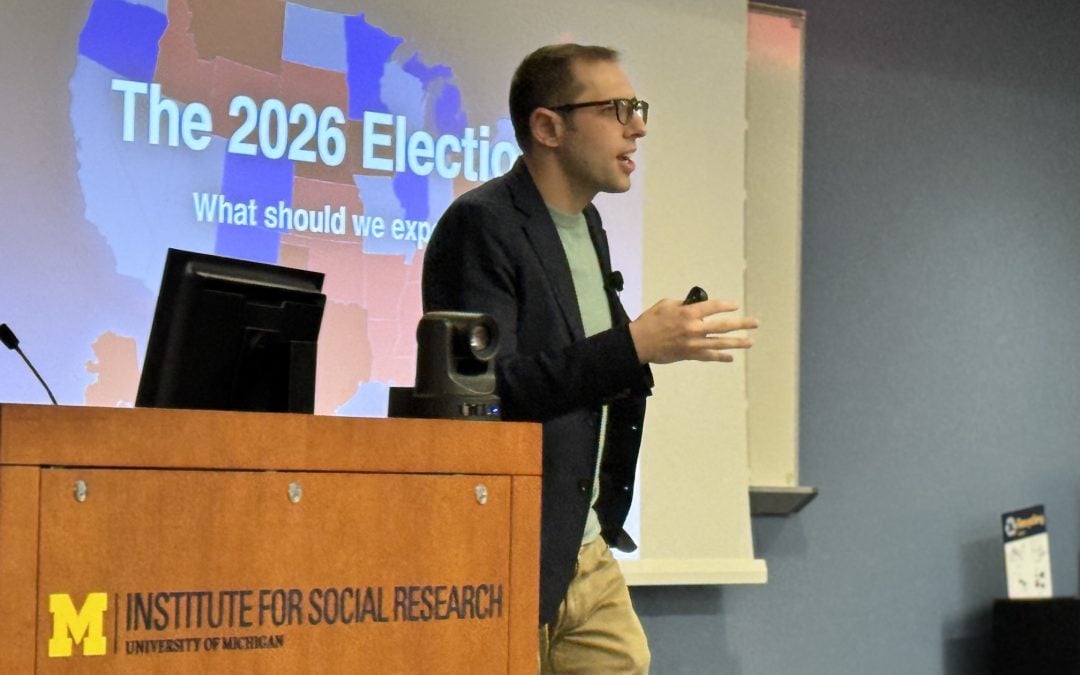
With Election Day less than two weeks away, University of Michigan public opinion researchers Michael Traugott and Josh Pasek provided an overview of what the data currently tell us about the upcoming midterms.
The talk was presented as part of the ISR Insights series held at the Institute for Social Research, where Center for Political Studies experts present analyses in panels before and after US elections. Three takeaways:
1. Every indicator political scientists watch is pointing the same direction
Political scientists typically treat midterms as a referendum on the sitting administration, and they measure that referendum several ways. Right now, those measures agree:
Presidential approval: Trump’s approval sits at roughly 39% against 59% disapproval — about 20 points “under water,” and the lowest reading for an incumbent president at this point in the era of modern public polling.
The generic congressional ballot: Aggregated polling shows roughly 51% preferring a Democratic candidate to 42% preferring a Republican — about an eight-point gap that has widened over the course of the term.
Historical base rates: Since the 1930s, the president’s party has almost always lost House seats at the midterm. Only three times has it gained seats. In 2018, Republicans lost 40.
Issue concerns:Recent Fox News polling found three in four Americans or more are extremely or very concerned about corruption in government (the top issue), inflation and prices, gas prices, health care, and government leadership.
When the fundamentals and the polling converge, Pasek noted, that agreement itself suggests the environment is tilted meaningfully in one direction, rather than reflecting noise in a single data source.
2. The Senate is the real contest
Republicans currently hold narrow majorities: roughly 219–214 in the House (with two vacancies) and 53–45 in the Senate, with two independents caucusing with Democrats. A four-seat shift would flip either chamber — not a big lift in the House, but a heavy one for the Senate.
House: Seat-translation models built on the generic ballot suggest that an eight-to-nine-point Democratic popular vote advantage would produce a Democratic pickup in the neighborhood of 26 to 28 seats.Alan Abramowitz’s model for Sabato’s Crystal Ball produces a comparable estimate (about 192 Republican seats at a minus-eight Republican margin). Aggregators are broadly confident Democrats take the chamber.
Senate: Senate forecasting works differently — it’s done state by state, with heavy weight on candidate quality and well-funded statewide advertising.The Cook Political Report identifies seven toss-ups: Alaska, Iowa, Kansas, Maine, Ohio, Texas (all currently Republican-held), and Michigan (an open seat).Nate Silver’s simulation model puts Democratic control at roughly a three-in-four chance.A caveat: The 2026 Senate map was long considered unfavorable for Democrats, because competing at all requires winning in territory with a partisan voter index of R+5 or greater. The current polling suggests they may be there — but it’s a harder map than 2028.
3. Election polling is genuinely hard, but this margin is larger than typical polling error
Pasek, who led the AAPOR Task Force on 2024 Pre-Election Polling, spoke on the challenges that election polls face, including low response rates, participation bias, and the burden of predicting future behavior. “Polls are excellent at telling you which races are competitive,” said Pasek. “They are not precise enough to tell you who wins a race decided by a point.”
That said, larger margins make contests easier to call, and recent polls have a decent track record of predicting Senate races within a 5-point margin of error, Pasek said. An open question is whether something specific was going wrong in ballot years when Trump was on the ballot — distrust of pollsters among his supporters, for example, leading them to hang up. If so, it’s unclear whether that carries into a midterm where he isn’t a candidate but is working hard to make the election about himself. “Not obvious,” Pasek said. No one really knows.
A referendum on democracy
Both presenters argued that how people want to vote may be a less decisive factor this year than usual, because of pressures on the process itself.
Pasek flagged claims about placing federal officers at polls, attempted changes to how the Postal Service handles ballots, and a growing number of officials who denied the 2020 results now administering elections. The presence of these issues in the media alone can impact voter turnout, Traugott noted, since uncertainty about federal officers at polling places, registration rules, or mail handling can depress participation on its own. Most concerning to Pasek: Apparent degradation of losers’ willingness to concede.
But U.S. elections are run locally, across nearly 200,000 polling locations. That decentralization is a real check against any single national intervention.
On Election Day, we may see an enthusiasm gap that drives more Democrats to the polls, and a potential shift away from Trump among Hispanic and younger voters.
Questions about how the process unfolds, how accurately polls predicted behavior, and who shows up to vote will only be knowable on election day. Several toss-ups sit in the Eastern time zone, so early returns from Maine, Michigan, and Ohio will offer an unusually good early read for East Coast viewers on the night.
Michael Traugott is a political scientist who studies campaigns and elections, voting behavior, and the impact of mass media on American politics, and is the author of A Voter’s Guide to the Election Polls, now in its 6th edition.
Josh Pasek is Professor of Communication & Media and Political Science, Research Professor at the Center for Political Studies, Institute for Social Research, and Core Faculty of the Michigan Institute for Data Science at the University of Michigan.
This post was developed by Tevah Platt, communications manager for the Center for Political Studies. Recordings of past and upcoming talks are available through ISR.
Dr. Shibley Telhami—the Anwar Sadat Professor for Peace and Development at the University of Maryland and an influential scholar on foreign affairs and American public opinion on the Middle East—presented a sweeping historical picture yesterday of how American attitudes toward Israel and the Israeli-Palestinian conflict have evolved in recent decades.
“What we’re witnessing is a paradigmatic shift that’s likely to last that sees Israel as a villain and perhaps even a genocidal villain,” Telhami said in a seminar presented to the Center for Political Studies at the University of Michigan Institute for Social Research. “We have something that I think is more than just a short-term shift in public opinion, and that is much deeper than people may assume.”
Telhami’s central argument, based on his work polling American attitudes toward the Israeli-Palestinian conflict since 1989, is that Americans’ support for Israel– waning gradually over the past 15 years– experienced a dramatic crash following the Oct. 7, 2023 Hamas attack and the Israeli assault on Gaza. Telhami: “The dam finally broke in Gaza once the scale of the Israeli assault became clear.”
A Paradigm Shift
Telhami emphasized that this transformation did not begin with the war in Gaza, but was building over time. Telhami’s polling data of past decades showed that a majority of Americans have consistently said they want the U.S. to take “neither side” in the conflict. Among the minority who did express a preference, support for Israel outweighed support for the Palestinians by wide margins—often five or six to one. Telhami has seen that gap close over time, with fewer Americans choosing “neither side,” and among those who do take sides, a narrowing—and eventually reversing—preference, especially among Democrats.
Under Biden, Telhami’s University of Maryland Critical Issues Poll confirmed that half of young Democrats (under 35) disapproved of the new U.S. president’s handling of the May 2021 Gaza conflict. Writing for theBrookings Institution, Telhami argued that the data underscored a generational shift that would prove to be a warning sign of a widening fracture within the Democratic coalition, and anticipated that could impact Biden’s reelection.
Telhami’s polling data showed an initial, dramatic spike in sympathy for Israel in the immediate aftermath of the October 7, 2023 attacks—the largest poll-to-poll increase he has measured in decades of surveying. But this reversed within roughly two weeks, even before the full scope of Israel’s military actions was apparent. Young Democrats did not shift in attitudes during this initial spike– and as the war intensified, their sympathies moved decisively toward the Palestinians.
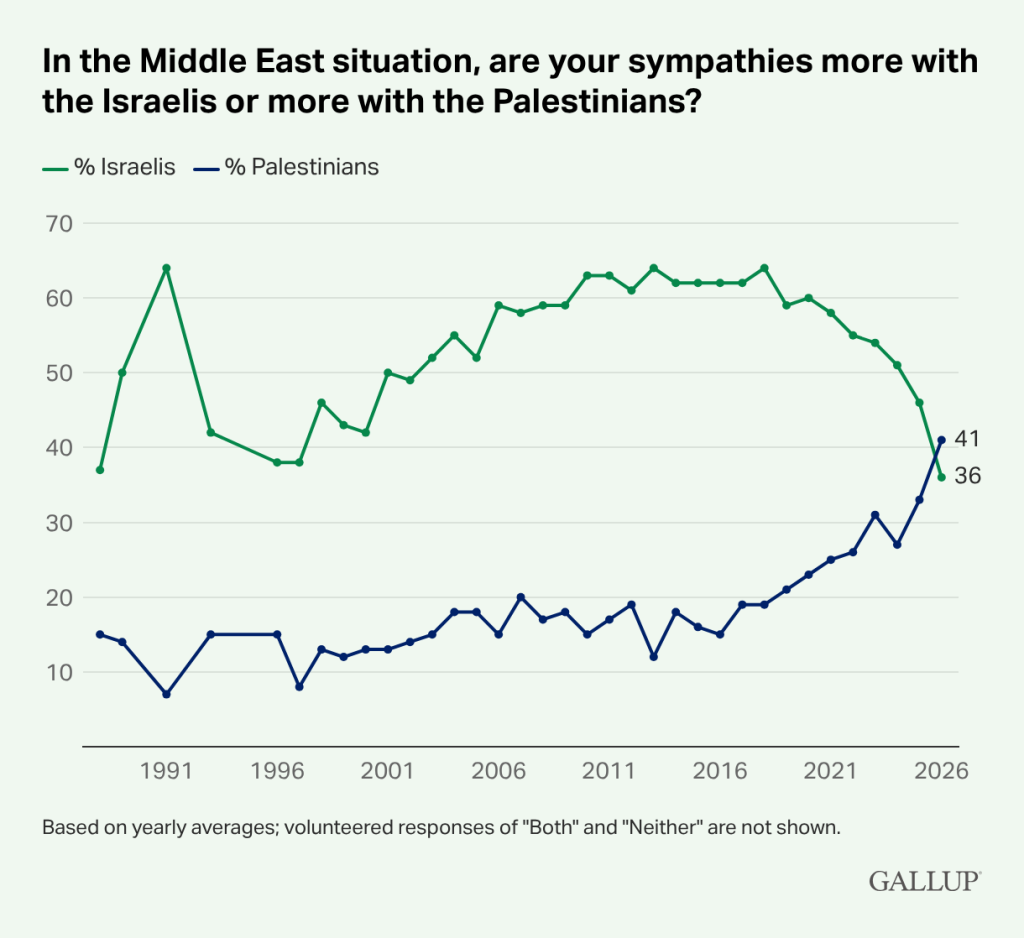
Telhami used Gallup Poll data to illustrate the scale of the overall reversal: Sympathy for Israel among all Americans fell from roughly 50% to 36%, while sympathy for Palestinians rose to 41%. Among Democrats specifically, the shift was described as “stunning”—support for Israel plummeted from over 50% in 2001 to roughly 17% in recent polling, while sympathy for Palestinians rose to 65%. Republican attitudes, by contrast, remained largely stable or even slightly strengthened in favor of Israel—with one critical exception.
A Generational Gap in Both Parties
Telhami’s data show a narrowing generational gap among Democrats and growing gap among Republicans.
Pew polling cited by Telhami showed that among Democrats, the gap between younger and older cohorts on unfavorable views of Israel has nearly disappeared (71% vs. 66%). Between 2022 and 2025, younger and older Democrats turned more negative toward Israel, but negative views among younger Democrats grew by 9 percent, compared with a 23-point increase among older Democrats.
Even more notable is movement among younger Republicans: Unfavorable views of Israel in this group rose from 35% to 57% in a short span—a shift Telhami called evidence that this is “spreading to more segments of society,” not confined to the political left.
Telhami’s research on evangelicals demonstrated that younger evangelicals, unlike their elders, were “walking away” from unconditional support for Israel.
When asked whether Israel’s actions in Gaza were “justified” as self-defense, only 22% of young Republicans responding to Telhami’s poll agreed, compared to 52% of older Republicans.
Why Now? Drivers of the Shift
Telhami outlined several interlocking explanations for why this issue has moved from the margins to the center of American political consciousness:
Rising priority for those attuned to the issue: Drawing on decades-old research with colleague Jon Krosnick, Telhami explained that policy influence depends less on broad public opinion than on “issue publics”—segments who rank an issue as a top priority. Historically, this issue public was small but overwhelmingly pro-Israel. Now, younger Democrats increasingly rank Israel-Palestine as a high concern, possibly because they view it as emblematic of broader commitments to human rights and democracy.
Perceptions of genocide and American complicity: Telhami’s polling shows substantial and growing numbers of Americans—including a plurality of the general public and majorities of Democrats—describing Israel’s actions in Gaza as “genocide” or “major war crimes akin to genocide.” More than 60% of respondents said U.S. military and diplomatic support actively enabled these actions, tying the issue directly to American foreign policy rather than treating it as a distant humanitarian concern.
The Iran War as an accelerant: Telhami argued that the U.S. strike on Iran transformed the issue from a foreign policy question into what he called a “pocketbook issue,” linked tangibly to energy prices and inflation. Public discourse increasingly framed the war as one the U.S. entered on behalf of Israel and Netanyahu.
A “permission structure” for criticism: Telhami theorized that a social and psychological threshold had been crossed: Once enough people began publicly criticizing Israel, others who privately held similar views felt emboldened to speak out, having previously assumed they were in the minority. Telhami’s polling of the public and of scholars of political science has directly asked whether and why Americans have self-censored in sharing their views on Israel-Palestine. Pre-war, more than 60% of scholars reported feeling the need to self-censor when discussing Israel-Palestine professionally, with the overwhelming majority citing fear of appearing critical of Israel. That figure rose above 80% after October 7. Extending this research to the general public, Telhami found that 42% of Americans say they feel the need to be “careful” discussing the Israeli-Palestinian conflict in public—compared to only 29% who say the same about Russia-Ukraine.
Looking Ahead: Fragility, Wild Cards, and Electoral Consequences
Telhami closed with reflections on the durability of this shift and its political stakes:
Israeli elections: While some observers hope a new Israeli government might ease American concerns, polling data suggests dissatisfaction with Israel runs deeper than opposition to Netanyahu personally.
Islamophobia as a “wild card”: Telhami highlighted dramatically rising unfavorable views of Muslims among Republicans—now at a 12-year high—which could continue to anchor pro-Israel sentiment within the GOP even as other factors erode it.
Trump and Republican fragility: Telhami argued that Republican support for Israel is more fragile than commonly assumed, and that anchoring this support in this moment is is President Trump’s personal backing of Israel. A political shift in course from the GOP might not result in major backlash from the evangelical base that supports Trump for reasons unrelated to Israel.
Electoral consequences: Telhami argued that the Israel-Palestine issue contributed to Democratic losses in 2024, including Kamala Harris’s defeat, citing both polling data and firsthand knowledge of internal campaign dynamics. He suggested the upcoming midterms will reveal how durable this electoral effect proves to be, with races like those in Texas potentially offering more revealing tests than reliably Democratic states like Michigan.
While acknowledging uncertainty about how this shift will translate into concrete policy outcomes that are never purely a function of public opinion, Telhami asserted: “Public opinion will matter more on this issue than it has in the past. I have no doubt about that.”
This post was written by Tevah Platt, who manages communications for the Center for Political Studies at the University of Michigan Institute for Social Research. It is based on Telhami’s presentation on Oct. 14, 2026 in the CPS Interdisciplinary Workshop on Politics and Policy.
Learn more: Telhami’s newly released 2026 Critical Issues Poll data tracks prejudice toward Jews and Muslims among the American public, and also measures change in how Americans define antisemitism and the extent to which they differentiate attitudes against Jews and Judaism from attitudes against Israel and Zionism.
When we think about how political beliefs are formed, conventional wisdom points to parents as the primary teachers—passing down party loyalties, civic values, and political knowledge to their children from an early age. But what happens when parents themselves are navigating an unfamiliar political landscape?
In his forthcoming book Information Brokers: Political Socialization in Latino Immigrant Families (University of Chicago Press, July 2026), political scientist Roberto F. Carlos upends traditional assumptions by investigating a reversal of roles that unfolds in many Latino immigrant households: It is the children who teach the parents about American politics.
When children influence political engagement
“Young children, particularly in immigrant households, often help their parents navigate life in the United States by acting as key sources of information,” writes Carlos, who rigorously provides evidence that this responsibility grants children influence over their parents’ political engagement, “with children shaping their immigrant parents’ political perspectives and decisions.”
These dynamics may be key to understanding political engagement and disengagement among Latinos, the largest ethnic minority group in the United States. Two-thirds of this population are either immigrants or the children of immigrants.
Carlos’s previous research examined the “prolonged partisan socialization process” experienced by second-generation Americans; in his 2018 article “Late to the Party,” he demonstrated that children of immigrants often grow up without the parental partisan transmission that mainstream theories take for granted. Because many immigrant parents arrive in the United States without deep familiarity with the American party system—hindered by language barriers, economic pressures, fear of deportation, and lingering ties to the politics of their home countries—they are frequently unable to map their values onto U.S. political parties early enough to pass a partisan identity along to their children. Information Brokers asks what happens to children who lack parental political guidance, but also what happens when those children become the guides themselves.
‘Information brokers’
The book’s central argument is that children of Latino immigrants function as “information brokers”—active agents who translate, interpret, and mediate the American political world for their parents. As immigrant parents navigate unfamiliar institutions, they often turn to their U.S.-educated children for help with everything from understanding government paperwork to making sense of elections and civic engagement. This brokering role places unique responsibilities on young people, granting them an unusual degree of influence over major household decisions, including political ones. When children advocate, explain, or intervene on behalf of their parents, Carlos argues, they are engaging in politically consequential behavior that shapes the attitudes and actions of both generations.
Carlos’s research draws on six original surveys and multiple survey experiments; he also gives a descriptive account of two young Latina women brokering information in response to the imminent passage of the Texas Senate Bill 4, which targeted undocumented immigrants for deportation in 2017. Their experiences illustrate how “information, obligation, and agency, often working in tandem, can serve as catalysts for immigrant households’ participation in the political sphere.” Often, the children of immigrants step up to fill an important informational void, out of necessity.
Political Implications
Countering a narrative that portrays lower rates of partisan identification and voter turnout as signs of apathy or disengagement, Carlos’s research suggests these patterns reflect a socialization process that unfolds differently—and often more slowly—in immigrant communities. Children who broker political information for their families are not disengaged; they are learning politics through direct, high-stakes experience. This could be a valuable insight for activities, politicians, and party strategists who can direct their attention to mobilizing the second generation, says Carlos. “I believe this book provides a significant cause for optimism when it comes to engaging the Latino community.”
This book also says something about today’s political climate as it relates to immigration and the way it is enforced. As Carlos recently noted in the Midwest Political Science Association (MPSA) town hall roundtable on rising authoritarianism in the U.S., children– especially those with mixed-status families– are forced to learn politics because they are helping their parents manage risk. They learn how state power works because they are the ones explaining it, translating it, and sometimes trying to protect their families from it. “That is political socialization under conditions of enforcement,” said Carlos. “It is not civics as we usually imagine it. It is not learning about voting or Congress or the three branches of government in a classroom. It is learning that the state can enter your family’s life through a traffic stop, a workplace raid, a court notice, a school absence, or a rumor that ICE is nearby. It is learning that politics is not distant. It is not abstract. It is protection or vulnerability.”
Carlos provides two striking statistics citing Vox journalist Christian Paz: One out of five people living in the United States is Latino, and every 30 seconds, a member of the Latino community becomes eligible to vote. As the 2026 midterm elections loom, Carlos’s new book provides a fresh perspective on a powerful voting bloc whose engagement could play a decisive role in election outcomes.
Roberto Carlos is an Assistant Professor in the Department of Political Science at the University of Michigan, and an affiliate of the Center for Political Studies at the Institute for Social Research. His research lies at the intersection of race, ethnicity, and politics, focusing on Latinx political behavior, immigration, and political socialization.
This post was developed by Tevah Platt, who manages communications for the Center for Political Studies.
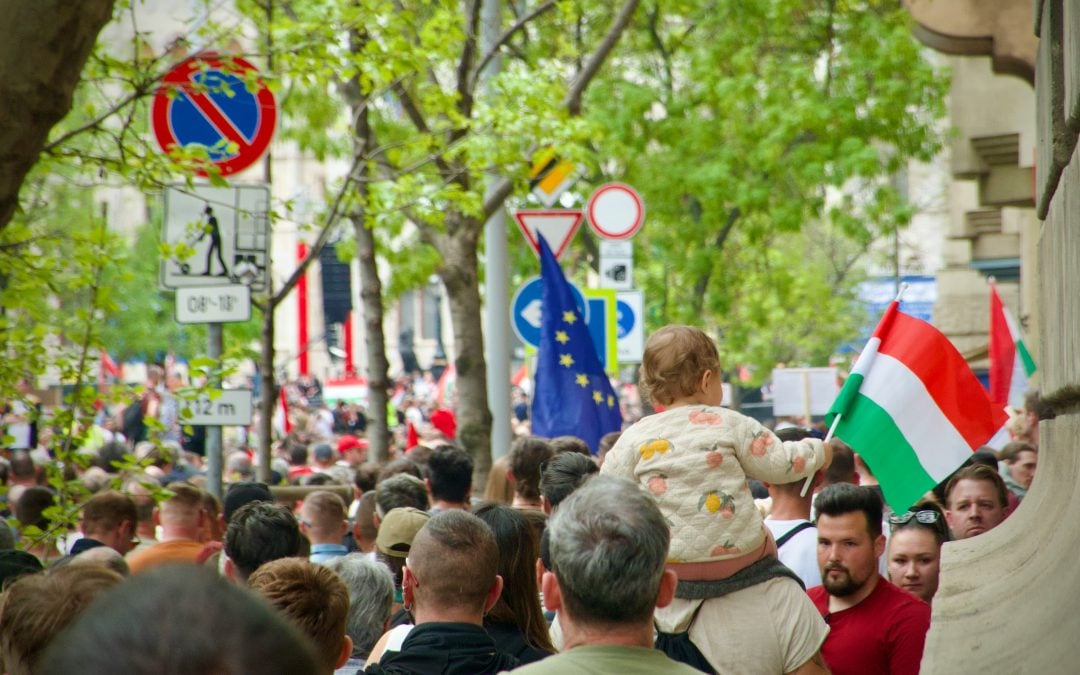
Victor Orbán, Prime Minister of Hungary for sixteen years (2010-26), has conceded the election to Peter Magyar and his opposition Tisza party. This is an enormous defeat for the right-wing populist leader and his right-wing populist Fidesz party and a landslide victory for the democratic opposition.
Parliamentary Supermajority for the Opposition Provides Lever to Rebuild Democracy
By winning more than 135 seats in the 199-seat legislative body, Magyar’s Tisza party has not just secured a majority but a supermajority in the Hungarian parliament. Orbán’s Fidesz party has held a parliamentary supermajority for four consecutive terms, which he has used to rewrite the constitution to consolidate his own power and to undermine democracy and the rule of law in Hungary.
Many of the tactics he used are part of the authoritarian playbook that is by now all too familiar—eliminating checks and balances on executive authority, taking control over media outlets, and reengineering the electoral system to disadvantage the opposition. Regaining control will enable the opposition to amend the constitution, reverse many of these changes, and rebuild institutions that promote democracy and the rule of law.
Yet, the landslide victory is not only a triumph for Hungary’s democratic opposition and the country’s future trajectory; it is also a major win for Europe, the European Union (EU), Ukraine, and the US.
Hope for a Strong and United Europe
The defeat of Orbán and his nationalist agenda signals to Europe, and to Europeans, that the rise of right-wing populism is not irreversible. Although not yet the dominant trend across the continent, far-right parties such as Orbán’s Fidesz have been gaining ground in Europe since the 2000s and appeared to be building momentum. Moreover, Orbán himself has become an iconic figure among them, exemplifying the success of illiberal democracy. The sweeping electoral victory of the liberal opposition in Hungary has countered this trend and diminished Orbán’s appeal as a model for Europe’s future. Instead, he is a cautionary tale.
Second, Orban’s defeat signals that Hungarians have not rejected either Europe or European values, including liberal democracy. As many European leaders stated following the election results, there is renewed hope for a strong and united Europe.
The primary beneficiary of this reunion—at least in the short run—is Ukraine. Among the many ways in which Orbán has undermined the EU is his refusal to support either further assistance to Ukraine or stricter sanctions against Russia following Russia’s full-scale invasion of Ukraine in February 2022. As part of his electoral campaign, Magyar pledged to rebuild Hungary’s relationship with the EU. He made good on this promise following his victory by agreeing to unblock critical aid in the form of a 90-billion-euro ($103-billion) loan to Ukraine.
Takeaways for the US
The cautionary tale of Orbán’s defeat also suggests a prescriptive one for the United States. Both the large turnout and the substantial margins made the Tisza party’s electoral win too decisive for even Orbán to contest. But neither the size of the turnout nor the landslide victory happened overnight. Albeit weakened by Orban’s policies, Hungarian civil society continued to mobilize undaunted, and Hungarian citizens increasingly took to the streets to show Orban, his loyalists, and most importantly, their fellow citizens that they would not tolerate an autocratic takeover.
The road ahead will be difficult. Orbán not only succeeded in dismantling democratic institutions and the rule of law. He also used his unchecked authority to institute a system of crony capitalism, rewarding loyalists with control over key economic sectors and lucrative development contracts, and destroying Hungary’s economy in the process. In fact, the protests that amalgamated in the opposition’s massive victory focused on anti-corruption and pocket-book issues. So too did Magyar’s electoral campaign, signifying that this is a winning electoral strategy. The new government will have to both rebuild and restore confidence in democratic institutions and the rule of law while actively combating the corrupt practices that have fueled inflation and slowed economic recovery.
This post was written by Pauline Jones, Research Professor and Director of the University of Michigan Center for Political Studies. Pauline Jones is a Professor of Political Science and the Edie N. Goldenberg Endowed Director for the Michigan in Washington Program. She is an expert on politics in the former Soviet Union (including Kazakhstan, Kyrgyzstan and Russia) and on assessing the impact of mass protest in authoritarian regimes. She regularly teaches PoliSci140: Introduction to Comparative Politics and recently shared her insights on US democratic decline in global perspective. Dr. Jones is currently a fellow of the Center for Advanced Study in the Behavioral Sciences (CASBS) at Stanford University.
Democrats had a big night last week, sweeping key elections and winning by unexpected margins up and down the ballot. Voters showed up in high numbers for an “off” election year and sided with Democrats in the elections’ four major contests: The mayor’s race in New York City, the governors’ races in Virginia and New Jersey, and the redistricting measure Prop 50 in California.
Tyler Simko is an Assistant Professor of Political Science at the University of Michigan, and an affiliate of the Center for Political Studies at the Institute for Social Research. Simko specializes in U.S. state and local politics, political geography, and computational social science. He is applying this expertise as an elections analyst for CBS, and he shared with us about the experience of doing this work and the major takeaways from the 2025 elections.
Expert Q&A with CBS Elections Analyst Tyler Simko
The content has been lightly edited for length and clarity.
1. What were your top takeaways from the 2025 elections?
Two specific trends stick out to me.
First, this was a stronger performance for Democrats than many people expected.
The election outcomes were not especially surprising. For all four major races, the expected result going into election day happened—for example, most polls before election day saw Mamdani, Sherrill, Spanberger, and “yes” on Proposition 50 as the clear frontrunners.
However, the final margins in favor of Democrats were larger than many people expected. For example, most polls placed Mikie Sherrill as the favorite, but polling averages showed a lead of around 3-5 percentage points. The ultimate election was a blowout, with Sherrill ahead with a final margin around thirteen points. Abigail Spanberger won the governor’s race in Virginia by even more.
The second major takeaway for me was that early analysis suggests that some of the “red shift” we saw in 2024 among groups like Latinos may have reverted back toward Democrats.
For example, high-Latino communities in New Jersey saw huge reversals toward Sherrill from the way residents in those same places voted in 2024 for Harris.
Results like these suggest that some of the shifts we saw in 2024 may not be set in stone. Charles Stewart III, another election analyst on the team and a Professor at MIT, has suggested this might be evidence that 2024 was a “deviating election,” rather than a new normal, citing research originally developed at the University of Michigan in the 1960s.
2. Was there anything notable about turnout for this election?
Turnout was unusually high in nearly every race on Tuesday night. In some ways, this is surprising because 2025 is an “off” election year without presidential or congressional midterm elections.
However, this high turnout reflects just how salient politics is for many Americans right now.
For example, early voting and election day turnout in the NYC mayoral election eclipsed the last election in 2021. This continued the trend we saw in the primary, where early voting more than doubled turnout in the last primary that elected Eric Adams. Turnout in other races was high as well, like California’s Proposition 50 measure on redistricting.
Further, it’s especially interesting to see where turnout was higher compared to past elections.
Patterns in turnout changes can offer insight into where voters are particularly energized right now.
For example, I wrote for CBS that many Democratic-leaning areas in New Jersey saw huge surges in turnout (some nearly 40% higher than the last gubernatorial election in 2021). This suggests that Democrats are particularly politically motivated right now, a trend that party leaders will hope continues into next year’s midterm elections.
3. What do you do as an Election Analyst on the CBS News Data Desk?
For this past election night on November 4th, I worked in the CBS Office in New York City alongside a team of other analysts to predict and analyze the elections for NYC Mayor, NJ/VA Governor, and California’s Prop. 50 redistricting referendum.
On election night the Data Desk is focused on forecasting voter turnout and predicting election results. We analyze data like exit polls and election returns as they come in, and look for interesting patterns. As with any network, one of our primary roles is to “call” the election winners.
But beyond calling the races, we’re also actively monitoring other data beyond vote shares. For example, the NYC Board of Elections frequently updates their “check-in” turnout numbers throughout the day. We use these records to help improve our turnout forecasts, which help us identify patterns early in the night. For example, even before election night, strong early voting in New Jersey’s Democratic-leaning areas suggested it would be a good night for Mikie Sherrill.
Finally, a good deal of work happens both before and after the elections too. For example, some members of the team prepare products like the CBS Exit Polls in preparation for election day.
Similarly, after election day there is a ton of new data to analyze. For example, the morning after election day, Kabir Khanna (Director, Election Analytics & Technical Systems at CBS) and I wrote an article for CBS News demonstrating how high turnout in Democratic-leaning counties strongly favored Sherrill. We’ll continue conducting this kind of analysis in the coming weeks.
4. What are the goals of this work, and how do your expertise and skills meet the needs of delivering election results and analysis?
Predicting election results (before they happen) and analyzing returns (after they happen) require knowledge of both electoral systems and statistics. At the University of Michigan, I teach courses on American Politics and Political Methodology in the Political Science department and research topics in political institutions and computational social science, so this kind of work is right up my alley. You know, I used real data from election night for an interactive prediction activity in my graduate-level Machine Learning course this past week.
Calling election results is a classic prediction problem. You don’t have complete information before election night is over, but you would like to use statistical “signals” to make data-driven predictions about what is going to happen. Often, we use statistical models because we want to detect patterns over the course of election night that may not be clear from simply counting returns as they come in.
For example, imagine a hypothetical situation where votes for NYC Mayor from Staten Island all come in first, early on election night. A simple “counting” approach would predict Andrew Cuomo had a large lead in the mayoral election because he had strong support in Staten Island, while in reality Mamdani clearly won overall. Statistical models help account for these patterns like geographic segregation in candidate support. Training in both political science and statistics/data science helps.
5. What are the future implications of the 2025 election results?
I think this set of results has two important implications:
First, this strong Democratic win will change the political dynamics over the next year as we head into the midterms. In the meantime, these results also give national Democrats more leverage in ongoing debates like the government shutdown.
We also might see these results change political rhetoric over the next few months. For example, Mamdani’s campaign focused on affordability and we have already seen Trump adopting this language in recent interviews.
The second major signal comes from the strong passage of California’s Proposition 50. This result greenlights Democratic efforts to push back against the new Texas redistricting plan that made their existing gerrymander even more extreme.
Republicans currently have the lead in this redistricting “war” because they have aggressively gerrymandered maps in several states. But, Prop. 50 will likely embolden Democrats in states like Virginia to try gerrymandering their own favorable plans.
Some of my own research helps clarify the consequences of gerrymanders. My co-authors and I at the ALARM Project—a research group focused on political geography and public policy—have shown that gerrymandering makes congressional elections less competitive and less responsive to the will of voters. Our research also shows that these other states could learn from Michigan, as our independent redistricting commission helps ensure redistricting plans are more fair and less biased.
Tyler Simko is an Assistant Professor of Political Science at the University of Michigan, and an affiliate of the Center for Political Studies at the Institute for Social Research. This post was developed by Tyler Simko and Tevah Platt, communications manager for the Center for Political Studies.





 Roberto Carlos is an Assistant Professor in the Department of Political Science at the University of Michigan, and an affiliate of the