Jul 23, 2014 | ANES, Elections, National
Post developed by Vincent Hutchings, Hakeem Jefferson, and Katie Brown.
The following post elaborates on a presentation titled “Out of Options? Blacks and Support for the Democratic Party” that was delivered at the 2014 World Congress of the International Political Science Association (IPSA).

Photo credit: Thinkstock
In 2012, Barack Obama received 93% of the African American vote but just 39% of the White vote. This 55% disparity is bigger than vote gaps by education level (4%), gender (10%), age (16%), income (16%), and religion (28%). And this wasn’t about just the 2012 or 2008 elections, notable for the first appearance of a major ticket African American candidate, Barack Obama. Democratic candidates typically receive 85-95% of the Black vote in the United States. Why the near unanimity among Black voters?
Vincent Hutchings, Professor of Political Science and Research Professor in the Center for Political Studies (CPS), and Hakeem Jefferson, Ph.D. candidate in the department of Political Science and CPS affiliate, set out to answer this question.
Hutchings and Jefferson especially sought to shed light on the “Black Utility Heuristic.” First proposed by Michael Dawson, the Black Utility Heuristic holds that Blacks tend to assess what is in the best interests of their racial group as a proxy for judging what are the best political decisions for them individually. So, given the widespread perception that the Democratic Party is best for African Americans, many Blacks support this party even if – in the case of the middle-class and social conservatives – it might not be in their individual interests to do so. But despite the reliance on this theory by numerous scholars, there exists little empirical support that it can account for Blacks’ lopsided support for the Democratic Party.
Using American National Election Studies (ANES) data, Hutchings and Jefferson tested the Black Utility Heuristic against other potential explanations for the near-unanimous support among Blacks for the Democratic Party.
The 2012 ANES pre-election survey includes 511 Black respondents. Using this survey, the authors report that 90% of African Americans identify as Democrats and 55% strongly so, compared to 39% and 11% of Whites. Yet, when the authors looked at a 7-point measure of ideology, only 47% of Blacks identify as liberal while 45% identify as conservative in the United States.
Given the mismatch between political ideology (measured using the liberal-conservative continuum) and partisanship, the authors turned to other ways to measure political ideology: egalitarianism, moral traditionalism, and ideal role of government. On egalitarianism and size of government, Blacks were indeed considerably more liberal than Whites; there was not significant difference between the groups on morality.
Despite the ideological underpinnings of these questions, they only weakly correlate with the standard measure of political ideology. The strongest correlation was between egalitarianism and political ideology – at just 0.18 Among Blacks, this correlation jumps to 0.42 for Whites. (Correlation coefficients give a measure of fit between two variables. If the two variables move up and down in concert, this is a perfect correlation of 1; if there is no connection the correlation is 0.) Further, support for bigger government was the only ideological measure that was a statistically significant predictor of partisanship, which may suggest a need to rethink how we conceptualize and measure ideology as it pertains to African Americans.
So could the Black Utility Heuristic offer the best explanation of the overwhelming support for Democratic candidates among Black voters? To test this, the authors looked at the connection between believing that what happens to other African Americans affects the survey respondent’s own life and Democratic affiliation. This connection was not significant, directly countering Dawson’s Black Utility Heuristic. On the other hand, an alternative measure assessing the importance of in-group racial identity predicted identifying as a Democrat among Blacks.
Hutchings and Jefferson thus conclude that African Americans do not vote Democrat because of their ideological identity as liberals, or because of notions of linked fate. Instead, strong support for activist government and the importance of in-group racial identity seems to drive this trend.
Jun 24, 2014 | ANES, Elections, National
Post developed by Katie Brown and Spencer Piston.
The 2008 election in the United States featured the first black major party presidential candidate in U.S. history – Barack Obama. Obama won in a historic election. But was his victory margin narrower than it could have been? In particular, did racial prejudice erode Obama’s vote share among those whites expected to vote for him: strong Democrats?
Photo credit: Thinkstock
Center for Political Studies (CPS) affiliate and Ph.D. Candidate in Political Science at the University of Michigan Spencer Piston explored this question with co-author Yanna Krupnikov (Northwestern University) in a recent article published in Political Behavior.
The researchers identify a gap in the field. Where previous work focuses on the connection between prejudice and vote choice, few studies have considered the relationship between prejudice and turnout on Election Day.
The researchers evaluate the relationship between racial prejudice, strength of party identification, and turnout. They are especially interested in a situation in which a white voter, high in racial prejudice, is faced with a black candidate from her party. How will the voter vote? In this scenario, racial prejudice is pitted against party identification.
Examining 2008 data from the American National Election Studies and replicating their analyses with survey data from a wave of a 2007-2008 Associated Press-Yahoo! News-Stanford University study, the authors find that highly partisan and prejudiced voters often address the tension embodied in a black candidate from their party by not turning out to vote. Interestingly, the authors also test if this group would instead vote for the white Republican presidential candidate John McCain. They would not. This is because they cannot compromise on race or partisanship. Unable to compromise, they instead choose not to vote.
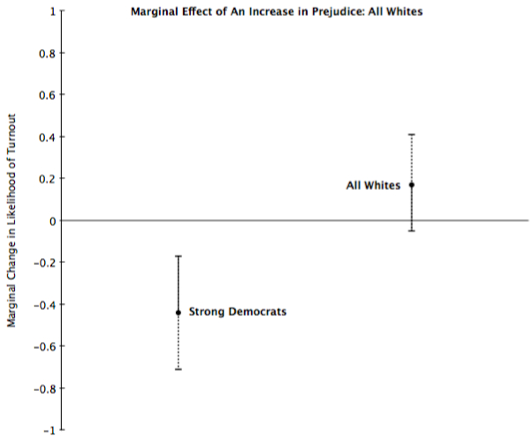
These findings have significant implications for American elections. The authors conclude, “Racial prejudice undermines black candidates’ efforts to mobilize strong partisans.”
Spencer Piston will join Syracuse University in the fall as an Assistant Professor of Political Science.
Jun 9, 2014 | ANES, ANES 65th Anniversary, National
Post developed by Katie Brown and Deborah Schildkraut.
 This post is part of a series celebrating the 65th anniversary of the American National Election Studies (ANES). The posts will seek to highlight some of the many ways in which the ANES has benefited scholarship, the public, and the advancement of science. Do you have ideas for additional posts? Please contact us by email ([email protected]) or Twitter (@umisrcps).
In this post, we consider the impact of ANES on teaching.
First, we hear from Tufts University Professor of Political Science Deborah Schildkraut, who shares her experience using ANES in the classroom. From Schildkraut:
ANES impacts my teaching in two key ways. First, I use raw ANES data in my lectures.Second, the research I rely on as I teach and that I think is really meaningful for my students includes:
All take advantage of the time series to help demonstrate both the importance of fundamentals and the role of particular events in shaping attitudes, behaviors, and election outcomes. And all are written at a level that combines sophisticated methods but approachability such that undergrads can engage with them.
Second, in a 1977 grant proposal to the American National Science Foundation (NSF), ANES founder Warren Miller outlined the current and potential use of ANES in teaching. This excerpt from the proposal encapsulates his analysis and vision:
The election data are even more widely used in activities related to teaching. Reports from the same roster of political scientists who were questioned about research use of the data indicate that the data were being used for teaching purposes in some 480 courses taken by more than 18,000 students… Given the reasonably short history of the systematic use of quantitative data by political science students in meeting course requirements, we were surprised to discover that three-quarters of the students using the data were actually undergraduates.
The hand typed table below from the 1977 proposal details the use of ANES (then called the Michigan Election Study) in the university classroom.
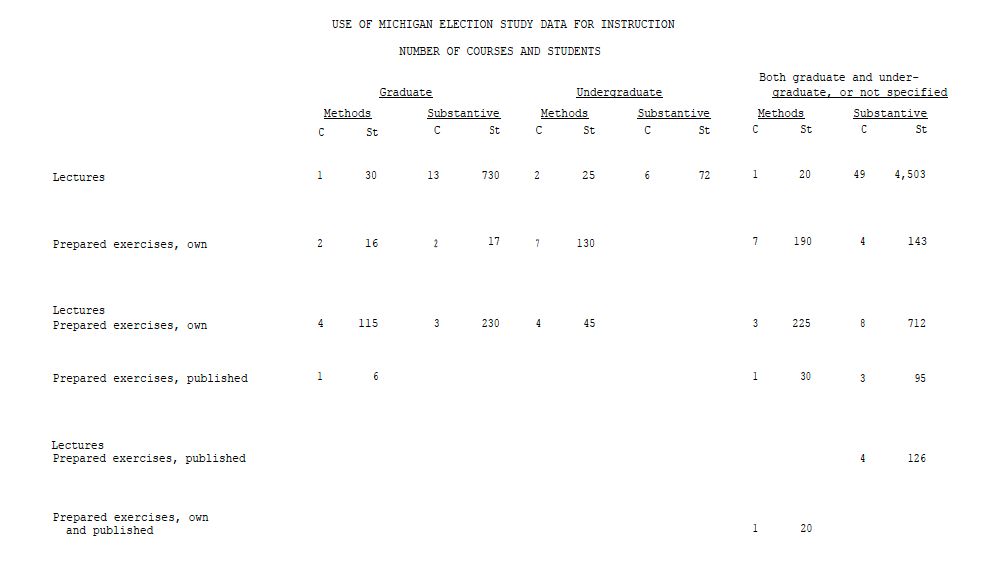
Miller then concluded, “The election studies promise to play an increasingly significant role in undergraduate teaching.” Professor Deborah Schildkraut’s use of ANES nearly forty years after the 1977 proposal demonstrates the continued reach of ANES in the classroom.
May 29, 2014 | ANES, Current Events, Innovative Methodology, National
Post developed by Katie Brown and Spencer Piston.
The gap between the rich and poor in the United States is growing. Occupy Wall Street, fast food worker strikes, and other manifestations of this gap make headlines often. And just a few weeks ago, President Obama visited the University of Michigan to champion raising the minimum wage.
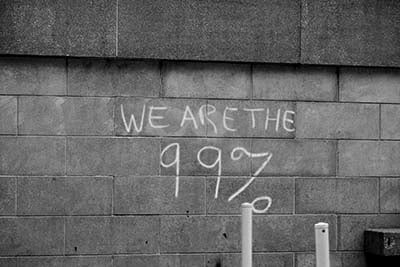
Photo credit: Thinkstock
Despite these movements, previous academic work suggests Americans look down on the poor. The news media perpetuate this message. The Economist claims, “Americans want to join the rich, not soak them,” while The New York Times published an article with the headline, “New Resentment of the Poor.”
But what if previous research and the mainstream media are wrong? What if anti-rich movements better capture the American ethos? Center for Political Studies (CPS) affiliate and Ph.D. candidate in Political Science at the University of Michigan Spencer Piston investigated this issue.
Piston addresses this question with an innovative approach. Previous scholarship measures attitudes with questions about “economic inequality” and “government-led redistribution.” But these are terms that survey respondents rarely use without prompting, and Piston finds reason to believe that many Americans don’t understand what these terms mean.
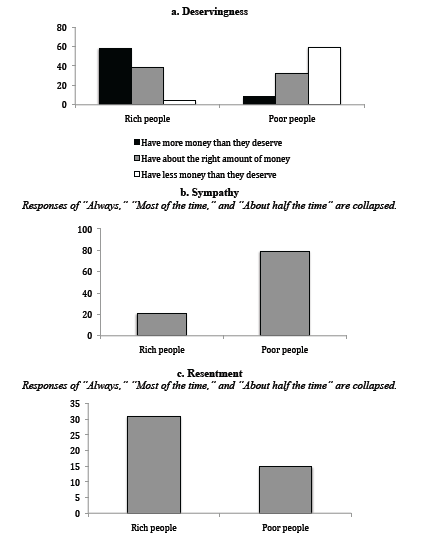
Piston therefore begins with a straightforward but rarely-used survey technique: he asks people how they feel about the poor and the rich. Piston examines answers to these questions using an original survey, and supplemented with American National Election Studies (ANES) data. The graphs below depict feelings of (a) deservingness, (b) sympathy, and (c) resentment toward and the rich and the poor. As we can see, people tend to see the rich as deserving less and the poor deserving more. They also see the poor as more sympathetic than the rich, and the rich as objects of more resentment than the poor.
Feelings toward the Rich and Poor
a. Do the (rich, poor) have more or less money than they deserve?
b. How often have you felt sympathy for (rich, poor) people?
c. How often have you felt resentment toward (rich, poor) people?
What effect might these Robin Hood attitudes have on elections? Piston tested this with several survey experiments. He finds that that a candidate who supports the poor garners more support among voters than an otherwise identical candidate who hurts the poor, regardless of the candidate’s party.
Effects of Candidate’s Record on Mean Support for the Candidate
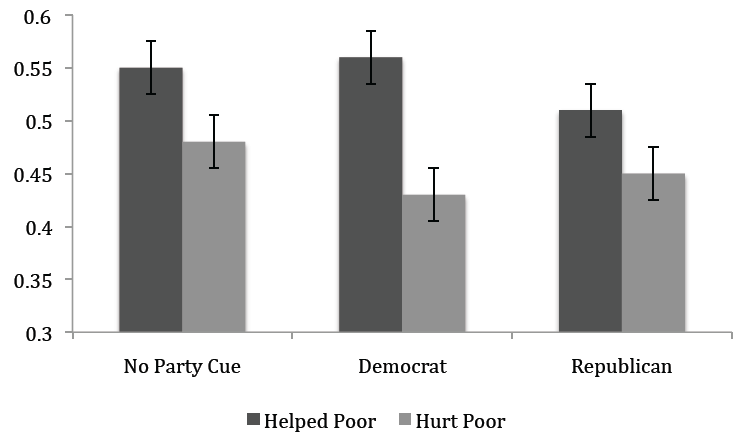
Taken together, these results suggest that previous research has overestimated public support for economic inequality and public opposition to downward redistribution. When survey questions are worded using terms that survey respondents more commonly use, it appears that many Americans want government to give more to the poor – and to take from the rich.
Spencer Piston will join Syracuse University in the fall as an Assistant Professor of Political Science.
May 8, 2014 | ANES, Current Events, National, Social Policy
Post developed by Katie Brown and Ashley Jardina.

Photo credit: Thinkstock
This month, Nevada rancher Cliven Bundy made headlines. What started as a battle against the U.S. Federal Government for his cattle and land turned into daily press conferences. As part of the Sovereign Movement, Bundy used the attention to propagate an anti-government agenda and racist ideas. Across the country at Princeton University, freshman Tal Fortgang also made headlines with his essay, “Checking my Privilege.” His championing of white privilege garnered backlash in the press. What do Bundy and Fortgang have in common? Both demonstrate reactions to a perceived status threat to whites.
Center for Political Studies (CPS) affiliate and Ph.D. Candidate in Political Science at the University of Michigan Ashley Jardina studies white identification. In particular, she argues that threats to dominant status make racial identity salient. Does this in turn influence support for political policies that could eliminate such status threats?
To answer this question, Jardina analyzed data from the American National Election Studies (ANES). Especially relevant is a measure of racial identity importance available for the first time in the 2012 ANES. This measure let Jardina gauge the extent to which white Americans feel that being white is important to their identity. She looks at whether this white identity relates attitudes toward policies (e.g., immigration) and candidates (e.g., Barack Obama) that exacerbate threats to white dominance. Immigration especially threatens whites’ dominance, because it drives demographic changes whereby whites are being displaced as the majority racial group in the nation. Likewise, as the country’s first African American president, Obama also represents a status threat.
Previous work has argued that out-group attitudes, either toward Hispanics or blacks, primarily drive whites’ attitudes toward immigration policy and support for Obama. But Jardina constructs models to explicitly test the relationship between in-group / out-group feelings. She finds in-group identity to be a more powerful and consistent predictor of restrictive immigration policies than out-group attitudes, including evaluations of Hispanics. Furthermore, whites who identified with their racial group were significantly less likely to vote for Obama, even after controlling for racial prejudice or resentment. Her results are replicated using two other datasets. Jardina concludes, “These results lend support for the notion that, in some important cases, a desire to protect the in-group, rather than dislike for the out-group, primarily drives opinion.”
Ashley Jardina will join Duke University in the fall as an Assistant Professor of Political Science.
Apr 16, 2014 | ANES, Current Events, National
Post developed by Katie Brown and Timothy Ryan

Photo credit: Thinkstock
Partisanship gets in the way of political progress. Hillary Clinton made this common claim last week. The lack of compromise inherent to partisanship is worth investigating. What causes such non-cooperation?
Timothy Ryan, a Ph.D. candidate in the University of Michigan’s Department of Political Science and affiliate of the Center for Political Studies (CPS), seeks to answer this question. In a paper presented at the 2013 meeting of the American Political Science Association – “No Compromise: Political Consequences of Moralized Attitudes” – Ryan ran four studies to understand non-cooperation.
Ryan’s overarching hypothesis boils non-compromise down to morals: a moral mindset orients citizens to oppose political compromises and punish compromising politicians. There are all kinds of issues for which some citizens seem resistant to compromises: tax reform, same-sex marriage, collective bargaining, etc. But who is resistant? Ryan shows that part of the answer has to do with who sees these issues through a moral lens.
Ryan tests moral conviction’s effect on compromise. Data come from the American National Elections Studies (ANES), as well as surveys of undergraduates, participants on Amazon’s Mechanical Turk, and citizens found via GfK Research (his work was made possible by a grant from the National Science Foundation (NSF)). Ryan also considers several types of compromises: hypothetical, actual, positions citizens want their elected officials to adopt, and a willingness to accept a monetary reward only if a disliked group (the Tea Party or the Progressive Change Campaign Committee) also receives a donation.
Participants with moral conviction around an issue are less likely to compromise. Hypothetical and real world compromises were hindered. Compromising politicians received less support. Personal gain was sacrificed to avoid the gain of the Tea Party (if a political adversary). As Ryan concludes, “Different attitude characteristics relate to compromise in different ways, with moral conviction being a particularly potent obstacle to compromise.”
In the fall, Ryan will continue his work on morality when he joins the faculty at the University of North Carolina at Chapel Hill as Assistant Professor of Political Science.