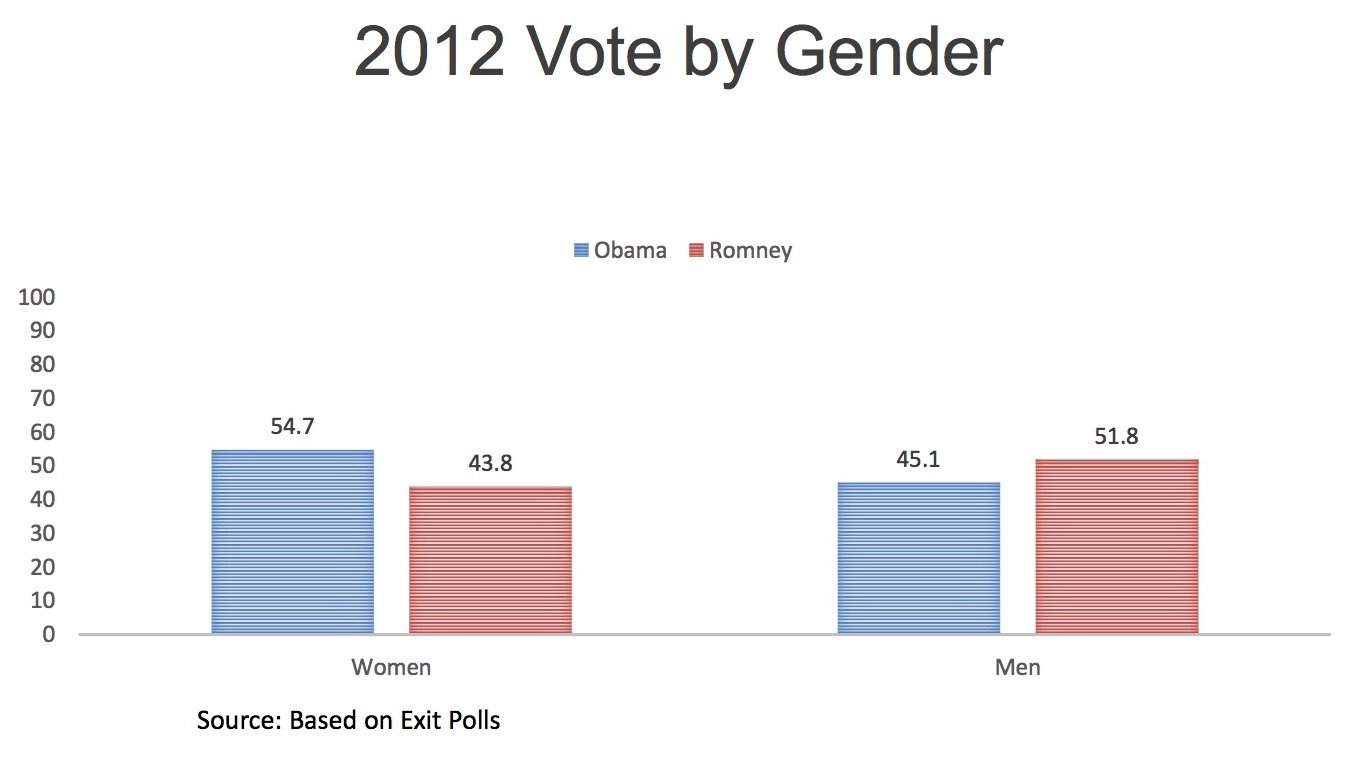
As of October, the latest national polls, predicted that the 2016 Election results will reflect the largest gender gap in vote choice in modern U.S. history. Today, according to NPR, “An average of three recent national polls shows that women prefer Clinton by roughly 13 points, while men prefer Trump by 12, totaling a 25-point gap.” If these polls prove true, the 2016 results would indicate a much larger gender gap than what was observed in 2012, where women overwhelmingly supported Barack Obama over Mitt Romney.
2012 vote by gender based on national exit poll conducted by Edison Media Research.
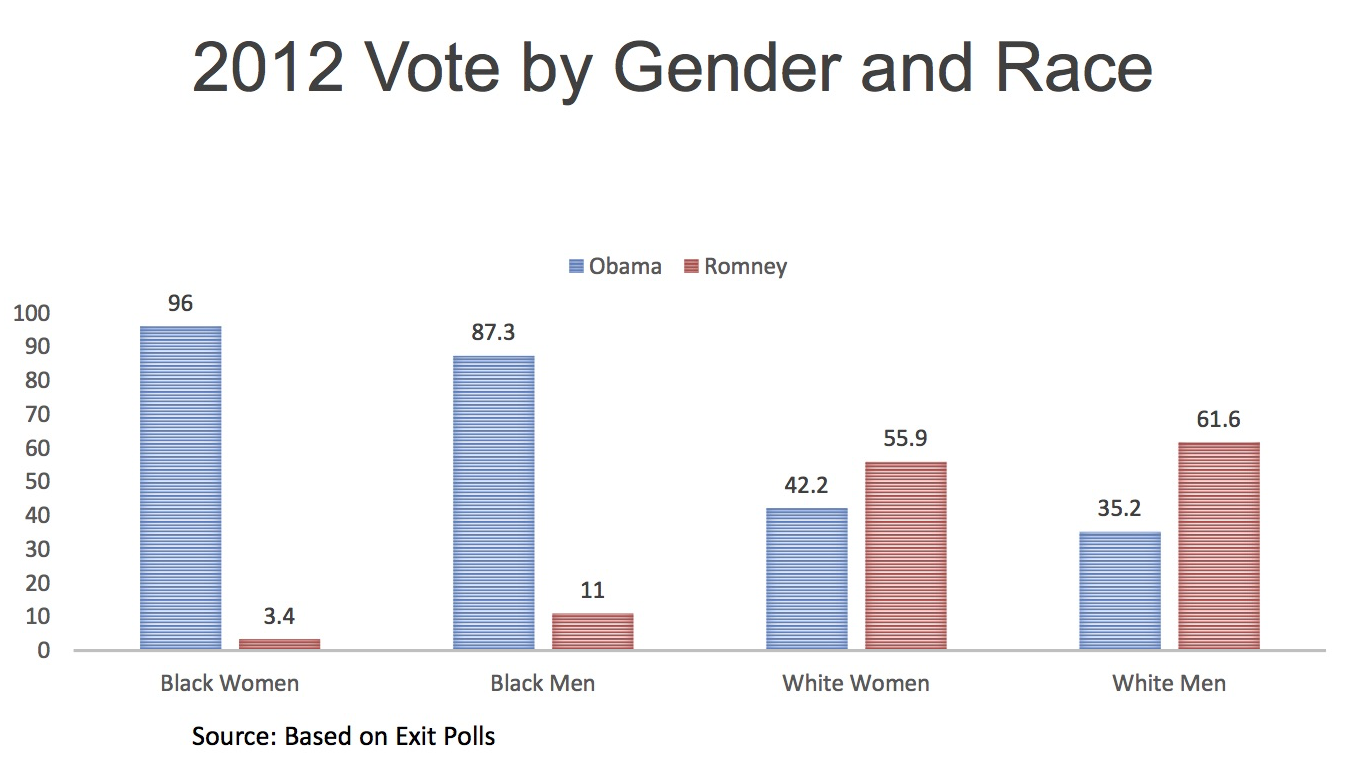
University of Texas at Austin Professor Tasha Philpot argues that what really may be driving this gap to even greater depths, is race. For instance, here’s the same data from the 2012 Election, broken down by gender and race.
2012 vote by gender and race based on national exit poll conducted by Edison Media Research.
Often overlooked in the discussion of the gender gap, race figures prominently into many American’s political identities.
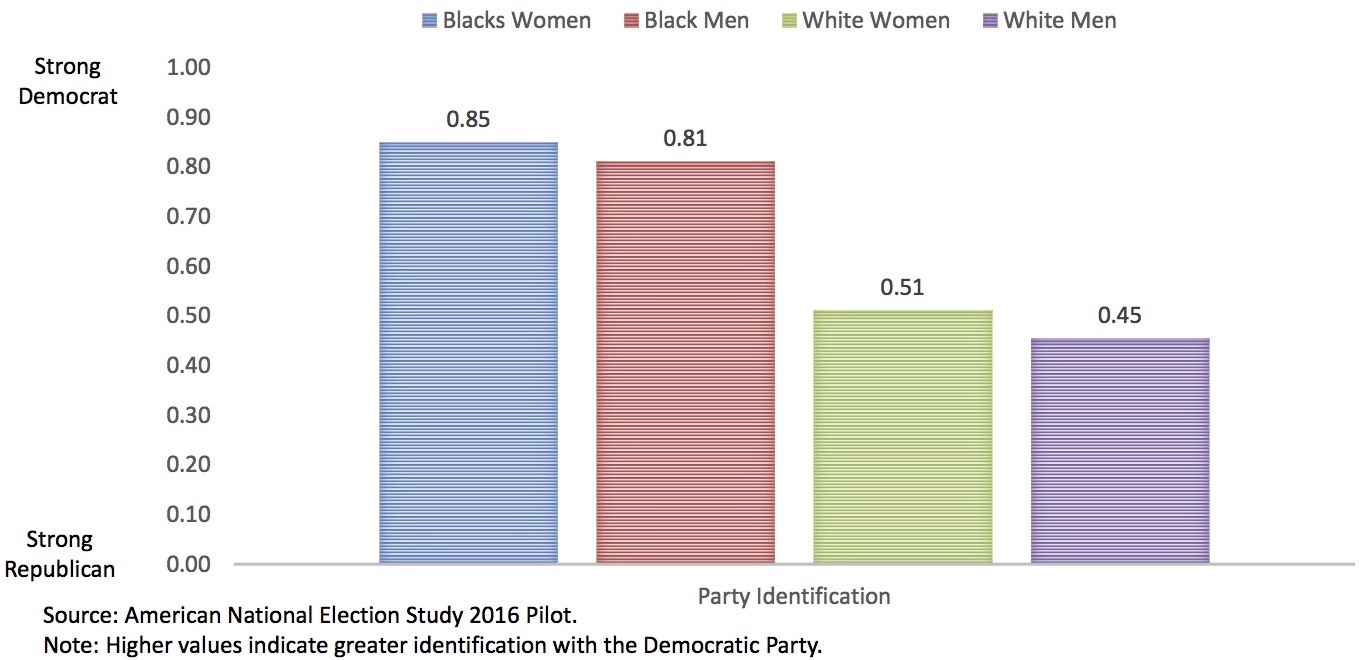
2016 Gender Gap in Party Identification
2016 Gender Gap in Party Identification.
Philpot recently participated in the panel “What We Know So Far About the 2016 Elections” at the University of Michigan’s Center for Political Studies. In her talk, “Race and the Gender Gap in the 2016 Election,” Philpot outlined the potential sources for the gender gap and emphasized the role that race is playing in widening the gap.
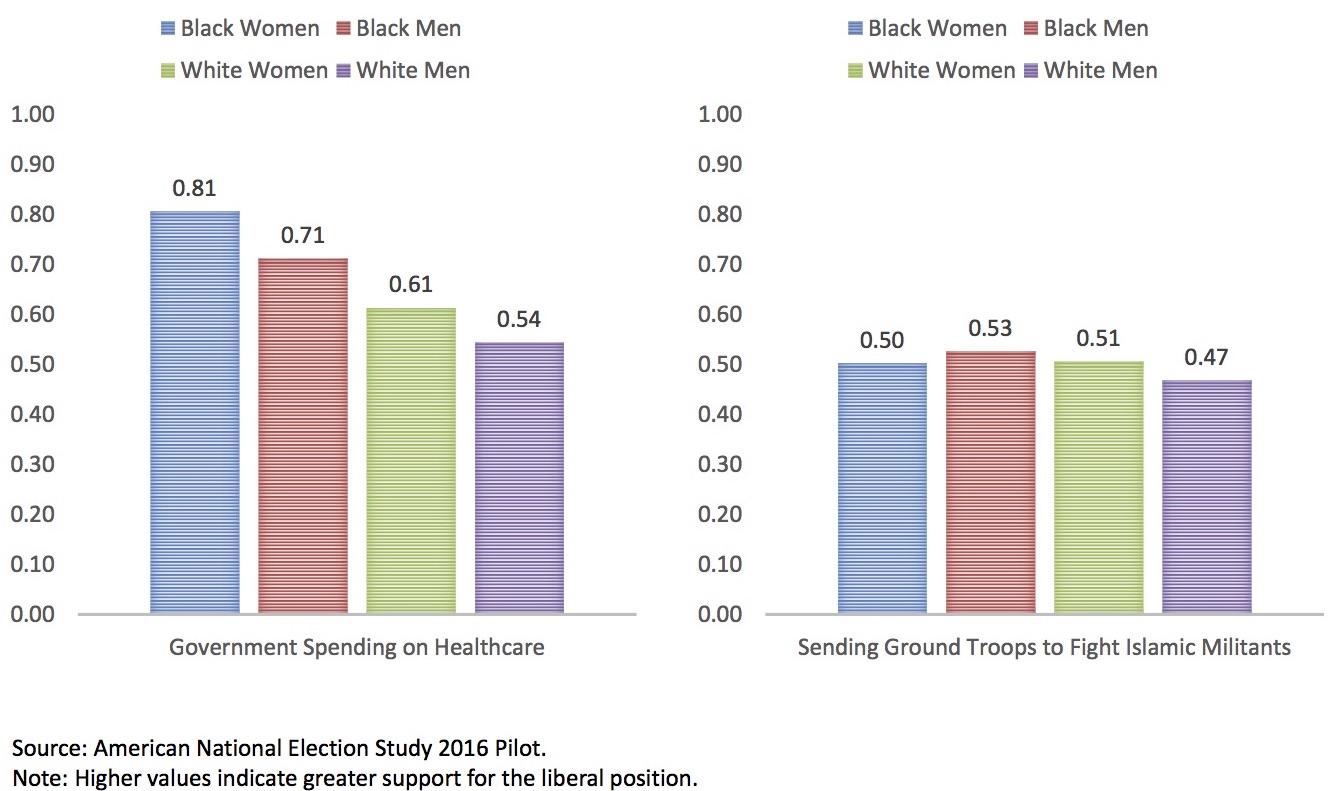
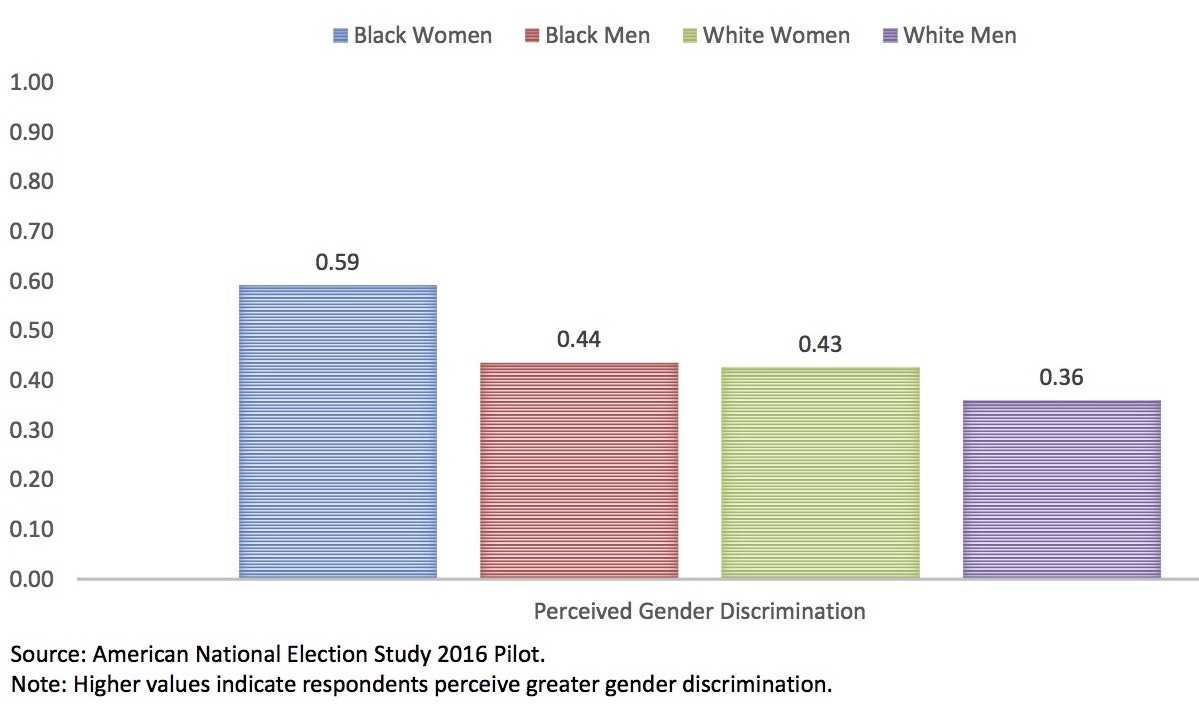
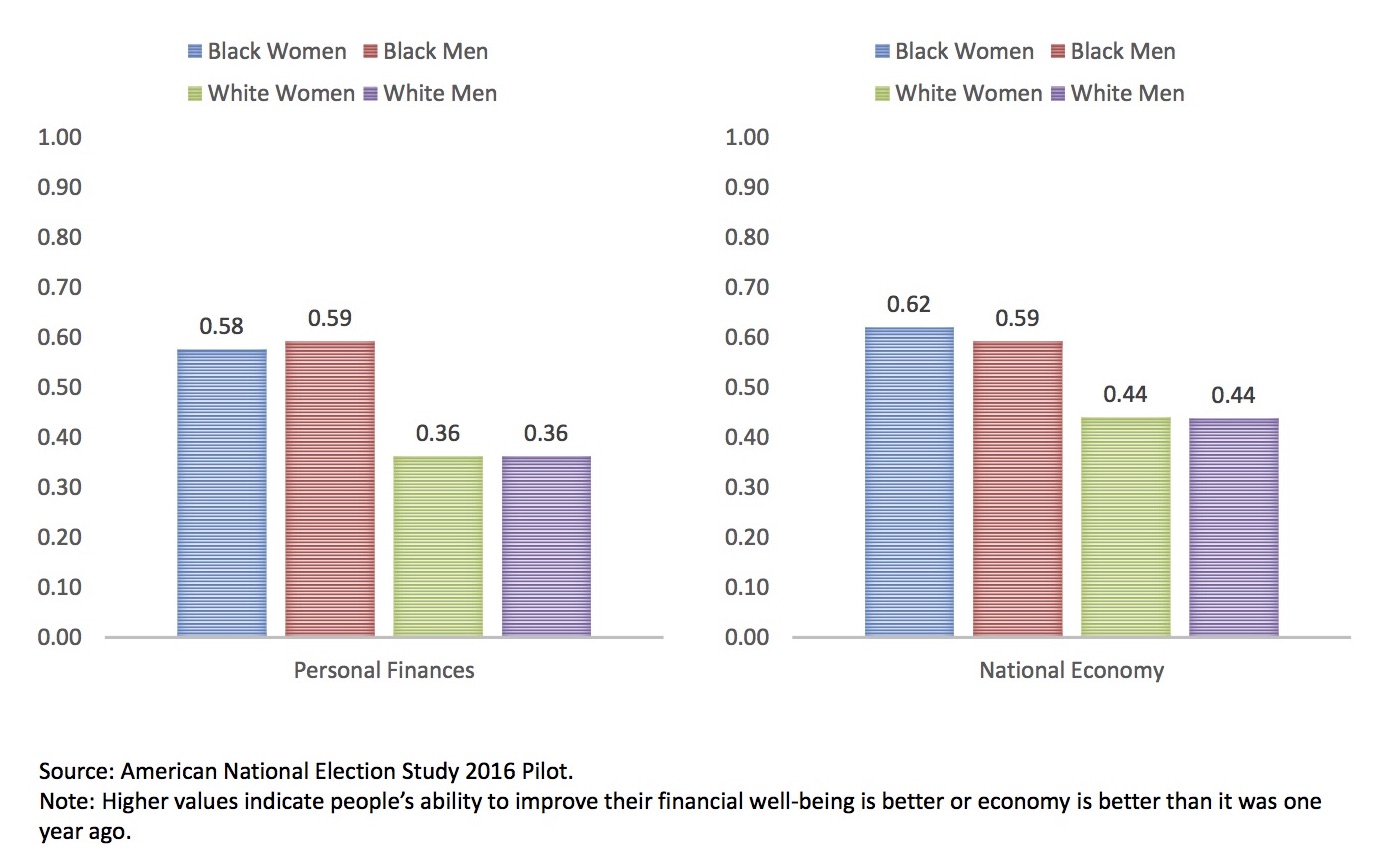
Using data from the ANES 2016 Pilot Study, Philpot compared opinions from white and black men and women on several issues such as government spending, inequality and discrimination, and evaluations of the economy. While there were noticeable differences strictly between men and women, the real story became clear when Philpot sorted the results by gender and race. Small gender gaps exist among both whites and blacks, but the most remarkable difference of opinions on all issues is between black women and white men.
SPENDING ON HEALTH CARE AND DEFENSE
2016 Gender Gap in Spending on Healthcare and Defense.
Perceived Gender Discrimination
2016 Gender Gap in Perceived Discrimination Based on Gender
Evaluations of the Economy
2016 Gender Gap in Economic Evaluations.
On most issues, black women and white men fall on opposite sides of the political spectrum. Philpot concludes that it’s an oversimplification to consider the gender gap as merely a gap between men and women, when, in reality, the observed gender gap is largest between white men and black women.
What We Know So Far About the 2016 Elections, was held on October 5, 2016 at the Center for Political Studies, University of Michigan. The panel also included the following talks:
Stuart Soroka: Read, Seen or Heard: A Text-Analytic Approach to Campaign Dynamics Nicholas Valentino: The Underappreciated Role of Sexism in the 2016 Presidential Race Michael Traugott: Pre-Election Polls in the 2016 Campaign
Post developed by Catherine Allen-West and Ozan Kuru.
ICYMI (In Case You Missed It) the following work was presented at the 2016 Annual Meeting of the American Political Science Association (APSA). The presentation, titled “Motivated Reasoning in the Perceived Credibility of Public Opinion Polls,” was part of the session “Surprises: A Magical Mystery Tour of Public Opinion and Political Psychology” on Saturday, September 3, 2016.
Polls have been an integral part of American democracy, political rhetoric, and news coverage since the 1930s. Today, there are new polls reported constantly, showing public opinion on a range of issues from the President’s approval rating to the direction of the country. Polls remain relevant because numbers and statistical evidence have always been regarded as sound evidence to support one’s beliefs or affirm their affiliations; similarly, polls are supposed to provide relatively objective information in politics.
However, despite their importance and ever-increasing prevalence, polls are often heavily criticized, both by the public and politicians, especially when they fail to predict election outcomes. Such criticisms and discounting of poll credibility is important, because people’s perceptions of polls matter. In such an environment, the perceived credibility of polls becomes an important issue for the public’s reception of poll findings, which then determines the likelihood of any meaningful impact of their results.
Post developed by Catherine Allen-West and Arthur Lupia
ICYMI (In Case You Missed It) this post details the Election Research Preacceptance Competition, organized by Arthur Lupia and Brendan Nyhan. Lupia discussed this initiative at the “Roundtable on the CPS Special Issue on Transparency in the Social Sciences” at APSA 2016 on Friday, September 2, 2016.
How can scholars study politics most effectively? The Election Research Preacceptance Competition (http://www.erpc2016.com) is an innovative initiative that will test a new approach to conducting and publishing political science research during the 2016 election.
Entrants in the competition will preregister a research design intended to study an important aspect of the 2016 general election using data collected by the American National Election Studies (ANES). A condition of entering the competition is that entrants must complete and register a design before the ANES data are released. Many leading academic journals have agreed to review scholarly articles that include these research plans and to review them before the data are available or results are known.
ICYMI (In Case You Missed It), the following work was presented at the 2015 Annual Meeting of the American Political Science Association (APSA). The presentation, titled “Election Frauds, Postelection Legal Challenges and Geography in Mexico,” was a part of the session “Detecting and Concealing Patterns in Data” on Saturday September 5th, 2015.
This new research by Mebane and Wall investigates if the numbers of casillas (i.e. ballot boxes) and votes challenged and nullified in Mexico reflect political strategies or genuine election irregularities. In the 2006 elections in Mexico, nullification petitions by runners up were filed against 21% of ballot boxes (27,109/130,788), even though only .56% of votes (237,736/41,791,322) were actually nullified. Similarly, in the 2012 elections, 22% of ballot boxes (32,151/143,132) were challenged and .38% of votes nullified (184,725/49,087,466).
Mebane and Wall examine how the types of nullification claims relate to ballot-box level measures of election fraud and whether the reasons cited for the challenges are uniform across the two elections and/or geography. That is, are complaints geographically clustered or does a complaint depend on geographically clustered frauds?
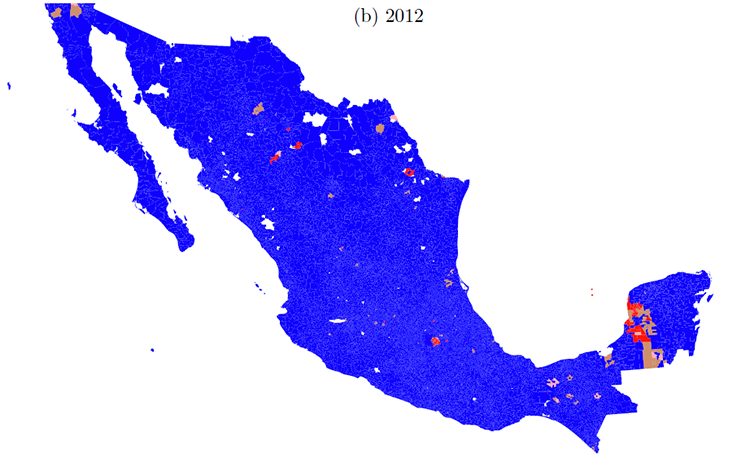
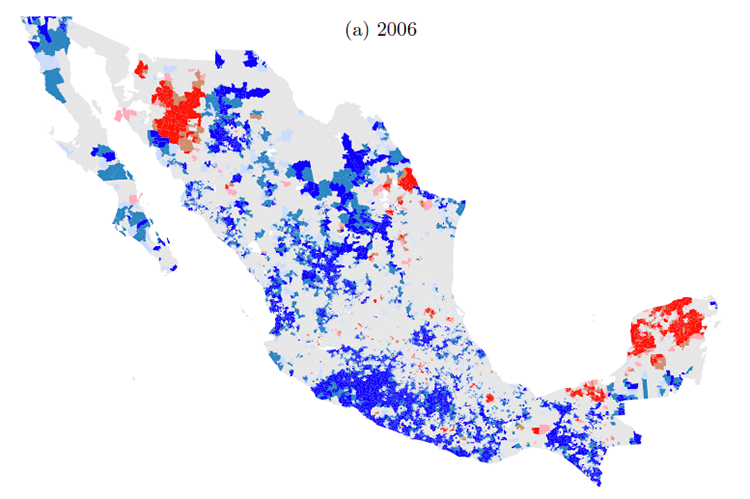
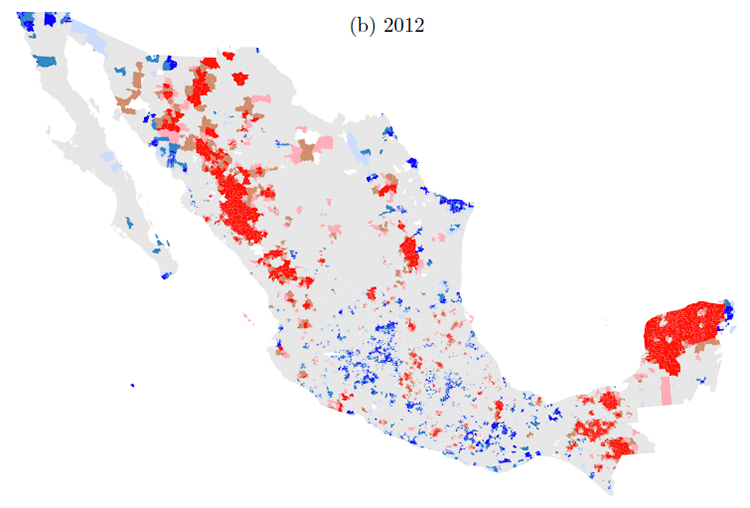
Ballot-box level measures of election fraud are estimated using casilla vote count data. Hotspot analysis is used to show how nullification petition challenges to casillas are distributed across geography. This technique identifies which locations have local means that are higher than the overall average values and which have local means that are lower than the overall average. A redder color indicates a cluster of locations with higher than average values, and a bluer color indicates a cluster of locations with lower than average values. Grey indicates a cluster of locations that does not differ significantly from the overall mean.
Figure 1 represents nullification complaints of type corresponding to willful misconduct or error in the vote count in the two Presidential elections, and Figure 2 represents incremental fraud probabilities for nullification complaints. Comparing Figure 2 to Figure 1 indicates that the pattern of geographic clustering for the incremental fraud probabilities does not correspond well with the pattern for nullification complaints.
Figure 1: Nullification complaints of type corresponding to willful misconduct or error in the vote count, Mexico, 2006 and 2012 Presidential election Casillas. Seccion (precint) geographic cluster hotspots
In 2006 there are more widespread regions with clusters of casillas having above average frequencies of complaints than there are regions in which there are clusters of casillas with above average incremental fraud probability values. Some of the above average type clusters overlap with above average incremental fraud clusters, but more than half do not. In 2012 on the other hand, we observe the opposite. Clusters of casillas with above average incremental fraud probabilities are much more prevalent than are clusters of casillas with above average frequencies of complaints.
Such patterns indicate that it is unlikely that the relationship between incremental fraud probabilities and the incidence of complaints are positively related. This therefore suggests that the occurrence of nullification petitions is related to the strategic and tactical incentives of political parties.
In many new democracies in developing countries, political parties are identified with particular ethnic groups, and voters tend to vote for the parties identified the same ethnicity as themselves – but not always.
Voters tend to believe that politicians will reward their co-ethnic supporters by building schools and health facilities and providing other services that benefit a limited local area. For voters who live among mostly people of their own ethnic group, it makes sense to vote for the party of their own group.
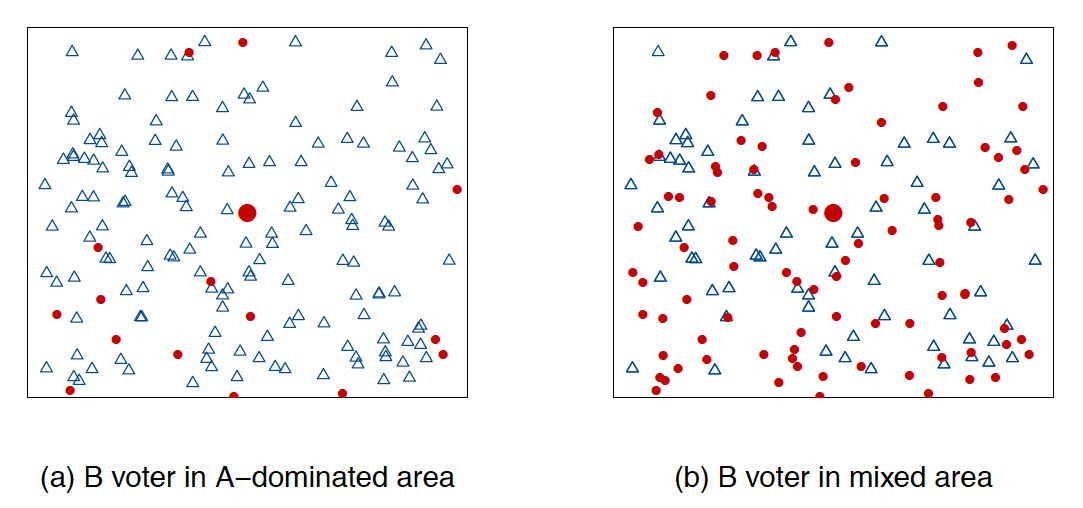
But voters sometimes find themselves living in an area dominated by another group or in a mixed area, and the calculation is more difficult. Take for example the first visualization (a) offered by the authors. A voter (circle) is surrounded by others of a different ethnicity (triangles). That voter might do better if a party of the other group (triangles) won the election and directed more benefits like schools to this area than if the party of her own group (circles) won the area and directed benefits to a different area with many of her own group (circles). If that same voter were in (b), where she is surrounded by more members of her own group (circles), then she becomes more likely to vote for the party of her own group than if she were in (a).
Voter Ethnicity Illustration
Ichino and Nathan tested these predictions Ghana. First, the authors mapped ethnic concentration and diversity with data from the 2000 Ghana Population and Housing Census. Then, they geocoded polling stations results to look at how elections results vary with local ethnic composition in rural areas.
Ichino and Nathan first focused on the 2008 presidential election results in Ghana’s Brong Ahafo, a region that is both rural and ethnically diverse and find support for their ideas. Polling stations in areas surrounded by more Akans had higher vote shares for the political party associated with the Akan. The authors also tested their hypothesis with survey results from the Afrobarometer. They similarly find that Ghanaians were more likely to intend to vote for a political party associated with an ethnic group when they were surrounded by more members of that group.
The authors believe their findings nuance the generally accepted idea that people in new democracies simply vote for candidates who share their ethnicity. Ichino and Nathan conclude that their study “demonstrates how local community and geographic contexts can modify the information conveyed by ethnicity and influence voter behavior.”
The inaugural Michigan Political Communication Workshop welcomed renowned political science and communication scholar Shanto Iyengar from Stanford University. Iyengar presented a talk entitled “Fear and Loathing across Party Lines.”
Iyengar began by considering the current polarized state of American politics. Both parties moving toward ideological poles has resulted in policy gridlock (see: government shutdown, debt ceiling negotiations). But does this polarization extend to the public in general? To answer this question, Iyengar measured individual resentment with both explicit and implicit measures.
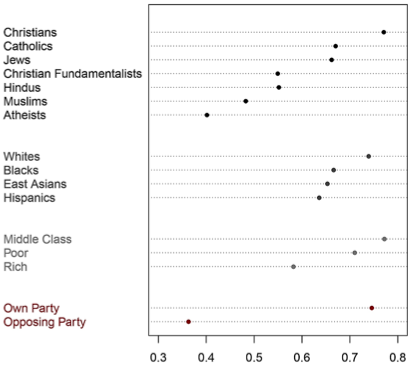
2008 ANES: Party vs Other Divisions
For an explicit measure, Iyengar turned to survey evidence. The American National Election Studies (ANES) indeed illustrates a significant decline in ratings of the other party based on feeling thermometer questions. Likewise, social distance between parties has increased over time, as measured by stereotypes of party supporters and marriage across party lines. In fact, this out-group animosity marks a deeper divide than other considerations, even race (see graph below).
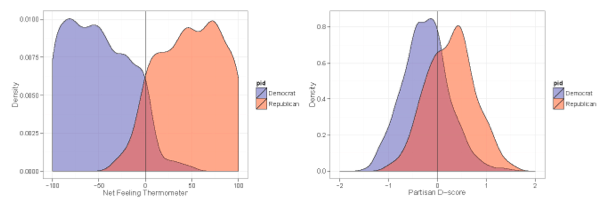
But these surveys gauge animosity at the conscious level. Iyengar also believes mental operations concerning out-party evaluations occur outside of conscious awareness. So, along with Sean J. Westwood, Iyengar pioneered implicit measures of out-party animosity. Specifically, Iyengar and Westwood adapted the Implicit Association Test— originally used to capture racism – to political parties. Interestingly, the IAT also captured this animosity, although the polarization was more pronounced with the explicit survey measures. The chart on the left shows the starker divide between Democrats and Republicans using the feeling thermometer; the chart on the right shows the difference with the IAT.
Comparing Implicit with Explicit Affect
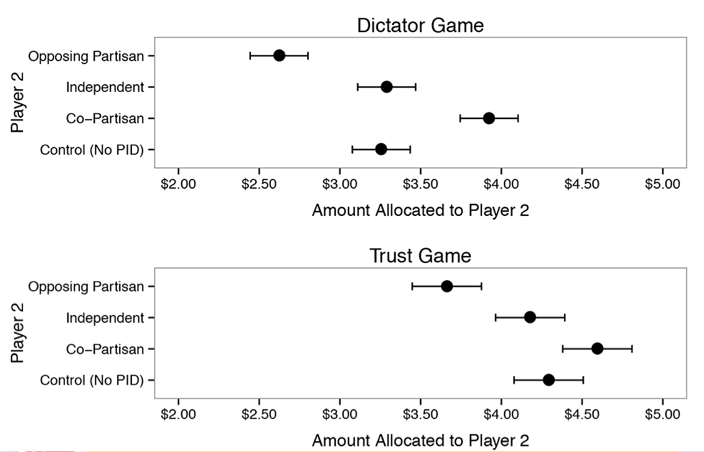
Iyengar also adapted classic economic games to test implicit out-party animosity. Both games allow the participant to share a proportion of money provided by the researchers. Interestingly, participants gave less to out-party opponents. Iyengar cites this as evidence of implicit out-party bias.
Economic Game Results by Party
Together, these results suggest marked party polarization. The hostility is so strong that politicians running on a bipartisan platform are likely to be out of step with public opinion.

 How can scholars study politics most effectively? The Election Research Preacceptance Competition (