Nov 3, 2014 | Elections, Innovative Methodology, National
Post developed by Katie Brown and Kristyn L. Karl.
It’s election time again. And elections bring advertising assaults by Internet, radio, and TV. In Michigan and Iowa, there is one political TV ad every two minutes. But what effect does this have on potential voters?
Center for Political Studies (CPS) affiliate and Ph.D. Candidate in Political Science at the University of Michigan Kristyn L. Karl investigated this question. Where previous research in this area uses self-reported measures of emotional response, Karl tackled the issue with a randomized experiment capturing a direct measure of physiological arousal – skin conductance. She was interested in the impact of emotional arousal from political ads on citizens’ intention to participate in politics.
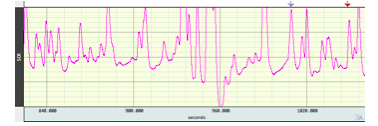
Sample Skin Conductance Output
For the study, Karl brought participants into the lab and measured their skin conductance while watching a political advertisement. The ad was fictitious and created in a way that gave Karl control over the message, images, music, and structure. Karl designed four ads: a positive Democratic or Republican ad, and attack ads on Democrats or Republicans. Participants randomly watched one of the four ads while their physiological arousal was captured; after the ad, they reported their current emotions and their willingness to participate with regard to 1) signing a petition, 2) initiating a conversation on a political topic, and 3) attending a meeting, rally, or demonstration.
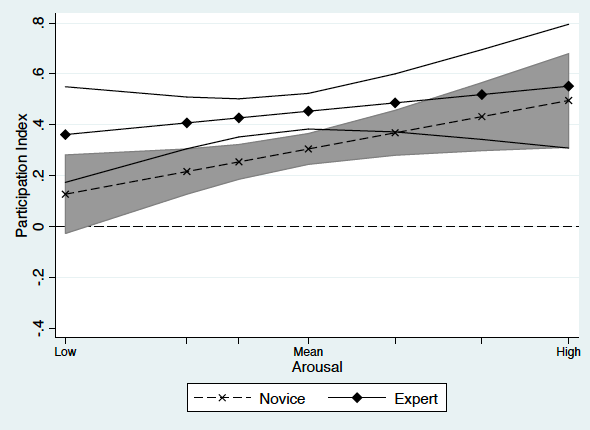
Karl finds some key differences between political novices and more experienced participants. For political novices, both physiological arousal and self-reported negative emotion positively predicted participation in politics. Among political experts, however, the connection between arousal, self-reported emotion, and intended participation is more muted. Specifically, while the trend is still positive, the effect fails to reach statistical significance.
The Marginal Effect of Physiological Arousal on Political Participation by Political Sophistication
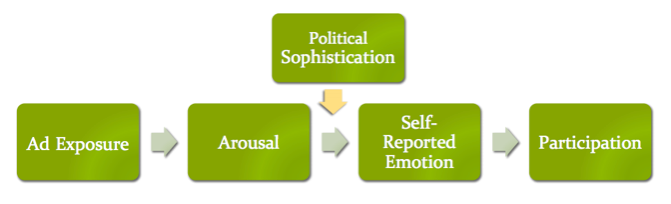
Karl turns to theory to explain the limited effect of arousal on intention to participate among experts. Experts have a well-developed cognitive network about politics which, for better or worse, allows them to more easily interpret and condition their emotional responses to political stimuli. Political novices do not have this expansive network and so react in a more instinctual way. The model below captures this:
This experiment highlights the importance of using alternative measures of emotional arousal as a complementary tool to self-reported measures. Moreover, it draws attention to the question of for whom political ads are motivating and how do they work.
Oct 31, 2014 | Elections, National
Post developed by Katie Brown and Josh Pasek.
Photo credit: ThinkStock
With each election cycle, the news media publicize day-to-day opinion polls, hoping to scoop election results. But surveys like these are blunt instruments. Or so says Center for Political Studies (CPS) Faculty Associate and Communication Studies Assistant Professor Josh Pasek.
Pasek pinpoints three main issues with current measures of vote choice. First, they do not account for day-to-day changes. Second, they capture the present moment as opposed to election day. Finally, they can be misleading due to sampling error or question wording.
Given these problems, Pasek searched for the most accurate way to combine surveys in order to predict elections. The results will be published in a forthcoming paper in Public Opinion Quarterly. Here, we highlight his main findings. Pasek breaks down three main strategies for pooling surveys: aggregation, prediction, and hybrid models.
Aggregation – what news companies call the “poll of polls” – combines the results of many polls. In this approach, there is choice in which surveys to include and how to combine results. While aggregating creates more stable results by spreading across surveys, an aggregation is a much better measure of what is happening at the moment than what will happen on election day.
Prediction takes the results of previous elections, current polls, and other variables to extrapolate to election day. The upside of prediction is its focus on election day as opposed to the present and the ability to incorporate information beyond polls. But, because the models are designed to test political theories, they typically use only a few variables. This means that their predictive power may be limited and depends on the availability of good data from past elections.
Hybrid approaches utilize some combination of polls, historical performance, betting markets, and expert ratings to build complex models of elections. Nate Silver’s FiveThirtyEight – which won accolades for accurately predicting the 2012 election – takes a hybrid approach. Because these approaches pull from so many sources of information, they tend to be more accurate. Yet the models are quite complex, making them difficult for most readers to understand.
So which pooling approaches should you look at? That depends on what you want to know. Pasek concludes, “If you want a picture of what’s happening, look at an aggregation; if you want to know what’s going to happen on election day, your best bet is a hybrid model; and if you want to know how well we understand elections, compare the prediction models with the actual results.”
Oct 17, 2014 | Elections, International, Uncategorized
Post developed by David Howell and André Blais.
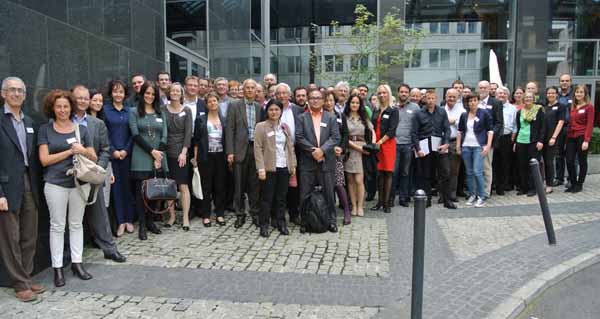
The Comparative Study of Electoral Systems (CSES) project recently celebrated its 20th anniversary during a Plenary Session of collaborators in Berlin, Germany, with thanks to the Wissenschaftszentrum Berlin für Sozialforschung (WZB) for their generous organizational and financial support of the event.
At the event, 31 election studies from around the world made presentations about their research designs, plans, challenges, and data availability, with most of their slide sets being available for viewing at the Plenary Session website.
It was especially appropriate to return to Berlin this year, the city having hosted the initial planning meeting for the project 20 years previously. The original event was sponsored by the International Committee for Research into Elections and Representative Democracy (ICORE). Originally anticipated as an outgrowth of ICORE, the CSES grew and eventually replaced it.
A CSES module consists of a 10-15 minute questionnaire that is inserted into post-election surveys from around the world. The project includes collaborators from more than 60 countries, with 50 election studies from 41 countries having appeared in the CSES Module 3 dataset. The CSES design is such that each module has a different theme which is intended to address a new “big question” in science. The project combines all of these surveys for each module, along with macro data about each country’s electoral system and context, into a single dataset for comparative analysis. There is no cost to download the data, and there is no embargo or preferential access. Every citizen in the world is able to download the data from the project’s website at the very same time as any of the project’s collaborators.
The recent Berlin meeting involved the first public presentation and discussion of content proposals submitted for CSES Module 5, for which data collection will be conducted during 2016-2021. After a public call, 20 proposals in total were received – a record number. Interested persons can view a presentation about the proposals, on topics ranging from corruption to populism to personality traits to electoral integrity. The theme for Module 5 will be selected, and the questionnaire developed and pretested, over the next one-and-a-half years. Prior modules have had as their themes: the performance of democracy, accountability and representation, political choices, and distributional politics and social protection.
As of the Berlin meeting in 2014, André Blais and the CSES Module 4 Planning Committee have handed over their role to a new CSES Module 5 Planning Committee, with John Aldrich as chair. John is an outstanding scholar who, in addition to having held leadership positions in many professional associations, has a long association with both the American National Election Studies and CSES.
While at its core CSES is a data gathering and disseminating organization, it has produced many other benefits as well. CSES considers an important part of its mission to be to create a community for electoral researchers, and to encourage election studies and local research capacity building around the world. CSES enables scholarship not just in political science, but other related disciplines – over 700 entries now appear in the CSES Bibliography on the project website.
The majority of funds for the CSES project are provided by the many organizations that fund the participating post-election studies. The central operations of the project are supported by the American National Science Foundation and the GESIS – Leibniz Institute for the Social Sciences.
We’d like to thank our many collaborators, funding organizations, and users for their support of the CSES, and we look forward to developing an engaging CSES Module 5!
Oct 14, 2014 | Current Events, Elections, National
Post developed by Katie Brown and Josh Pasek.
The Birther movement contends that Barack Obama was not born in the United States. Even after releasing Obama’s short form and long form birth certificates to the public, which should have settled the matter, the rumors to the contrary continued. Some contend Obama was born in Kenya. Others argue he forfeited American citizenship while living in Indonesia as a child.
What drives these beliefs?

Obama’s short form birth certificate, courtesy of whitehouse.gov
Center for Political Studies (CPS) Faculty Associate and Communication Studies Assistant Professor of Josh Pasek – along with Tobias Stark, Jon Krosnick, and Trevor Tompson – investigated the issue.
The researchers analyzed data from a survey conducted by the Associated Press, GfK, Stanford University, and the University of Michigan. The survey asked participants where they believed Obama was born. The survey also asked about political ideology, party identification, approval of the President’s job, and attitudes toward Blacks.
21.7% of White Americans did not think Obama was born in the U.S.; their answers included “not in the U.S.,” “Thailand,” “the bush,” and, most frequently, “Kenya.”
Further analyses revealed that Republicans and conservatives were more likely to believe Obama was born abroad. Likewise, negative attitudes toward blacks also correlated with Birther endorsement. Importantly, disapproval of Obama mediated the connection between both ideology and racism on the one hand and Birther beliefs on the other.
The authors conclude that, “Individuals most motivated to disapprove of the president – due to partisanship, liberal/conservative self-identification, and attitudes toward Blacks – were the most likely to hold beliefs that he was not born in the United States.” Put simply, the key feature of Birthers wasn’t that they were Republicans or that they held anti-Black attitudes, but that they disapproved of the president. It was this disapproval that was most closely associated with the willingness to believe that President Obama was ineligible for his office.
The full Electoral Studies article can be found here.
Oct 2, 2014 | Elections, National
Post developed by Katie Brown and Arthur Lupia.

Photo credit: ThinkStock
In a post last year, Center for Political Studies (CPS) Research Professor and Professor of Political Science Arthur Lupia declared there to be two types of people: those who are ignorant about politics and those who are delusional about how much they know. There is no third group.
If people lack information, it can lead to bad decision-making. As part of an effort to reduce bad decisions, Lupia examines how to inform voters more effectively in his forthcoming book, How to Educate Ignorant People about Politics: A Scientific Perspective.
Lupia focuses on improving the efforts of teachers, scientists, faith leaders, issue advocates, journalists, and political campaigners. How can they best educate others? To further this goal, Lupia focuses on the transmission of information. He clarifies how different kinds of information can improve important kinds of knowledge and competence. A key part of Lupia’s argument is that people are easily distracted and often evaluate information based on how it makes them feel. As a result, the way to improve knowledge and competence is to find factual information that is not only relevant to the decisions that people actually have to make but also consistent with their values and core beliefs. For if a person sees factual information that is inconsistent with their values and beliefs, they tend to ignore it; and if the information is not relevant to their actions, then it cannot improve their competence. In this examination, facts are not enough. The real task is to convey facts to which people want to pay attention.
Despite the pessimistic premise of broad ignorance, Lupia is ultimately optimistic. The central thesis of his book is that offering helpful information is possible. Or as he puts it, “Educators can convey valuable information more effectively and efficiently if they know a few more things about how people think and learn.”
Sep 10, 2014 | Conflict, Current Events, Elections, Foreign Affairs, International
Post developed by Katie Brown in coordination with Khalil Shikaki and Mark Tessler.

Photo credit: ThinkStock
This summer witnessed intense fighting between Israel and Gaza. With tens of thousands of rockets fired, the conflict killed more than 2,000 Palestinians, mostly civilians, and 80 Israelis, mostly soldiers. How has the most recent conflict affected Palestinian attitudes?
The Palestinian Center for Policy and Research (PCPSR) conducted a survey to gauge this impact. PCPSR is run by Khalil Shikaki. This year, Shikaki is a visiting scholar at the Center for Political Studies (CPS), working closely with CPS Research Professor and expert on the Middle East Mark Tessler. In this post, we offer results from PCPSR’s study along with insight from Tessler to understand the impact of the conflict on Palestinian public opinion.
PCPSR surveyed 1,270 adults in 127 locations across the West Bank and Gaza Strip between August 26 and August 30, 2014, coinciding with the first lasting ceasefire of the conflict. Results suggest that a significant majority (79%) of the Palestinian public views Hamas as the conflict’s winner. Just 3% believe Israel emerged victorious, while 17% believe both sides lost. Likewise, 79% blame Israel for starting this wave of fighting, while 86% support launching rockets at Israel from Gaza when under attack. As for the ceasefire agreement: 63% think it satisfies Palestinian interests.

Photo credit: ThinkStock
In addition to these conflict-specific findings, the PCPSR study also finds increasing support for Hamas among Palestinians to levels not seen since 2006. If elections occurred today, current Hamas deputy political bureau chief Ismail Haniyeh would easily win a presidential race against current president Mahoud Abbas. This is a massive shift in public opinion. Tessler notes that before the most recent conflict, support for Hamas was fading. Shikaki attributes this gain to the conflict, while predicting the Hamas support may wane as time passes. Tessler likewise cautions, “If things do settle down for a reasonable period and there is a new and stable status quo, any spike in Hamas popularity will probably drift back toward its ‘normal’ level based on what people favor and perceive with respect to political Islam, compromise with Israel, corruption and other issues that drive Palestinian politics in normal times.” Thus, the lingering effects of the 2014 Israel-Gaza conflict will depend on whether or not the ceasefire continues.
Khalil Shikaki will give a talk at the CPS Interdisciplinary Workshop on Politics and Policy on September 17, 2014 in Room 6006 of the Institute for Social Research in Ann Arbor, Michigan.