Post developed by Katherine Pearson and Diana Mutz
Foreign trade is a complex issue, but the public still has strong opinions about the issue. Diana Mutz demonstrated that social psychology can help to understand attitudes about trade when she delivered the 2019 Miller Converse lecture. A recording of her talk “Winners and Losers: The Psychology of Attitudes Toward Foreign Trade” is available below.
Most people rely on small-scale social experiences to understand large-scale interactions such as international trade. From this understanding, people tend to embrace beliefs about trade that are not necessarily accurate. For example, folk beliefs suggest that impersonal transactions are more dangerous than personal ones, that trade is zero-sum, and that trade “deficits” mean that a country is losing more jobs as a result of imports than it gains due to exports. These beliefs are inaccurate, yet understandable, generalizations from the world of face-to-face social exchange.
Contrary to popular wisdom, trade preferences do not reflect people’s economic self-interest. Mutz demonstrates that, surprisingly, these attitudes are not influenced by a person’s occupation, industry of employment, community job loss, geographic location, or individual job loss. Instead, perceptions of what is in the collective economic interest determine attitudes toward trade. Coverage of trade in the media has a large influence on these perceptions. Media coverage of foreign trade was mostly negative until 2016. As media coverage of trade has become more balanced since 2016, support for trade has also increased.
Politicians from all parties have been unwilling to champion trade when running for office because foreign trade is seen as a political liability in the United States. As the world economy changes, Mutz asserts that leaders will need to advocate for trade and for safeguards against its negative effects. She cautions that it’s unhelpful to leave the public out of that conversation altogether as has been common in the past.
For an additional perspective, Mutz compares attitudes about trade in the United States and Canada. She finds that attitudes about trade in the two countries are different due to differing attitudes toward competition. Americans value competition more, and believe in the fairness of unequal outcomes. In the U.S., nationalism reduces support for foreign trade, but in Canada the opposite is true. Canadians who hold the strongest beliefs about national superiority want to promote more trade and immigration.
Differing perspectives on trade in these countries can be explained by variation in two different types of ingroup favoritism. First, Americans in Mutz’s studies systematically preferred trade agreements in which their fellow Americans benefited more than trading partners. In fact, there was no level of job benefits to foreign countries that would justify the loss of even a single American job. This was not the case among Canadians. In addition, Americans demonstrated their competitive attitudes toward trade by demonstrating greater support for trade agreements that not only benefit their country but also disadvantage the trading partner. Canadians, in contrast, preferred the kind of “win-win” trade agreement that economists suggest benefits all countries involved.
Attitudes about race drive attitudes about trade and Mutz finds that the reverse may also be true. In a study that asked respondents to select which students should be admitted to college, participants who had just watched an ad against foreign trade were less supportive of admitting Asian-American students, as well as students from Asia.
Mutz concludes that, while many of these results are distressing, attitudes remain malleable. Efforts to change opinions toward trade that emphasize similarity and shared values are more effective than efforts emphasizing pocketbook gains. Since 2016, her data shows that there has been an increase in support for foreign trade and a realization that it comes with benefits as well as negative consequences.
The cultural and political divide in America receives considerable media and scholarly attention. Republicans and Democrats have different preferences for everyday things like cars and drinks – most people are familiar with stereotypes of latte-drinking liberals or truck-loving conservatives. These differences even extend to their children’s names, the places they live, and the amount they give to charity.
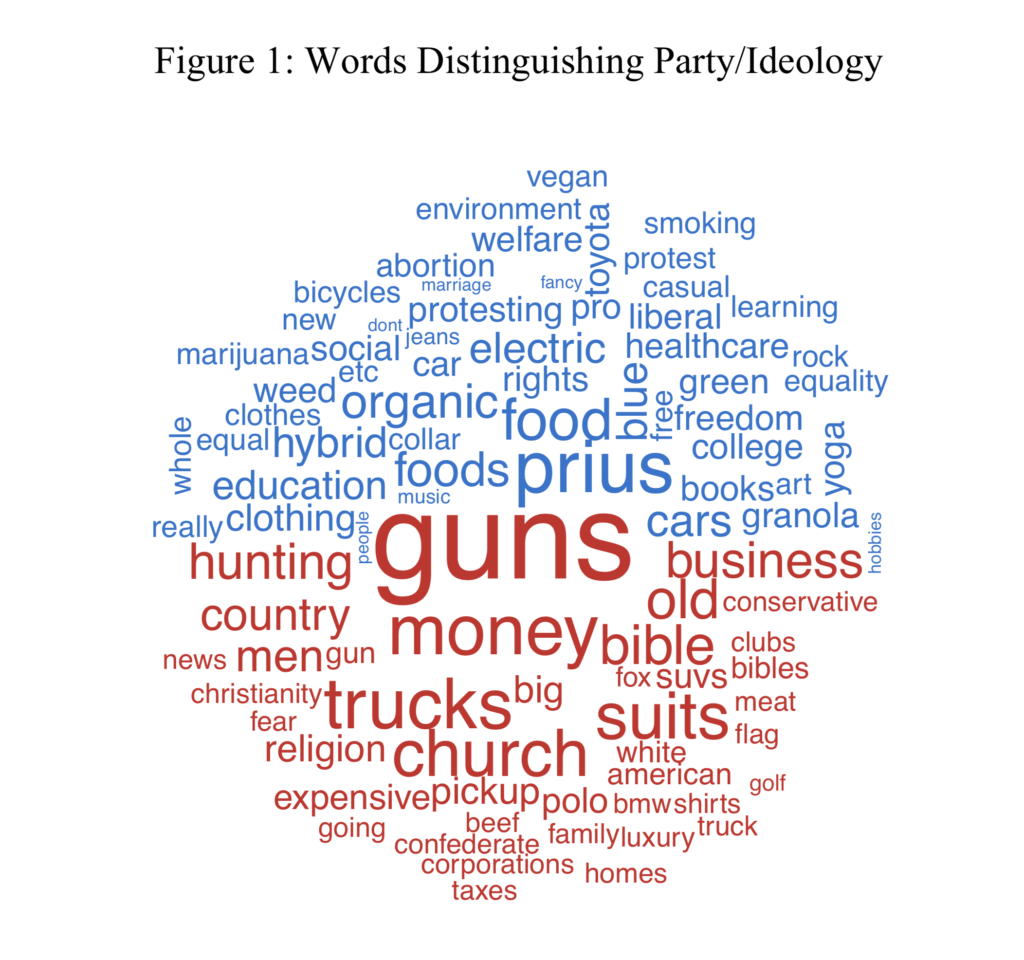
The authors of this paper took a closer look at the extent to which non-political objects, activities, and places are associated with partisanship and ideology. Participants in the study were first prompted to list objects and activities they associate with either liberalism or conservatism. Following this open-ended question, respondents were asked to rate a list of 26 objects and activities based on ideology or partisanship.
The results of the open-ended question are illustrated in the figure below, which shows the words most strongly associated with Democrats (blue) and Republicans (red). The figure makes clear the ease which which respondents name objects and activities often associated with the two partisan groups.
Hiaeshutter-Rice, D., Neuner, F., Soroka, S. 2019, “Divided by Culture: Partisan Imagery and Political Evaluations”, paper presented to the 77th Annual MPSA Conference, Chicago, IL, April 4-7, 2019.
In subsequent studies, the authors examined respondents’ reactions to a series of photos of political candidates standing in front of different backgrounds, including a NASCAR race, an organic food store, and a shooting range. Not all treatments made a difference, but the shooting range (and another image of a gun shop) in particular affected the way that respondents perceived the candidates’ ideology and policy proposal.
As more politicians use social media to share images of their campaigns, it is essential to be aware of the ways in which voters evaluate candidates. Nonverbal political communication conveys information that can help shape public opinion and political behavior. Will voters be manipulated by objects and scenery in political messages? The authors suggest that even as respondents can attach partisanship to wide range of non-political activities, their candidate-photo experiment finds only limited effects of hypothetical press-conference backgrounds. They conclude on a comforting note: “The fact that voters are readily able to attach partisanship to objects and activities, but yet barely take this information into account when rating candidates and policies, may be good news for representative democracy.”
Faida Zacharia studies access to energy and water resources for smallholder farmers in Dodoma Region in Tanzania. As a visiting scholar at the University of Michigan, she worked closely with Professor Kelly Askew to further her research on “Small-scale Groundwater Irrigated Agriculture and Livelihoods in Drylands Areas: The Case of Dodoma Region, Tanzania.”
Faida Zacharia is an Assistant Lecturer in Development Studies at the University of Dodoma, Tanzania. She came to the University of Michigan as a member of the University of Michigan African Presidential Scholars (UMAPS) 2018-19 cohort.
Addressing groundwater irrigation in Dodoma
“Water wars” are on the rise around the world as access to fresh water becomes ever more limited. Countries around the world are facing increased demand for water at a time when fresh water is becoming an ever more scarce resource. Food security and economic development depend on access to water, hence developing countries like Tanzania are seeking new means of increasing access to water for all the needs of its population.
In Dodoma, a semi-arid region in Tanzania, access to fresh water is a challenge. Climate change, industrial activities, and political conflicts all threaten the available water supply. The region has various reservoirs to collect surface water, among them Msalato reservoir, Mkonze dam, Hombolo dam, Bahi dam and Makutupora dam. Mtera dam, the largest dam in Tanzania, is also the primary source of electricity for the national grid. But despite all of these resources, Dodoma faces a shortage of water.
People in Dodoma rely on smallholder farming and livestock keeping for their livelihoods, but the recent rapid growth of this region has put additional pressure on water resources necessary for agriculture. When President John Magufuli was elected in 2015, he declared that Dodoma City would be the political capital of the country, and required all government ministries relocate from Dar es Salaam to Dodoma. People came to Dodoma from other regions of Tanzania, increasing the demand for water for household uses, for industry, and for agriculture beyond what the reservoirs could sustain. Tapping into groundwater resources may provide a solution.
Zacharia is developing new research that will explore how groundwater irrigation in Dodoma region contributes to agriculture and food security, and how it helps poverty reduction in the drylands of central Tanzania. Her research maps the groundwater in the region to establish how much there is and where it is located. This baseline data and knowledge will help to initiate, implement, and sustain groundwater irrigated agriculture in Tanzania.
Zacharia wants to know who benefits and who does not when groundwater irrigation is established in smallholder farming communities. Groundwater irrigated agriculture may prove to have great potential as a strategy that mitigates the impact of climate change on agricultural communities. These findings will inform the policy decision-making process and strategies related to small-scale groundwater irrigated agriculture to enhance the livelihoods of drylands communities.
Zacharia’s research supports sustainable development of infrastructure through an integrated approach to water management to balance the competing needs of agriculture, human consumption, industry, and environmental conservation. In the rush to secure more water, she cautions against a lack of planning that lead to the present water crisis in Cape Town, South Africa and other sites in China, India, and California where groundwater aquifers have been depleted.
Experience of a visiting scholar
Zacharia says that her time at the University of Michigan has been essential to advancing her research. Her fellowship allowed her to work closely with her mentor to receive support and feedback on her research. Zacharia presented research at two conferences during her visit: the Sustainability and Development Conference at the University of Michigan, and the African Studies Association annual meeting in Atlanta, Georgia. She said that the experience of attending the conferences and presenting work to her peers was one that she is eager to repeat. “It has changed my entire outlook and attitude towards life of academics,” Zacharia said.
Access to the university libraries was another important benefit of her time as a visiting scholar. Zacharia said that the wealth of research resources, and the efficiency of accessing them, was important to conducting her work. She worked closely with experts in geographic information systems (GIS) to map groundwater data. Other visiting scholars, especially those from Uganda, Ghana, and Nigeria, supported Zacharia’s research by reviewing her work and providing new insights. She expects that the relationships she has built during this program, with faculty and other scholars, will extend long into the future. “It’s not easy to find someone to give you the support like I get here,” said Zacharia. “That support makes me more comfortable to start my research.”
Zacharia returns home to Tanzania at the end of February, where she will apply to PhD programs to continue her work. We wish her all the best and look forward to future partnerships with her.
There are people all over the world who need the social sciences to reconcile the problems of their lives. At the Open Social Science Conference in Mannheim, Germany, Arthur Lupia told attendees that this is why social scientists must work to ensure that their work is transparent and credible. Lupia delivered his keynote address “It’s Up to Us – Transparency and the Public Value of Science” on Friday, January 25, 2019. A recording of the talk is available online.
Lupia studies how people make decisions when they don’t have much information. Quantitative researchers, he notes, make scientific claims backed up by proofs. A proof allows others to understand the thought process and produce the same result. It allows researchers to go beyond their own understanding, and bring others along.
It’s not always sufficient to show evidence, however. The scientist must also consider the person who receives the information: what they pay attention to, how they make sense of that information, what they understand. In order to create change, social science research must first reach its audience. The way scientists communicate knowledge makes a difference.
What makes social science research valuable to people who use it?
The mission of social science researchers, according to Lupia, is to offer people a better understanding of the relationship between things they can see and things they can do.
The amount of information available has increased greatly within our lifetimes. An abundance of information is available online. So why should anyone seek out rigorous scientific research? If information can be found for free, why should anyone fund social science?
To answer these questions, Lupia starts by explaining that decisions rely on evaluations of evidence. The essential criteria for evaluating evidence are:
Credibility – there is something about the claim that is trustworthy?
Legitimacy – is this claim developed in accordance with recognized principles?
Challenges facing scientists
While scientific inquiry fosters greater honesty in evaluations, the incentives that scientists face present challenges, as well. Scientists have a strong incentive to discover novel findings and publish them. The marketplace rewards claims that go viral. On the other hand, the incentives to explain how these discoveries emerge are very weak.
These incentives threaten the meaning and the value of the research. If scientists publish only astonishing results, but ignore more mundane studies that disagree, scientific credibility and legitimacy are eroded. If social scientists want to advance research that improves quality of life in the world, then credibility and legitimacy matter a lot.
Opportunities to improve transparency
Transparency in scientific research can be improved by creating better incentives. Because researchers already have strong incentives to publish, Lupia suggests that it makes sense to focus efforts on academic journals. He gave several examples of incentives that help journals increase transparency.
The Data Access and Research Transparency (DA-RT) Statement increases transparency in social science. The statement was signed by 28 academic journals that promised to “commit to greater data access and research transparency, and to implementing policies requiring authors to make as accessible as possible the empirical foundation and logic of inquiry of evidence-based research.”
The Transparency and Openness Promotion Guidelines are a model for increasing transparency in publishing. Created by the Center for Open Science, over 8,000 journals have committed to these guidelines.
The Election Research Preacceptance Competition, led by Lupia and Brendan Nyhan, asked researchers to design a paper using data from the 2016 American National Election Studies (ANES) and submit the design to a participating journal before the data were available for analysis. In return, selected entries were offered an award of $2,000 and placement on a panel at a major political science conference. This challenged researchers to share ideas regardless of whether the analysis yielded the expected results. Lupia noted that they received fewer submissions than they expected. He suspects that it’s difficult for researchers, especially younger ones, to take the risk to publicly share an idea without knowing what the outcome will be.
The value of social science is up to us
When was the golden age of social science? Lupia says it is dawning right now. Scientists must ensure their work has value to those who can use it to make change, and that’s why they need to commit to greater transparency. Increasing transparency requires creating incentives and improving infrastructure for openness. Most people who consume scientific research will never read the evidence that went into the findings. Instead they take the results on faith. Lupia cautions that if researchers don’t uphold standards of transparency, they lose their value as credible sources of knowledge.
White conservatives who not only have racial animus but are also knowledgeable about politics were the most likely group to believe that former President Barack Obama was not born in the United States, according to a University of Michigan Institute for Social Research study.
Michael Traugott and Ashley Jardina
The study, published in the Journal of Race, Ethnicity and Politics, teased out motivations of white voters for believing the so-called birther rumor. It found that white conservatives who ranked as having a high amount of knowledge were most likely to support the idea that Obama was not born in the U.S.
“This is a piece of social science research about biased perceptions in the political world and what their consequences might be,” said the study’s co-author Michael Traugott, a researcher at the Center for Political Studies at ISR. “It’s relevant because the whole concept of fake news is about devaluing information that doesn’t conform to either what you believe or what you want other people to believe, therefore suggesting a basis upon which it can be discounted or thrown away.”
Traugott and co-author Ashley Jardina, a former U-M doctoral student and now an assistant professor of political science at Duke University, say politically knowledgeable conservatives may be more likely to believe the rumor because they may follow what’s called a “motivated reasoning model.”
“One of the most interesting things about the motivated reasoning model is that the more resources the person has—which could be political information—the better they are able to argue against new information that doesn’t fit their worldview,” said Traugott.
Traugott and Jardina explored a portrait of a birther among white Americans using data from the 2012 American National Election Study. The ANES, conducted in person among a nationally representative sample of respondents, asked several questions assessing belief in contemporary conspiracy theories.
As recently as 2017, nearly a third of U.S. adults believed it was possible Obama was born outside the U.S., according to the researchers.
The survey also assessed participants’ knowledge by asking them to identify the office held by several political figures. A respondent’s score on the scale was the proportion of correctly answered questions.
The researchers found that 62 percent of very strong Republicans reported that Obama was born in the U.S. compared to 89 percent of very strong Democrats. Thirty-eight percent of very strong Republicans reported that Obama was probably born in another country, while 11 percent of very strong Democrats reported the same.
To estimate the impact of racial attitudes on the birther rumor, the researchers compared two conspiracy theories detailed in the 2012 ANES survey: the Obama birther rumor and the existence of the Affordable Care Act “death panels,” or, the idea that the ACA authorized government panels to make end-of-life decisions for people on Medicare.
Additionally, the researchers found:
Strong Republicans with higher levels of racial animus are more inclined to believe the birther rumor, but not the death panel rumor.
Republicans both low on resentment and low on knowledge are also more inclined to believe the birther rumor.
Democrats with higher levels of racial resentment are not significantly inclined to adopt either rumor.
Democrats low on knowledge and high on resentment are more likely to adopt birther beliefs.
High-knowledge Democrats with high levels of racial resentment are less likely to believe the rumor.
“Until recently, the relationship of party identification to things like voting behavior had weakened, but it has strengthened again,” Traugott said. “We expected partisanship would play a role in attitudes about Barack Obama, and because he was an African American, racial attitudes would play a role as well. These things are now increasingly important because of this kind of tribalism that’s infecting contemporary politics.”
It’s an election year in America, and with that comes an endless string of media coverage of the political campaigns. If you are like 70% to 80% of Americans over the past 12 weeks, you’ve read, seen or heard some information about the top two presidential candidates, Hillary Clinton and Donald Trump, on any given day.
Content analyses of these open-ended responses offer a unique picture of campaign dynamics. The responses capture whatever respondents remember hearing about the candidates over the previous few days from traditional media, social media, or friends and family. As Gallup points out in the article above, results from this project are noteworthy because while most survey research tracks Americans’ opinions on candidates leading up to an election, this study looks directly at the information the public absorbs, on a daily basis.
Tracking the ‘Tone’ of What Americans Have Read, Seen or Heard
In this blog post, we offer some supplementary analysis, focusing on the tone of responses to the “read, seen or heard” question. Positive and negative tone (or sentiment) are captured using the Lexicoder Sentiment Dictionary, run in Lexicoder. The Lexicoder Sentiment Dictionary includes roughly 6,000 positive or negative words. We count the frequency of both, and produce a measure of tone that is the % positive words – % negative words, for every response, from every respondent.
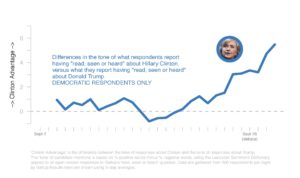
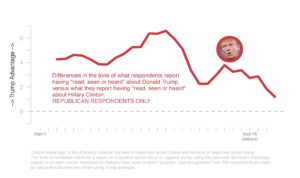
Taking the average tone of responses daily provides insight into the content that American citizens are receiving (and remembering) during the campaign. In this analysis, we focus on measures of “candidate advantage,” where “Clinton advantage” is the gap between the tone of responses to the “read, seen or heard” question about Clinton, and the tone of responses to the “read, seen or heard” question about Trump. Positive values reflect a systematic advantage for Clinton; that is, a tendency for recalled information about Clinton to be more positive than recalled information about Trump. Negative values reflect the opposite.
As would be expected, when we look at partisanship, Republicans have more a net positive assessment for Trump. This is particularly true in the first weeks of September. Democrats show a similar tendency in that they have more net positive assessments for Clinton. That said, the first few weeks of September show, at best, a very weak advantage for Clinton among Democrats. During the early weeks of September, Democrats’ recalled news was not markedly more positive for Clinton than it was for Trump. ‘Read, seen or heard’ comments from Democrats even turned to Trump’s advantage in the period from September 16th to 18th, before trending more positive towards Clinton again. This shift from Democrats followed concerns about Clinton’s health, but it also (and relatedly) reduced mentions of emails. This trend continued after the recent bombings in New York and New Jersey became prominent. And then came her performance in the debate. All of this coverage led to a steady increase in Clinton’s advantage among Democrats.
For Republicans, the picture is nearly the opposite. The gap between recalled information about Trump and recalled information about Clinton was striking through the first few weeks of September. While Democrats did not recall information favorable to Clinton, Republicans clearly recalled information favorable to Trump. But responses started to shift in the middle of the month and the ‘Trump Advantage’ in the tone of recalled information from Republicans has continued to fall since the first debate.
What do these findings suggest about the presidential campaign thus far? While these results do not capture vote intentions, nor are they direct assessments of the candidates, these data do give us a unique sense for the information that voters remember. Whether shifts in ‘read, seen or heard’ mentions are predictive of attitudes towards the candidates remains to be seen. Exploring this possibility is one objective of the ongoing project.
The Gallup, Michigan, Georgetown Working Group consists of: Frank Newport, Lisa Singh, Stuart Soroka, Michael Traugott, and Andrew Dugan.