Jun 4, 2014 | Innovative Methodology, International
Post developed by Arun Agrawal and Katie Brown.
Are our efforts to measure changes in conservation by talking to decision makers effective?

Photo credit: Thinkstock
This question motivated recent research by Arun Agrawal, Center for Political Studies (CPS) faculty associate and Professor in the School of Natural Resources and the Environment (SNRE) at the University of Michigan.
An article by Christoph Nolte, Agrawal, and Paulo Barreto that appears in Environmental Research Letters considers the effectiveness of a globally used assessment strategy that is referred to as Rapid Assessment and Prioritization of Protected Area Management (RAPPAM).
Utilized in over 50 countries, RAPPAM is the most popular tool to determine environmental protection. RAPPAM aims to measure whether a protected area is achieving its conservation goals. This ,in turn, influences the allocation of resources (financial, personnel, equipment, and otherwise). Despite its popularity, its empirical effectiveness had yet to be demonstrated. So Nolte, Agrawal, and Barreto conducted their study to see if RAPPAM’s measurements are indeed effective. The research team analyzed data on 66 protected areas in the Brazilian Amazon.
The results? RAPPAM appears ineffective.
Specifically, there is no correlation between RAPPAM’s indicators and avoided deforestation. These null results highlight the need to invest in new, better, and more valid measurements. Such measurements should not be based just on subjective assessments by those who are paid to manage protected areas.
Sound simple? It still hasn’t happened! Good decision tools may not be enough to make conservation work. Nolte, Agrawal, and Barreto argue that without such tools, it is even less likely to work.
May 22, 2014 | ANES, Elections, Innovative Methodology, International
Post developed by Katie Brown and Ioannis Andreadis.
Voting Advice Applications (VAAs) are web platforms that help voters determine the candidate or the political party that best matches their own political ideology. Visitors answer a series of questions to gauge their political positions. The VAA platform then estimates the similarity or dissimilarity of these positions to those of candidates or parties.
There are various ways to present these estimates. One option is to display a list of the candidates or parties along with a number indicating the similarity or dissimilarity of each. Another option is a graph like the one below from Greece, where issues from the election are represented on each axis, and users can visualize their ideological position relative to that of the parties.
-
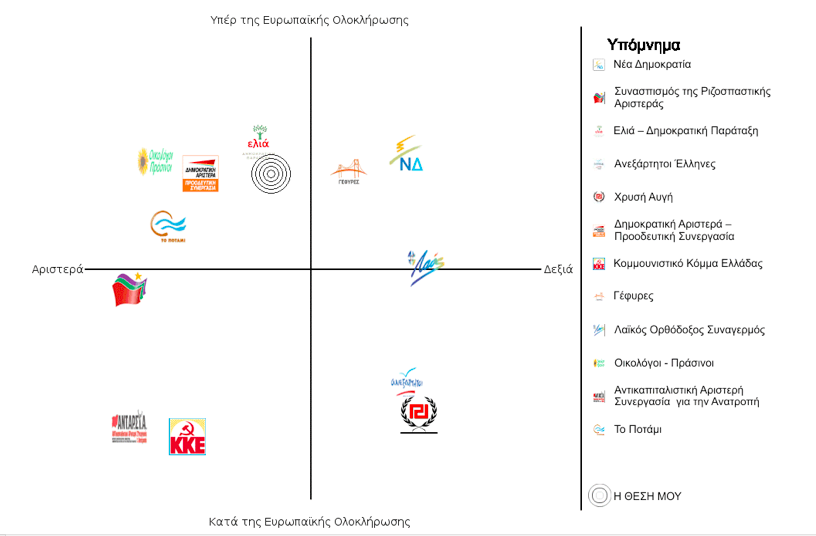
Example of diagram from the Greek VAA www.votematch.gr from the elections for the European Parliament. Left/Right is represented by the horizontal axis and Pro-Europeanism/Euroscepticism is represented by the vertical axis. The political party logos indicate their ideological position and the center of the concentric circles indicates the position of the user.
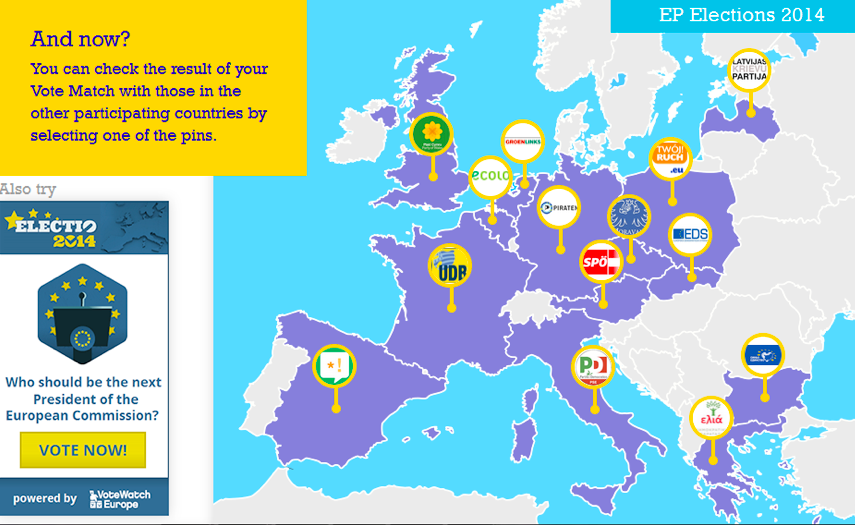
Another example of VAAs in action is Vote Match Europe, an international network of VAAs for the 2014 European Parliament elections across fourteen EU countries. The Vote Match Europe website allows users to see the parties closest to them across all of the countries in the network, and to learn more about the parties and their policies. A goal of the Vote Match Europe website is to promote European citizenship and better inform citizens about the elections for the European Parliament at large.
Ioannis Andreadis is Assistant Professor of Quantitative Methods in the Department of Political Sciences at Aristotle University Thessaloniki. This semester, he is a scholar in residence at the Center for Political Studies (CPS), seeking to learn more about the American National Elections Studies (ANES) and the Comparative Study of Electoral Systems (CSES) under a grant from the Fulbright Program.
In his capacity as a researcher, Andreadis has studied and written about VAAs, and he also both designs and studies VAAs. In particular, he created and oversees the Voting Advice Application HelpMeVote. HelpMeVote was used by more than 480,000 voters during the May 2012 Greek Parliamentary Elections. The application was also used in Iceland and Albania, and is currently being used for the 2014 European Parliament election.
In a recent paper, Andreadis tackles the question of utility of VAAs. He suggest that VAAs must be built to high academic standards, and realize the following benefits:
- VAAs help voters should become more knowledgeable about party positions, allowing the voters to make better choices.
- VAAs help political parties not covered in traditional media to connect with voters who agree with their values.
- VAAs generate data that researchers can use to better understand voting behavior.
VAAs are growing in popularity in places with multi-party systems and high Internet availability – for example, in Western Europe.
In electoral systems with only two parties, VAAs may be less useful given the limited choice set. If a VAA had been used for the 2009 Greek elections or earlier – when two major Greek political parties dominated national politics – it probably would not have been as popularly used. But in the 2012 elections, the Greek parliament featured seven parties, making way for a new VAA market.
With this in mind, adaptation to America’s two party system poses challenges. VAAs could be used in American primaries, where many candidates from the same party compete against each other, but only if candidates running in the same primary have very different positions on enough issues.
May 15, 2014 | Current Events, Foreign Affairs, International
Post developed by Katie Brown and William Zimmerman.

Photo credit: Thinkstock
Russian President Vladimir Putin often makes headlines. This week, U.S. sanctions against Putin in the wake of the Ukraine crisis dominated the news, while Putin’s rewrite of recent music history appeared in popular culture news. Why is Putin such an interesting figure in America? Is it because he challenges our notions of “normal”?
On April 27, Princeton University Press released Ruling Russia: Authoritarianism from the revolution to Putin, the latest book by Center for Political Studies (CPS) Professor Emeritus William Zimmerman. Ruling Russia traces Russia’s history over the last century. The definition of normalcy varied with Russia’s leaders. Gorbachev and Yeltsin for all their differences conceived normalcy to correspond with Western political systems while the leaders of the failed coup against Gorbachev in 1991 and Putin more recently have defined normal to equate with stability, security, and absence of change.
Zimmerman argues that there have been plural Soviet systems and plural Russian political systems and provides a typology to encompass the government types across the century from the revolution to today which distinguishes among democratic, competitive authoritarian, full authoritarian, and totalitarian regimes.
With that as background we can consider the last two decades to better understand current politics in Russia. From 1996 to 2008, after a brief move toward democracy, Russian elections became less open, less competitive, and more meaningless. This time period witnessed Putin’s first (2000) and second (2004) election to President. With Putin unable to run for a third consecutive term in 2008, Dmitry Medvedev ran for President and Putin became Prime Minister.
Then, Medvedev and Putin “castled” in 2012, with Putin running again for President and Medvedev being named Premier. While some believe this move was agreed upon between Putin and Medvedev back in 2008, there is no evidence of this. Zimmerman believes Putin put forth the idea in 2011. Regardless, and interestingly, the 2011-2012 election cycle was more competitive and less predictable than its predecessors. Putin ran a campaign supporting the status quo, stability, and nationalism – a return to normalcy.
The book’s historical analysis ends in 2013. Zimmerman sees full authoritarianism as the most likely near term evolution. This would map onto recent events, including the crackdown on homosexuality during the Sochi-hosted Olympics and military aggression in Ukraine.
From an American vantage point, each move away from democracy was a move away from normal. But for Russia, the idea of “normal” moved toward authoritarianism.
Zimmerman dedicates the book to his students, stating that insights from their dissertations inspired multiple parts of the book.
May 13, 2014 | Elections, Innovative Methodology, International
Post developed by Katie Brown in coordination with Brian Min.
With six weeks of phased voting, 80% of potential voters are expected to cast ballots in India, making it the world’s largest election. Already marked by political posturing and violence, the elections also include the politics of light.
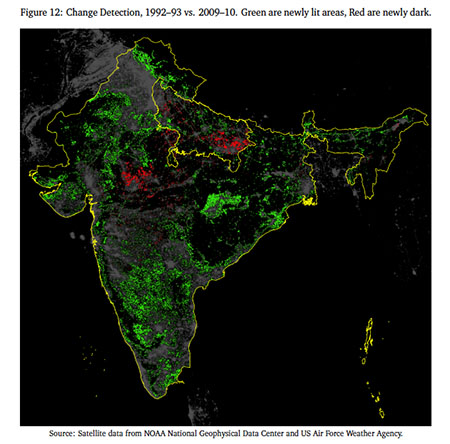 CPS researcher Brian Min developed an innovative way to track energy emissions. Min tracks images from the Defense Meteorological Satellite Program’s Operational Linescan System (DMSP-OLS). In orbit since 1970, these satellites record high resolution images of light on Earth every night. Min uses these images to track energy consumption over time.
In a recent paper, Min applied this methodology to elections in India. Some of the country remains isolated from a consistent supply of electricity. Using data from 1992 to 2010, Min finds that otherwise dark villages are often illuminated during election cycles. When elections come around, politicians promise light and often deliver power leading up to votes. These areas are then returned to darkness as election promises literally fade from the spotlight.
It remains to be seen if the 2014 election will change power grids. Min will be ready to measure using the satellite images. Look out for future posts about Min’s state-of-the-art research based on the same satellite imaging in other areas.
Apr 23, 2014 | Innovative Methodology, International
Post developed by Katie Brown and Arun Agrawal.
This semester, the University of Michigan’s College of Literature, Science, and Arts is sponsoring a theme semester: India in the World. India was selected as a focus for many reasons: its vibrant economy, its middle class is the world’s largest, and its government is the world’s largest democracy. The theme semester seeks to “emphasize the ways that India is a part of everyday life in our increasingly globalized world.”
In this post, we celebrate both the theme semester and yesterday’s Earth Day by featuring the work of Center for Political Studies Faculty Associate and School of Natural Resources and Environment Professor Arun Agrawal. Agrawal studies environmental policy. A recent article in Environmental Science and Policy by Agrawal, Daniel G. Brown, Gautam Rao, Rick Riolo, Derek T. Robinson, and Michael Bommarito focuses on research in India to help us understand how we can use networks to curb resource use.
Research usually focuses on formal institutions as being the difference between successful and unsuccessful resource allocation. But Agrawal and his colleagues argue that institutions are only important in the context of informal networks, or the social interactions between neighbors. Networks are a pervasive part of life. They also change rapidly. But they are little studied in the context of natural resources.
Agrawal and his colleagues examine how institutions and networks interact to influence natural resource use. The authors conducted extensive fieldwork in northern India to investigate how firewood harvesting was influenced by organizations and local social networks. Firewood is critical for cooking food in India so is an important resource to study.
Individual Agents and Social Networks
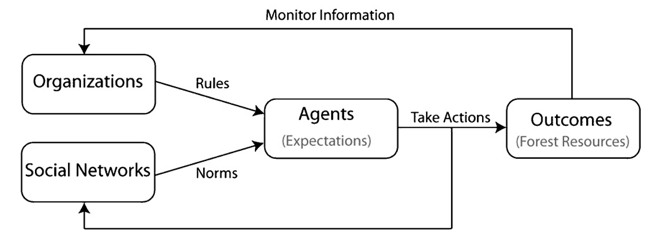
The authors created the above model to consider changes in behaviors and changes over time. Their focus was on how people make decisions – in particular, on the amount of firewood to harvest from the forest. The changes in these decisions are affected by both institutions and networks.
Based on the results of their modeling work, the authors conclude that effective organizations leverage existing social networks. Specifically, they build on existing norms and interactions to change resource use. If institutions make small investments in changing norms, this can have a disproportionately positive impact in reducing resource use, because network interactions amplify the changes across people. That is, small changes in social networks can translate into large savings in resource use.
Connecting back to the theme semester of India in the World, Agrawal’s research in northern India holds intriguing lessons for how policy making can lead to more sustainable resource use practices: institutional changes should build on local social network effects.
Apr 8, 2014 | Current Events, International, Law
Post developed by Katie Brown in coordination with Yuen Yuen Ang.
The fairness of China’s court system made the news this week. Apple supplier Knowles, which makes microphones and hearing-aid pieces for iPhones, asserted it was blocked from testifying in a trial with a rival of Apple. How can we understand this?
Court cases are on the rise in China, with the number of commercial cases growing steadily, second only to civil disputes. The expansion of courts should mean the rise of the rule of law and a more level playing field for firms, right? Not exactly.
Center for Political Studies (CPS) faculty associate, assistant professor of political science, and Center for Chinese Studies faculty associate Yuen Yuen Ang studies this trend. In a recent article, forthcoming in The Journal of Politics, Ang and Nan Jia find that politically connected firms are actually more likely to use courts than non-connected firms. These connected firms are congressional delegates and/or former party-state officials.
Political connections among private firms in China shape not only their access to resources and profitability, but even their willingness to use courts for dispute resolution.
Number of Court Cases by Type over Time
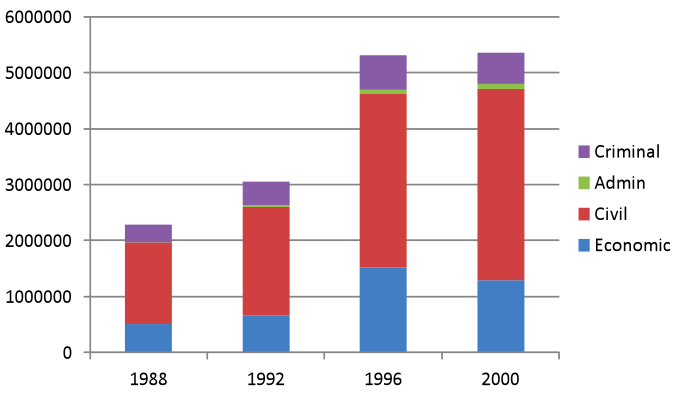
However, the fact that politically connected firms use courts more may not signal the subversion of law. Besides having access to officeholders (“know who”), politically connected firms also tend to have more knowledge about and confidence in navigating the legal system (“know how”). So do politically connected firms use courts more because of “know who” or “know how?”
By analyzing survey data of over 3,900 private firms in China, Ang and Jia finds that “know who” dominates “know how” in inducing politically connected firms to use courts more.
Findings from the study challenge the assumption in Western-based theories that as law and courts expand, connections will diminish in influence. As the authors write:
“The substitutive view of formal laws and informal networks is premised on the substantial passage of time and absence of a strong authoritarian state in legal development. The edifices of law can be quickly built, but one cannot assume that norms and practices of impartiality will follow, particularly when courts are subordinated to politics by design. In institutional landscapes such as those of China, we can expect a fusion of legality with politics and the informal with the formal.”