Mar 20, 2014 | Current Events, Elections, Innovative Methodology, International
Post developed by Katie Brown in coordination with Kirill Kalinin.
Photo credit: Thinkstock
An earlier post on the Center for Political Studies (CPS) Blog covered Kirill Kalinin’s work concerning election fraud in Russia. That post showed evidence from empirical work that polls ahead of the 2012 Russian presidential election were flawed, setting the stage for subsequent election fraud. This post returns to Kalinin’s work to consider why.
Political Science Ph.D. candidate Kirill Kalinin studies election fraud. Along with Professor of Political Science, Professor of Statistics, and Center for Political Studies Faculty Associate Walter Mebane, Kalinin authored a paper – Understanding Electoral Frauds through Evolution of Russian Federalism: from “Bargaining Loyalty” to “Signaling Loyalty” – arguing that Russia’s election fraud can be understood as rooted in federalism and a formal signaling game model.
Kalinin and Mebane support this argument with empirical analysis. The researchers find that the occurrence of 0s and 5s in the last digit of election turnout percentages to be suspicious. In fact, using statistical modeling, they find it to be linked to election fraud connected with post-election rewards and punishments. From 2000 on, fraud appears to be widespread.
But why? In 2000, Putin came to power and initiated a process of recentralization. From the mid 1990s through the 2000s, regional governors made changes based in rational strategy to Russia’s federal relations.
In the mid-1990s, the central government rewarded governors with political, institutional, and financial resources in exchange for favorable election results. In the 2000s, this escalated to election fraud.
As Kalinin concludes, “Over the most recent election cycles Russian elections have become increasingly unfree and unfair, characterized by suppression of electoral competition, rising levels of administrative interference and drastic growth of electoral frauds.” That is, the rewards for fraud have rendered Russian elections inherently fraudulent.
Mar 5, 2014 | Conflict, Current Events, Foreign Affairs, International
Post developed by Katie Brown in coordination with Muzammil Hussain

Photo credit: Thinkstock
In recent weeks, massive protests have swept through Venezuela and Ukraine. Instagram and Twitter have been featured as playing a key role in the latter. Digital activism is increasingly attributes to helping spark rapid waves of mobilization across several recent international cases.
Center for Political Studies (CPS) faculty associate and assistant professor of communication Muzammil Hussain studies the role of technology in protest. With Philip N. Howard of the University of Washington, Hussain published an article weighing the roles of Internet infrastructure and mobile telephony in the Arab Spring mobilizations.
Though in a different area of the world, understanding the role of communication systems, the political uses of digital media, and the politicization of internet infrastructure in the Arab Spring can help shed light on the current wave of democratization. Hussain argues that information technologies do not cause political change, but they have become a consistent tool and space to afford and act out political contentions.
To understand the relative success of the Arab Spring across different countries in the Middle East and North Africa, the authors look at a variety of contextual factors, including income, wealth distribution, unemployment, demographics, digital connectivity, censorship, and economic dependence on fuel. In the article, they examine the impact of these factors on regime fragility and social movement success. Interestingly, they argue that the inciting incidents in each country were digitally mediated. The describe how digital communication sets off a six-stage process of political mobilization experienced in both successful and failed attempts for regime change.
The authors conclude that “information infrastructure – especially mobile phone use – consistently appears as one of the key ingredients in parsimonious models for the conjoined combinations of causes behind regime fragility and social movement success.” That is, digital communication networks, especially mobile phones, drive political upheaval. In addition to offering insight into the Arab Spring experiences, this may also help explain the recent successful ousting of Ukraine’s president.
Feb 18, 2014 | Current Events, Elections, Innovative Methodology, International
Post developed by Katie Brown in coordination with Kirill Kalinin

Photo credit: Thinkstock
In March of 2012, Vladimir Putin was elected to his third term as President of Russia, after a four year leave serving as Prime Minister. Massive protests and speculation about electoral manipulation and fraud accompanied the election. Yet at the same time, polls ahead of the election predicted a landslide victory by Putin.
Are both the polls and election results incorrect? Could this be explained by social desirability?
Political Science Ph.D. student Kirill Kalinin studies election fraud. Along with Professor of Political Science, Professor of Statistics, and Center for Political Studies (CPS) Faculty Associate Walter Mebane, Kalinin conducted a series of studies that consider the role of social desirability (or the tendency to answer questions not truthfully but in line with public opinion) in the most recent Russian presidential election. This work is possible due to financial assistance from the Department of Political Science at the University of Michigan, Weiser Center for Emerging Democracies at the University of Michigan, and fruitful cooperation with Henry Hale (George Washington University) and Timothy Colton (Harvard University) within the project of Russian Election Study.
Kalinin focuses on a particular kind of social desirability: preference falsification. Preference falsification pertains to when an individual’s private preferences diverge from public preferences in the context of an election. In the case of Russia 2012, Russian public opinion overwhelmingly supported a strong ruler, i.e., Putin. But did this then push people who would vote against Putin to report to pollsters they planned to vote for him anyhow?
To test this, Kalinin and Mebane conducted a series of list experiments. Run in the month before and after the 2012 election, potential Russian voters were given a list with four statements. Those randomly selected into the sensitive statement condition saw a fifth statement, either about Putin’s electoral support or about voter turnout. Participants indicated how many of the statements they agree with.
Their results overwhelmingly point to preference falsification both ahead and after the election. Specifically, there appears to have been over-reporting both of turnout and electoral support for Putin.
Kalinin concludes that, “In an authoritarian setting like Russia, covering up election fraud is important. This study, however, shows that electoral polling may also be susceptible.” This sets the stage for subsequent election fraud. That is, if Putin is mis-predicted to win, then election fraud can make this win a reality. Poll and election results match but neither is true.
Feb 3, 2014 | ANES, Conflict, Current Events, National, Social Policy
Developed by Katie Brown in coordination with Darrell Donakowski.
Source: Thinkstock
On September 16, 2013, a former reservist killed 12 people in a Washington, D.C. Navy Yard. This latest high profile mass American shooting prompted President Obama to urge another push for stronger gun control. Obama first marked the issue as a national priority after a gunman shot and killed 20 first graders and six educators in a Newtown, Connecticut elementary school in December 2013. Obama promised to do everything in his power to prevent another such tragedy. In a Newtown vigil, and referencing the Aurora, Colorado movie theater shooting of the previous summer that killed 12 and injured 70, Obama declared enough.
Obama’s post-Newtown proposals included tougher background checks to purchase arms and the ban of military-style assault weapons used in several high profile mass shooting. But the package stalled in Congress. After the Navy Yard shooting, Obama urged the electorate not to accept mass shootings as a new normal, instead to demand common sense gun laws.
How do the American people feel about gun control?
For 65 years, the American National Election Studies (ANES) have interviewed a representative sample of voting age Americans on a variety of topics, including but not limited to voting and turnout, public policy support, societal values, and demographics. As ANES describes, the resulting data “inform the nation about itself.” Data from the 2012 survey were released at the end of June 2013.
One question in particular from the ANES sheds light on national attitudes toward gun control. The question was asked in 2000, 2004, 2008, and 2012, allowing us to trace responses over time. The graph below displays these trends (leaving out the small fractions who did not know or refused to answer).
Do you think the federal government should make it more difficult for people to buy a gun than it is now, make it easier for people to buy a gun, or keep these rules about the same as they are now?
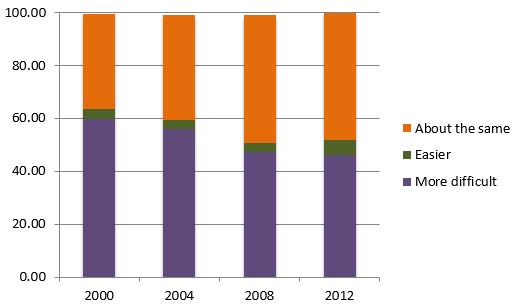
As we can see, the proportion of the public supporting tougher regulation is shrinking over the time period, while satisfaction with current regulations increased. Yet, support for tougher gun laws is the most popular choice in all included years. It is important to note that these data were collected before Aurora, Newtown, and the Navy Yard shootings. The 2016 ANES study will no doubt add more insight into this contentious, important issue.
Jan 23, 2014 | Current Events, International, National
Post developed by Katie Brown in coordination with Ronald Inglehart.
Time Magazine’s 2013 cover story by Joel Stein labeled Millennials – the generation born between the early 1980s and the early 2000s – as self-entitled narcissists. That story is one in a slew of articles berating Millennials for a host of issues. But the Time story in particular caused quite a stir, spawning both similar critiques and rebuttals in the mainstream press.
But what are Millenials really about? Center for Political Studies Research Professor Ronald Inglehart is the Founding President of the World Values Survey (WVS). Conducted in waves, the WVS traces values and cultural exchange over time and across the world. WVS data offer insight into the world’s Millenials generation.
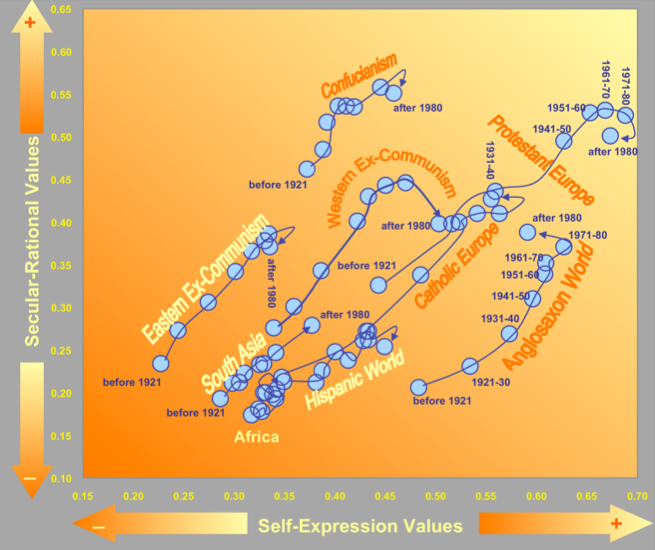
The graph above shows where WVS respondents fell on two values scales by birth year, within various groups. Within each group, Millenials are represented by the blue dots for those born after 1980. This evidence from the WVS suggests that the Millennials generation demonstrates higher self-expression than most of the other generations within each group. Greater self-expression values means having more action resources – both material and cognitive. The chart below highlights the chain reaction set off by these action resources.
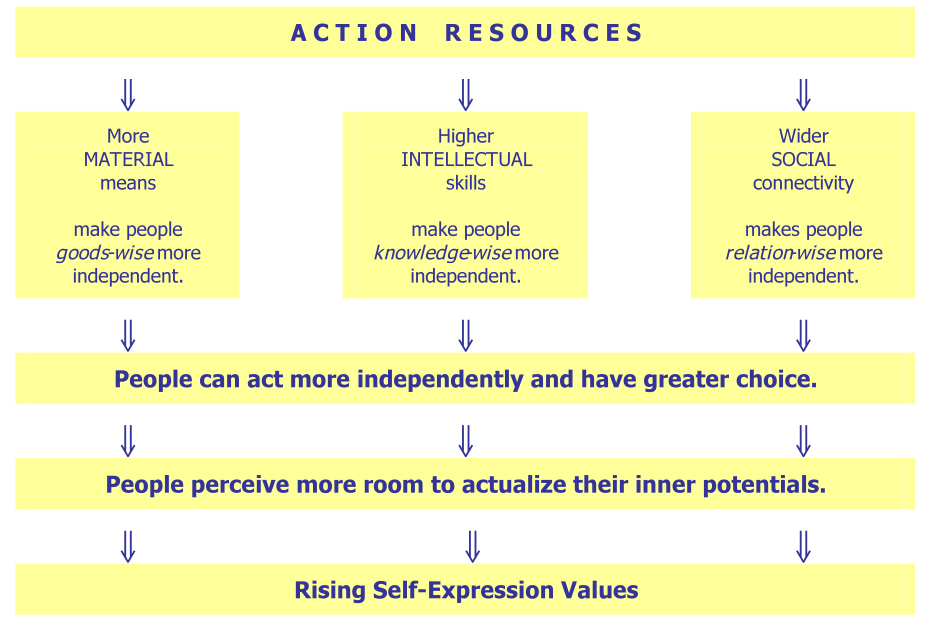
How can we see this enhanced self-expression in action? In support for environmental protection, tolerance of diversity and out-groups like foreigners and LGBT populations. In valuing political and economic participation. And in emphasizing imagination and tolerance when rearing children. Also accompanying higher self-expression values are a greater sense of subjective well-being and interpersonal trust. These trends bring hope for the future led by the often vilified Millennial generation.
Jan 2, 2014 | Current Events, Foreign Affairs, International
Developed by Katie Brown in coordination with Ronald Inglehart.
The World Values Survey tracks values and cultural change over time and across the world. Conducted in five waves from 1981 to 2007 – with a sixth wave being collected now – the survey samples from 90% of the world’s population.
The World Values Survey is especially interested in human empowerment. To map the process of empowerment, World Values Survey researchers created the Utility Ladder of Freedoms. Climbing the ladder means moving from a life based in threats to a life based in opportunity. Nations can climb the ladder as their citizens have more ways to improve their daily lives, like education. Typically, the higher a nation climbs on the ladder, the more universal freedoms are tolerated and practiced within that nation. Here, we use the ladder to take a closer look at the country of Turkey.
In August 2013, the Center for Political Studies (CPS) Blog featured a post about the protests in Turkey, suggesting that the government’s violent response was related to Turkey’s weak democracy. Since that time, the protests in Turkey have settled down. However, Turkey’s bid to host the 2020 Olympics has replayed some of these earlier tensions. Some have expressed that the political transformation and violence would make the selection of Turkey a risky choice. After Japan was instead selected to host the 2020 Olympics, some Turkish citizens actually celebrated, using the opportunity to criticize the Turkish government.
So, where is Turkey in its climb up the Utility Ladder of Freedoms?
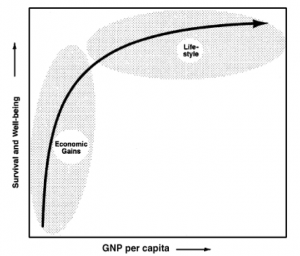 Let’s start with Happiness. The World Values Survey asks about happiness and life satisfaction – what we’ll call Subjective Well Being. An article by CPS Researcher Inglehart, Roberto Foa of Harvard University, the late pioneer of positive psychology Christopher Peterson, and Christian Welzel of Germany’s Leuphana University, looks at the determinants of Subjective Well Being. As the chart to the left shows, Subjective Well Being rises very quickly as Gross Domestic Product (GDP) rises, but then levels off. An earlier Inglehart study from 1991 also finds a connection between GDP and life satisfaction. So, earning more money means higher well being, but only to a point.
Now let’s consider Turkey. The graph below plots the GDP of specific countries against their reported Subjective Well Being. Turkey has a lower GDP and a Subjective Well Being at the mid-point between survival and well being. Inglehart’s earlier work finds that the as Subjective Well Being increases, so does democratic potential. So, Turkey’s mid-level happiness correlates with its weak democracy.
Subjective Well Being vs. GDP
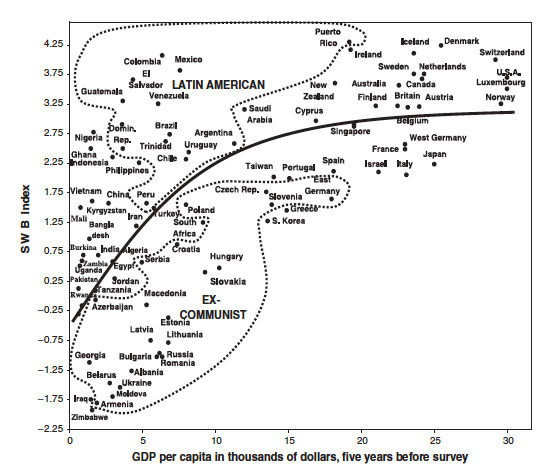
But, Turkey’s Subjective Well Being is on the rise. The chart below shows that Turkey’s Subjective Well Being is increasing faster than most other nations. By that logic, Turkey’s democratic potential should also be on the rise.
Subjective Well Being
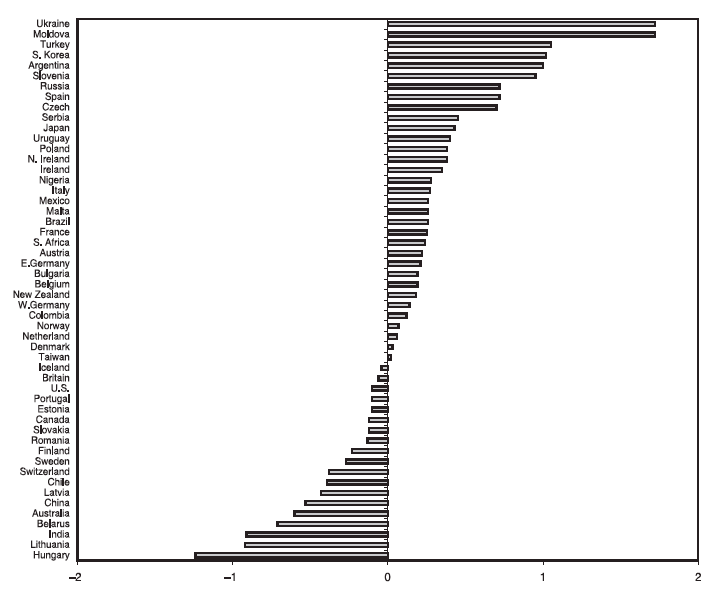
Position on the Utility Ladder of Freedoms depends on choice, equality, autonomy, and voice – all qualities that also act as keys to democracy. Turkey’s Subjective Well Being and its potential for democracy are on the rise. So, Turkey seems poised to climb the ladder. However, the sometimes disconnect between the country’s government and citizens, occasionally to violent ends, suggests that moving up the ladder can be a rough climb.