Oct 28, 2013 | Conflict, Current Events, Foreign Affairs, Innovative Methodology, International
Post developed by Katie Brown in coordination with Mark Tessler.
Egypt attracted international attention as a key participant in the Arab Spring. Along with Tunisia, it was among the first countries to witness the fall of a decades-long authoritarian regime. In early 2011, protestors demanded that then Egyptian President Hosni Mubarak step down. In February 2011, Mubarak relented, turning over power to the military.

Photo credit: Thinkstock
In November of 2011, the country held parliamentary elections and these were won by the Muslim Brotherhood’s Freedom and Justice Party. In June of 2012, the Brotherhood’s Mohamed Morsi was elected president of Egypt. Over the next year and a half, Morsi pushed remaining officials from Mubarak’s reign out of government, all the while consolidating his power.
With the economic situation deteriorating, and with conflicting claims about who was responsible, anti-Morsi protests spread throughout Egypt in summer 2013. Then, on July 3, 2013, in response to the growing unrest, the military removed Morsi from office. Violent clashes between the military and supporters of the Muslim Brotherhood followed and have continued sporadically since that time.
A key question raised by these events, and by post-Arab Spring developments in a number of other Arab countries, concerns the role to be played by Islam in government and political affairs. As expressed by Egypt’s Grand Mufti in April 2011, following the ouster of Mubarak, “Egypt’s revolution has swept away decades of authoritarian rule but it has also highlighted an issue that Egyptians will grapple with as they consolidate their democracy: the role of religion in political life.”
Center for Political Studies (CPS) Researcher and Samuel J. Eldersveld Collegiate Professor of Political Science Mark Tessler is making major strides to understand what ordinary citizens in Egypt and other Arab countries think about the complicated and contested relationship between religion and politics in the Middle East. Among the data on which Tessler is drawing is the multi-country Arab Barometer survey project, which Tessler co-directs. Arab Barometer surveys in Egypt in 2011 and 2013 offer insights about how recent events have influenced the way the Egyptian public thinks about Islam’s political role.
One finding from these surveys is that most Egyptians believe democracy and Islam to be fully compatible, and this view did not change between 2011 and 2013. On the other hand, while most Egyptians have confidence in Islam itself, there has been a dramatic decrease over this period in the proportion that believes that the country is better off when religious people hold public office. Some Egyptians describe this as wanting Islam but not Islamists.
These Arab Barometer surveys are part of a larger dataset pertaining to Islam and governance that Tessler has constructed with support from the Carnegie Corporation of New York. The dataset pulls together information from 44 nationally representative surveys conducted in 15 countries in the Middle East and North Africa and includes not only respondent political and social attitudes but also major characteristics of the country of which the respondent is a citizen.
Tessler’s analysis of these data will be published in a forthcoming book, Islam and the Search for a Political Formula: How Ordinary Citizens in the Muslim Middle East Think about Islam’s Place in Political Life. The book will offer a deeper understanding of the desired role of Islam in politics across the Middle East, a religion and region often misrepresented in American media, politics, and minds. In addition, the database will be placed in the public domain for use by other scholars who study the relationship between religion and politics.
Oct 14, 2013 | Conflict, Current Events, Foreign Affairs, International
Post developed by Katie Brown in coordination with James Morrow.
Photo credit: Thinkstock
The horror in Syria has gripped international attention, especially in recent weeks with the release of images of those killed by chemical weapons. But why would Bashar al-Assad, the President of Syria, use chemical weapons when he is winning the civil war against insurgents?
Center for Political Studies (CPS) Research Professor and A.F.K. Organski Collegiate Professor of World Politics James Morrow recently spoke to this issue on MSNBC’s The Last Word. Assad’s target was a rebel controlled neighborhood in Damascus, the capital of Syria. A large chemical attack would scare other civilians, inducing them to flee for safety. After they left, Assad could move his forces into one the few remaining rebel areas. Morrow also highlights the timing of Assad’s chemical strike: it occurred after the rebels began to lose ground across Syria. Assad used chemical weapons precisely because he is winning.
Morrow’s comments on MSNBC are grounded in his research. In a forthcoming book, Order Within Anarchy, Morrow models violations of the laws of war, like the use of chemical weapons. Violations typically come early in war. When they come later – as in Syria – violations tend to be perpetrated by the winning side. The violation itself increases the perpetrator’s chance to win the war. Thus, Assad’s deployment of chemical weapons could be seen as a coup de grâce.
Yet, Assad also faced a strong global backlash. Obama declared a red line crossed and seemed poised to order counter-attacks on Assad. Such a strike could undo any gain from the chemical weapons. But, Russia – who, with China, blocked approval to counter-attack Syria in the United Nations – proposed an alternative solution: order Assad to surrender his chemical weapons for destruction by international monitors. Obama and Assad agreed to this approach. Last week, Assad received praise for his steps to chemically disarm. And also last week the Nobel Prize committee awarded the Organisation for the Prohibition of Chemical Weapons with the Nobel Peace Prize for its efforts to disarm Syria. But the gains of his use of chemical weapons remain.
Sep 5, 2013 | Current Events, Elections, Innovative Methodology, National
Post developed by Katie Brown in coordination with Michael Traugott.
In the American presidential election of 2012, most polls predicted a narrow win for Democratic incumbent Barack Obama over Republican challenger Mitt Romney. But on November 5, 2012, Obama won both the popular vote (62,611,250 to 59,134,475) and the Electoral College (332 to 206) by a comfortable margin.
Most major polling organizations underestimated Obama’s votes, yet closely targeted Romney’s outcome. Gallup and Rasmussen, on the other hand, overestimated Romney’s vote share, projecting that he would win.
In order to understand its error and, more importantly, correct its estimation for future elections, Gallup called upon Professor of Communication Studies and Center for Political Studies (CPS) Research Professor Mike Traugott. Traugott studies public opinion, survey methodology, and voting technology, with more than 100 articles and book chapters and 12 books published.
Traugott’s connection to the project goes beyond his expertise. Early in his career, he worked for Gallup founder George Gallup. Traugott has also served as president of the American Association for Public Opinion Research (AAPOR). In 2008, he chaired an AAPOR committee to investigate the causes of an industry-wide estimation error in the New Hampshire primary. As a follow up, AAPOR launched an initiative to make polling practices more transparent. Though the initiative garnered initial support, it hasn’t matured as rapidly as hoped because many commercial firms are reluctant to expose their proprietary methods. Yet, given the widespread mispredictions of 2012, Gallup agreed to make its investigation transparent as a service to the public and the pre-election polling profession.
Gallup’s initial investigation, led by Traugott and published here, identifies several potential contributing factors to the errant projection. The main problem appears to lie in the sampling design. Gallup interviews potential voters using only a combination of listed landline and cell phones. Because listed landline users are more likely to be conservative, Gallup’s respondent pool skewed conservative. Other potential factors include giving more weight to past voting behavior than other polls, time zone issues, and the format of race and ethnicity questions. Further, Gallup, like other major polling organizations, does not take the candidates’ campaign effort into account. As this map illustrates, in 2012, the candidates focused most of their campaign spending in battleground states, which in turn impacted turnout and vote choice by state.
In response to the report, Gallup has brought in a team of researchers which will test the hypotheses derived from the initial report during the 2013 New Jersey and Virginia gubernatorial elections. Traugott is also leading a graduate seminar this fall at the University of Michigan that will allow students to participate in the design of the experiments and analyze data related to the inquiry. According to Traugott, this is a “very unusual, almost once in a lifetime chance to combine real world applications of conceptual and theoretical issues about survey design.”
Aug 29, 2013 | Current Events, Foreign Affairs, International
Post developed by Katie Brown in coordination with Ken Kollman.
Photo credit: Thinkstock
On July 22, 2013, the European Union (EU) declared that the military wing of Hezbollah was now on its list of terrorist organizations. This reversal of policy has implications for Hezbollah and the EU’s influence in parts of the Middle East.
Three events precipitated the change in policy by the EU. First, while Hezbollah denies involvement, most blame people in the group for a 2012 bus bombing in Bulgaria. Second, Hezbollah forces are fighting on behalf of Assad in Syria, while the EU is openly supporting the Syrian rebels. Three, a Lebanese Swedish man on Hezbollah’s payroll was charged and sentenced in 2013 for planning to attack Israeli tourists in Cyprus.
The declaration of Hezbollah’s military wing as a terrorist group took longer than many expected and came belatedly after years of prodding by the United States government. Decisive foreign policy decision making of this kind is difficult to achieve in the EU given its lack of a centralized executive with well-defined responsibilities for foreign affairs.
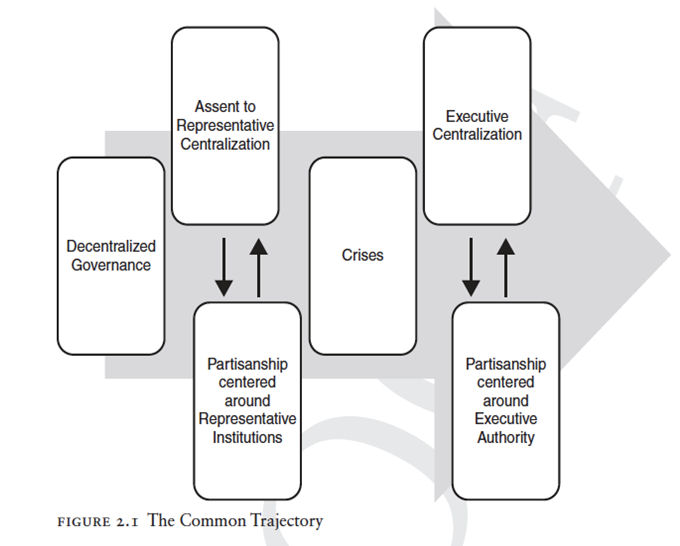
Ken Kollman, Center for Political Studies (CPS) researcher and director of the International Institute at the University of Michigan, has a forthcoming book examining the histories of federated institutions like the EU to learn of the development of centralized executive power. In Perils of Centralization: Lessons from Church, State, and Corporation, Kollman dissects the histories of the U.S. government, the Roman Catholic Church, General Motors Corporation (GM), and the EU. In the book he argues that the EU is at a turning point. It has evolved what he calls representative centralization, which means that the countries of the EU still exert considerable authority over centralized decision-making. Unlike the U.S. government, which has tipped into what Kollman calls executive centralization, the EU countries, when they lack a consensus on matters like the Hezbollah listing, find many ways to delay unified decision-making. In the U.S. the subunit governments and subunit representatives have largely delegated to a single executive (the president) foreign policy decision-making power.
The Figure shown here from Kollman’s book shows the typical pattern for federations, but he notes that the EU is now poised between assent to representative centralization and executive centralization.
While Brussels exercises authority that supersedes a given nation on several key policy issues, the power is diffuse. When policy decisions are announced, for example, three or more leaders often stand behind the microphone, a symbol of both multiplicity and unclear jurisdictions. Executive power in the EU is not unified and often cannot be decisive.
The example of the lengthy process of Hezbollah’s listing and other similar examples showcase EU’s fragmented political power. Its halting evolution as a federated system leads to its precarious position as a potential player on the world stage.
Aug 16, 2013 | Current Events, Foreign Affairs, International, National
Post developed by Katie Brown in coordination with Darrell Donakowski
Yesterday, The Washington Post released an internal report from the National Security Agency (NSA) revealing the agency broke its own privacy rules thousands of times per year since 2008. The source? Edward Snowden, former Central Intelligence Agency (CIA) employee and analyst at NSA contractor Booz Allen. The Post release is the latest chapter in the story of Snowden and government trust.

Photo credit: Thinkstock
In June and July of this year, UK’s The Guardian published a series of news articles revealing surveillance by NSA. The US charged Snowden with espionage and revoked his passport. On the lamb, Snowden flew to Hong Kong from Hawai’i. WikiLeaks founder Julian Assange worked to broker asylum for Snowden in Iceland to no avail. Snowden moved onto Russia, residing in the transit zone of Moscow’s Sheremetyevo airport for over a month. On August 1, Russia granted Snowden a one-year asylum. Snowden has an additional 20 applications out for asylum.
Snowden’s asylum prospects complicate US international relations. Obama canceled a summit with Russian Prime Minister Vladimir Putin. Senator Lindsey Graham (R) called for a boycott of the 2014 Olympics in Sochi, Russia, a plan rejected by Speaker of the House John Boehner. On July 2, Bolivian President Evo Morales’ plane was denied entry to several European nations’ airspace and airports amid rumors Snowden was on board, stressing European and US relations with several Latin American countries (Bolivia, Venezuela, and Nicaragua granted Snowden’s request for asylum).
In the wake of the story, questions turned into a debate in the media as to how to understand Snowden. Leaker? Traitor? Punk? The American public appears to see Snowden as a whistleblower. Further, the media linked the immediate fallout – plus the IRS scandal and Benghazi trials – with an 8 point drop in Obama’s approval rating. Hovering around 44%, Gallup shows Obama’s recent ratings below the presidential average of 54%.
But what about trust in the government in particular? The American National Election Studies offers a glimpse of trust in government across time. Asked how much of the time the government does what is right, respondents could choose between three answers: “just about always,” “most of the time,” and “some of the time,” with some respondents volunteering “none of the time.” The graph below displays the spread across time and across answers.
How much of the time do you think you can trust the government in Washington to do what is right?
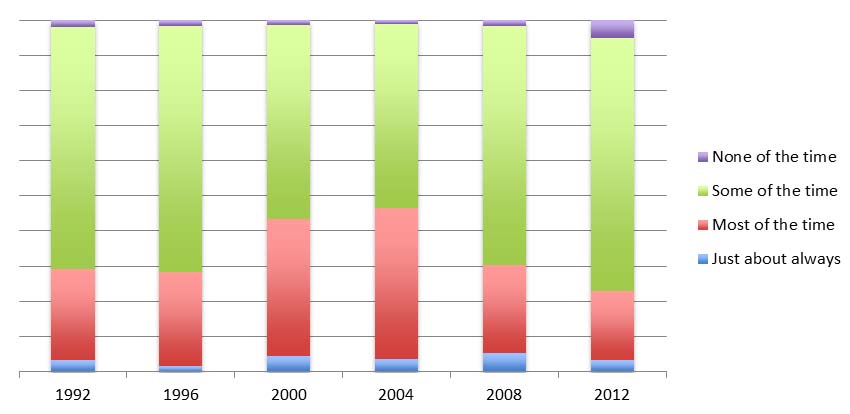
While this graph does not correspond to the Snowden event, it contextualizes the attributed decrease in trust across time. That is, the decrease in trust attributed to the leak would correspond to a generally decreasing trend.
Last week, Obama announced an overhaul of NSA surveillance. Though Obama refuses to acknowledge Snowden as a catalyst for the changes, Assange claims the move vindicates Snowden. The move suggests a push for transparency and restored trust in the government.
Aug 7, 2013 | Conflict, Current Events, Foreign Affairs, International
Post developed by Katie Brown in coordination with Christian Davenport
Photo credit: Thinkstock
On August 5, 2013, a Turkish court convicted 275 people, including ex-military officers, of plotting to overthrow Prime Minister Recep Tayyip Erdogan. Though the court case took five years, the verdict comes at a tenuous moment in Turkish politics, deepening the divide between Ergodan and critics.
This summer, protests erupted across Turkey. Initially a movement against the planned development of Taksim Gezi Park, a rare patch of green in the city of 13.5 million, the uproar spread as general government dissent. A small fraction of the protestors resorted to violence. The government cracked down with force in response. Erdogan initially presented a mixed message, alternating between ultimatums, violence, and agreeing to meet with protestors. By the end of June, his message and tactics showed more force. More than 5,000 were injured and 4 killed. Doctors tending to the wounded were arrested, a fact verified by Erdogan. The government also worked to block social media, blamed for spreading the word. And Ergodan lashed out against international media, claiming false representation.
The violence is noteworthy in a country with an emerging democracy with dreams of ascension into the European Union. But is the violence really a surprise?
Research on violent dissent by Center for Political Studies researcher Christian Davenport sheds light on the current situation in Turkey, through his work on the power of democracy to ease repression. A central thesis of the work asserts the calming power decreases in the face of violent dissent. Using a cumulative index created by Polity, Davenport published an article with David Armstrong. The authors find that lower levels of democracy, unlike higher levels of democracy, have no calming influence on violent repression.
A graph from Polity shows the trend over time, illustrating that Turkey is not just a weak democracy, but emerging in many senses. Davenport’s work helps us understand that the violent reaction in response to anti-government protests is not surprising given Turkey’s relatively weak democracy. Turkey’s democracy is weak enough that it cannot pacify repression of this sort.
The EU passed a resolution in response to the violent repression. Erdogan fired back that the EU should, “know [its] place!” The repression was not quelled by Turkey’s weak democracy, nor it seems the EU, both of which are challenged by the violence.
Interestingly, the protests in Turkey are credited with inspiring anti-government protests in Brazil. And while initial protests in Brazil were met with tear gas and rubber bullets, the number of injuries rests near 100. Prime Minister Dilma Rousseff even supported the right to protest, while expressing interest in listening: “These voices need to be heard, my government is listening to these voices for change.” Yet the protests continue and are forecasted to continue up to the 2014 World Cup, hosted in Brazil and a source of dissent.