Words That Matter is the collaborative work of eight authors: Leticia Bode, Ceren Budak, Jonathan M. Ladd, Frank Newport, Josh Pasek, Lisa O. Singh, Stuart N. Soroka, and Michael W. Traugott. The authors have expertise in a range of disciplines including public opinion, communications, public policy, and computer science, and they take different approaches to the study of campaign media. As a result, the book is nuanced in its handling of news content, social media posts, and survey responses.
There are a number of reasons that the 2016 presidential campaign was exceptional. The media landscape has changed dramatically in recent years, with many people accessing and sharing news through social media. The authors find that news coverage during the 2016 campaign “was more negative than in recent previous presidential campaigns, consistent with these candidates being the most personally unpopular nominees in polling history.”
Words That Matter guides readers through the media’s process of producing information, how that information gets to voters, and what information voters actually absorb. The authors argue that advances in media technology call for new ways to measure the information environment. They address this challenge through innovative surveys and content-analytic research techniques.
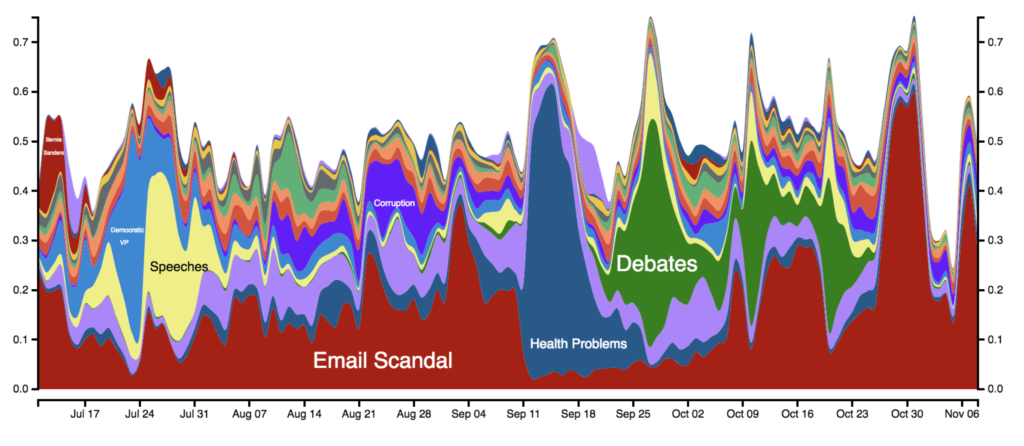
This figure highlights the changing topics that Americans remember about Clinton since July 2016. The x-axis shows the date and the y-axis the fraction of responses that fall into a particular topic.
A key finding of the work is that the largely negative campaign played out differently for the two major party candidates: Donald Trump was confronted with a shifting but largely uninfluential series of scandals, whereas Hillary Clinton faced a single, stable, and influential scandal involving her use of a private email server. The authors show that the long-standing nature of the email scandal made it especially sticky in the public mind. They write “Even when there was other news about Hillary Clinton, the public thought about ‘her emails’—for months and months—indeed, starting before the election campaign was even underway.”
Some scholars are skeptical that the media have the power to influence votes, whereas others believe that campaign messaging can have a large effect. The authors show that not all voters are equally open to influence. The most politically-engaged voters are steadfast, while the least engaged are difficult to reach at all. “The fact that middle- and low-engagement voters are the most susceptible to influence,” write the authors, “also helps us understand why the topics given heavy attention in the media environment can be consequential.”
News stories that are repeated over a long period of time are the most likely to be noticed by people who are not highly engaged with politics. The authors also find that telling people how to vote is less effective than simply changing the subject. Voters who don’t follow the news carefully may not remember the details of various scandals, but they do tend to notice if one specific issue garners sustained coverage. Those sustained scandals stand out as more important when voters make their choice.
The authors conclude that media content can indeedshift voter behavior for some voters, and that in a close election like the 2016 presidential election, these effects can be of real consequence.
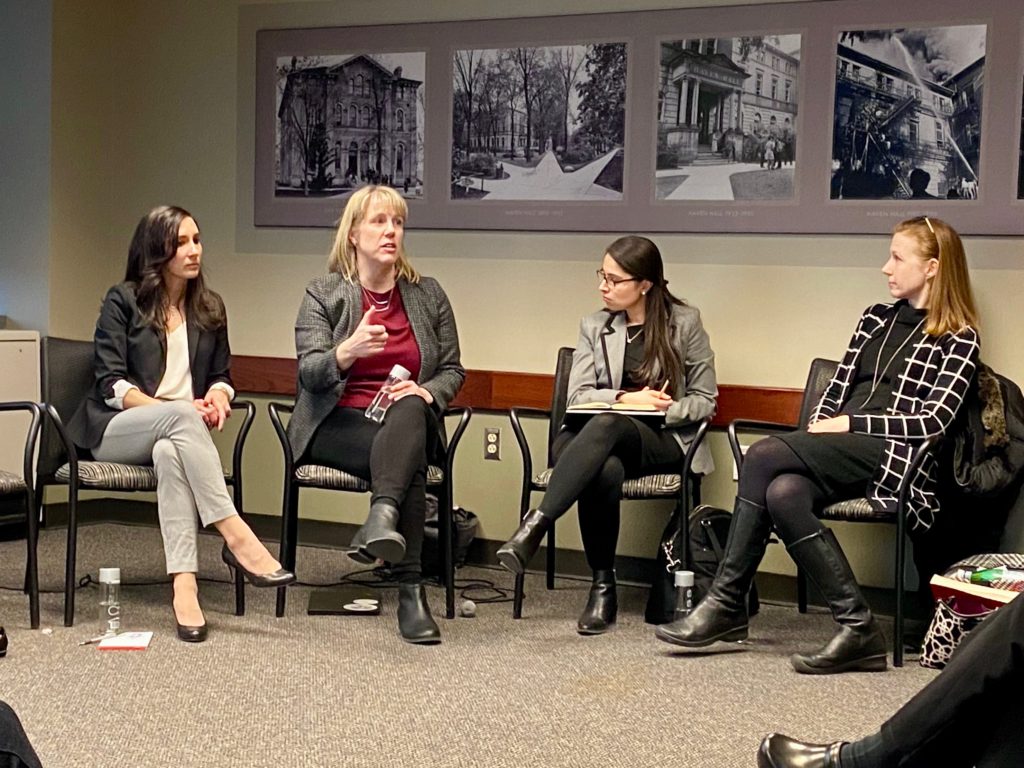
A panel of prominent political scientists presented their research at the panel “One Hundred Years of Women Voting: The Nineteenth Amendment’s Legacy and Current Implications” on Monday, February 24, 2020. The experts discussed the political behavior of women leading up to and since the passage of the Nineteenth Amendment to the U.S. Constitution, which granted women the right to vote. Jenna Bednar, professor of political science at the University of Michigan and research faculty at the Center for Political Studies, moderated the discussion. The event was part of the U-M Department of Political Science Rubin Speaker Series and U-M Suffrage 2020 event series.
Mara Ostfeld, Christina Wolbrecht, Angela Ocampo, and Corrine McConnaughy
Popular views of women voters over the past 100 years, and what the evidence actually tells us about them
In her newly-released book, A Century of Votes for Women: American Elections Since Suffrage, Christina Wolbrecht, professor of political science at the University of Notre Dame, presents evidence to challenge some of the long-standing beliefs about the way women vote and engage in politics.
In the first several decades of women’s suffrage in the U.S., understanding of women’s political behavior was based on rhetoric, not based on data, said Wolbrecht. Data does show that married women often voted as their husbands did. Political experts interpreted this correlation as evidence of political disinterest on the part of women, but this conclusion was not based on data. Following the belief that women didn’t form independent political opinions, Gallup used quota controlled sampling that undersampled women. The American Voter describes women as following their husband’s wishes rather than voting according to their own beliefs.
Wolbrecht argues that these unsupported conclusions still matter today because these books are still read today. She emphasizes that although married women often vote as their husbands do, we don’t know who is influencing whom.
Political Pioneers: Women of Color as Candidates and Elected Officials
Angela X. Ocampo, a research fellow in the department of political science and the Center for Political Studies, presented current research assessing the representation of women of color as political candidates and elected officials. “Women don’t get access to vote until their racial group does,” said Ocampo, noting that women of color were still denied the right to vote or hold elected office on the basis of race after the passage of the Nineteenth Amendment.
Most research on women of color in elected office focuses on the federal level, but Ocampo, along with her research collaborator, Ana Oaxaca, is studying representation in local government. Their research shows that women are most likely to be elected from places that are protected by the Voting Rights Act. Following the Supreme Court’s decision in Shelby County v. Holder, which significantly weakened the Voting Rights Act, Ocampo sought to understand how the representation of women of color was affected at the local level.
To answer this, she’s analyzing data on city councils in the 300 largest U.S. cities to isolate the factors that are associated with a high proportion of women of color council members. Women of color are underrepresented in city councils, making up only 10% of council members. Ocampo finds that the more Democratic a locality is, the higher the proportion of women of color and minority council members. Proxies of political power are also important. When there is a higher proportion of more minority voters in a city, the proportion of women of color and minority council members also increases.
Ocampo concludes that gains have been made in representation, but parity is yet to be achieved. Representation of women of color and minorities depends on political pressures and the voting power of minority voters. She cautions that upward trends in the representation of women of color and minorities will likely be derailed by efforts to suppress minority votes.
Hidden Politics: Women’s Organizing and the Shape of American Democracy
Corrine McConnaughy is an Associate Professor of Political Science at George Washington University. She earned her Ph.D. at the University of Michigan and worked closely with many of the faculty during that time.
McConnaughy said that to find examples of women doing political work in the period before suffrage, we must look beyond formal suffrage organizations. Whether political organizing was taking place within suffrage organizations or other organizations, historians find common themes in women’s political activity in the period before the nineteenth amendment. Women were doing crucial service work in their communities and creating innovative ways to gain power. Importantly, women were doing political work as women, but not unified by womanhood.
The suffrage movement faced challenges because women were not seen as a promising voting bloc, McConnaughy said. Because so many people believed women would vote as their husbands did, no party stood to gain an advantage by allowing women to vote. For this reason, bi-partisan support was essential to gaining franchise. The ability to form coalitions with other groups also proved essential. Suffragists were well-organized and good at raising money, which made them attractive coalition partners.
Why Women Oppose Policies that Support Women
The final speaker was Mara Ostfeld, is a Faculty Associate with the Center for Political Studies and an Assistant Professor in the Department of Political Science. She presented research she is conducting with two graduate students, Lauren Hahn and Sara Morell.
Ostfeld framed their question: “In the 100 years that women have had access to voting rights, and in the context of women constituting the majority of voters in America, why hasn’t there been more progress for policies to provide women with equitable opportunities?” She cited statistics to illustrate the issue: 20% of women say that reports of the gender pay gap are overblown; one-third of women say that women who complain about sexual harassment create more problems than they solve; another third believe that at least half of the time that women demand equality, they’re actually seeking special favors.
Family socialization is the key reason for these beliefs, according to Ostfeld. “Unlike other marginalized groups, women are not raised in women-majority environments,” she noted.
Ostfeld, Morell, and Hahn conducted a survey to gauge how women believe their family members would react to taking pro-women positions, to assess how women perceive the social costs of their beliefs within their families. The survey also asked about the polices the women supported. Ostfeld found clear evidence that women who believed they will be stigmatized for embracing policies to promote gender equality are far less likely to support those policies. Even among women respondents who recognized the gendered disparities motivating the policies, they were still less likely to support policies promoting gender equality if they felt their family members would stigmatize them for doing so.
Christian Sandvig, the Director of the new Center for Ethics, Society, and Computing (ESC), says he developed this new center “to reconcile the fact that I love computers, but I’m horrified by some of the things we do with them.” ESC is dedicated to intervening when digital media and computing technologies reproduce inequality, exclusion, corruption, deception, racism, or sexism. The center was officially launched at an event on January 24, 2020. Video of the event is available here.
The associate director of ESC, Silvia Lindtner, elaborated on ESC’s mission at the event. “I’ve learned over the years not to shy away from talking about things that are uncomfortable,” she said. “This includes talking about things like sexism, racism, and various forms of exploitation – including how this involves us as researchers, and how we’ve experienced these ourselves.”
ESC is sponsored by the University of Michigan School of Information, Center for Political Studies (CPS), and the Department of Communication and Media. CPS Director Ken Kollman called the new center “an exciting, interdisciplinary effort to ask and address challenging questions about technology, power, and inequality.” Thomas Finholt, Dean of the School of Information, said, “if you look at the world around us there are a seemingly unlimited number of examples where individual leaders or contributors would have benefitted dramatically from the themes this center is going to take on.”
The wide range of disciplines represented among the ESC faculty is essential to its mission. “To have people in computer science, engineering, social science, and humanities interacting together on questions about the impacts of technology strikes me as the kind of necessary, but all too rare, collaborative efforts for generating new ideas and insights,” Kollman said.
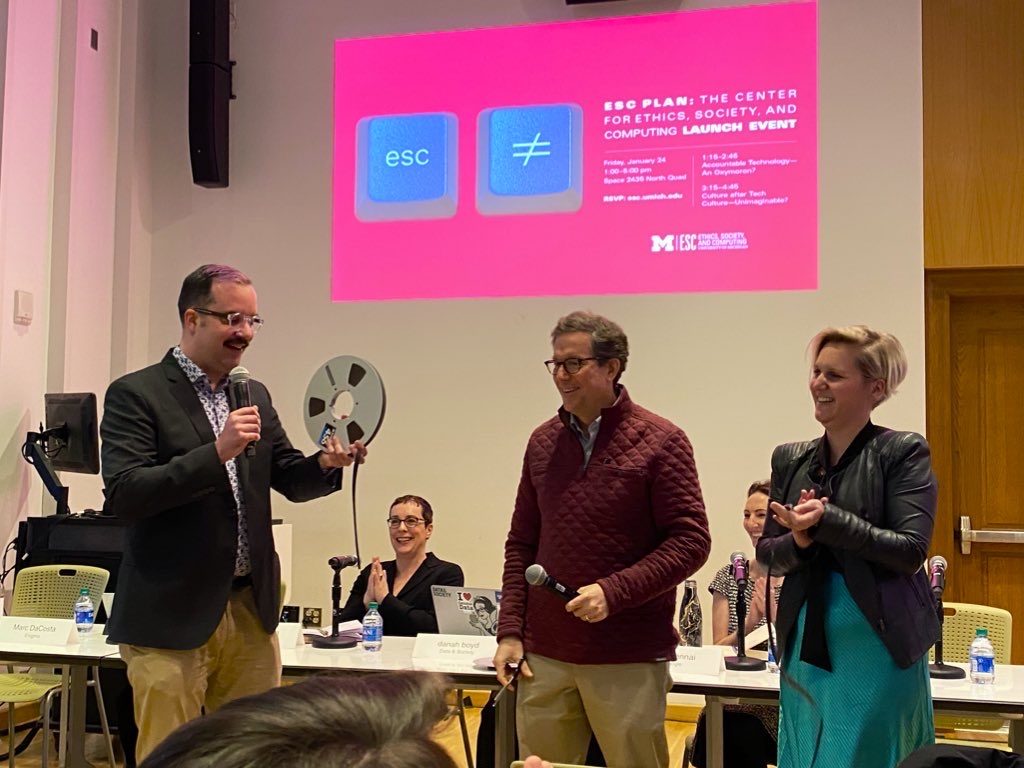
Christian Sandvig, Thomas Finholt, and Sylvia Lindtner cut the ribbon to launch the ESC Center
The launch event was comprised of two panel discussions featuring notable experts in technology and its applications. The first panel, “Accountable Technology — An Oxymoron?” explored the ways that big companies, the media, and individual consumers of technology hold the tech industry accountable for issues of equity and fairness. Pulitzer Prize-winning journalist Julia Angwin highlighted journalists’ role in investigating and framing coverage of tech, including her work to launch a publication dedicated to the investigation of the technology industry. Jen Gennai, Google executive responsible for ethics, fielded questions from the audience about accountability. danah boyd, Principal Researcher at Microsoft Research and the founder of Data & Society, and Marc DaCosta, co-founder and chairman of Enigma, rounded out the panel, which was moderated by Sandvig.
During the second panel, “Culture After Tech Culture — Unimaginable?” Silvia Lindtner, Holly Okonkwo, Michaelanne Dye, Monroe Price, Shobita Parthasarathy, and André Brock debated the inevitability of technology’s impact on culture, and how the future might be reimagined. The panelists challenged the audience to think of technology from the perspectives of different cultures around the world, not just a single monolithic entity. Questions from the audience interrogated the ways the tech could be more inclusive.
ESC organizers encourage students and faculty to get involved with the new center. A series of mixers to get to know ESC are scheduled through the spring.
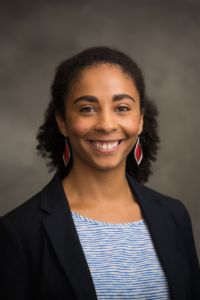
Shea Streeter began her graduate work in political science as a comparativist interested in state repression around the world. When the protest movement in Ferguson, Missouri exploded after the killing of Michael Brown, Streeter turned her attention to police violence and protest in the United States. As a President’s Postdoctoral Fellow at the University of Michigan, she’s examining how race and gender shape the ways that people experience, perceive, and respond to incidents of violence.
“Racial animus is in the air we breathe,” Streeter says, “but when we look at police violence, we can get distracted by race and ignore other important factors.” Her dissertation included an experiment to examine how the race of victims of police violence determines whether the public sees the violence as just. Surprisingly, she finds that the race of the victims is less salient than expected. Instead, the social context strongly shaped the attitudes of the respondents. Those who were predisposed to consider societal and institutional forces were less likely to believe the victim deserved the outcome, compared to respondents who place sole responsibility on the individual.
Racial differences in rates of protest
Half of the people killed by police each year are white, and yet the rate of protest over white victims of police violence is very low. A dataset that Streeter is currently completing includes all publicly available information on police killings and any protests that happened in 2015-2016. For those two years, about a third of the police killings of African Americans led to some sort of protest, but when whites were killed by police, protests occurred only five percent of the time. “I argue that it’s the biggest racial gap related to policing,” Streeter says. “There are a lot of reasons we could point to why African Americans would be protesting. But why wouldn’t whites also be protesting when their community members are killed?”
When conducting field research in several different cities in the United States, Streeter asked community organizers about protests for white victims of police violence. The organizers told her that they reach out to the families of white victims, but those families often do not want to be involved with protests. Instead, many white family members express understanding and forgiveness toward the police. Streeter makes sense of these reactions by tying them to the psychological concept of a belief in a just world. The idea is that people get what they deserve and they deserve what they get. Streeter observes that even when people who hold this belief lose a member of their own family, their trust in the police remains unchanged. “If you have these beliefs, it can be like a double loss,” Streeter notes, which may explain why there are fewer protests for white victims of police violence.
The role of mentorship
Mentorship has played a large role in Streeter’s academic career. Christian Davenport became a mentor to her when she was a senior at Notre Dame. At that time, Streeter was thinking about her career but hadn’t considered pursuing research. While working as a research assistant for Davenport, he encouraged her to pursue graduate work in political science. Streeter cites this support as a key reason she decided to come to the University of Michigan. She also gives credit to David Laitin and Jeremy Weinstein at Stanford, who pushed her to study the United States when she was training as a comparativist. “I had confusion about what my identity as a scholar would be if I changed paths, but they put my fears to rest, so I give them a lot of credit for helping me pursue this research path,” Streeter says.
Looking forward
In addition to her ongoing research on police violence, Streeter is turning her attention to the ways interpersonal violence affects the way that people think and act politically. She sees connections between different types of violence, including mass shootings, domestic violence, and suicide. “We don’t often see these as political violence, but they affect how people operate in the world,” Streeter says. She’s especially interested in the ways violence affects people differently based on gender. Streeter’s work is innovative and varied, but united by a common theme, which she sums up as “How does violence affect our world, and what are the aggregate consequences of that? That’s the big picture.”
Post developed by Katherine Pearson and Dianne Pinderhughes
Drawing from published work that will be compiled as a new book, Black Politics After the Civil Rights Revolution, Dianne Pinderhughes explored the arc of 20th-century civil rights reform and the growing political incorporation of African Americans into electoral politics when she delivered the2019 Hanes Walton, Jr. lecture.
Understanding the history of collective action is essential to tracing the development of 20th-century racial politics in the United States. Pinderhughes began by describing racial injustice in the U.S. starting with thePlessy v. Ferguson decision in 1896, which some consider the nadir of race relations in the U.S. Following this era, Pinderhughes described a period of innovation and institution building beginning in the early and mid 20th century, which saw the development of legal defense funds and an increase of racial diversity in academia.
Social and political scientists recognize the gradual increase in African American political participation and the increasing numbers of elected officials of color. As the political dynamics of the eras changed, Pinderhughes described how African Americans have pushed to enter, to change, and to reframe their status.
Pinderhughes posits that the election of Donald Trump in 2016 posed a direct challenge to that framing of the evolution of successful racial reform. In doing so, she asks whether the U.S. is entering a new nadir. “My own work around these issues of democracy, political participation and efforts to integrate on a stable basis, and to begin to address the economic and political dimensions of citizenship, was challenged by how they might be framed,” Pinderhughes said. “But most of that work began from and was conceptualized within a relatively stable set of policy values and expectations, and that racial and ethnic exclusion was no longer possible, or acceptable.”
In the end, Pinderhughes concludes that the state of politics in the 21st century is far more hopeful than the nadir of the 19th and early 20th centuries. Institutional reforms have substantially recreated the American electoral and political process. Race is central to American life, and it will continue to be a dynamic force in electoral politics.
The Hanes Walton, Jr. lecture series was launched in 2015, in honor ofHanes Walton, Jr. One of the most influential and productive political scientists to emerge from the civil rights era, Walton published numerous journal articles, several book chapters, and authored more than twenty books. Walton is remembered for his in-depth subject knowledge, sense of humor, and ability to connect with his students. He was a caring and supportive mentor to his countless graduate and undergraduate students, many of whom have gone on to distinguished careers in academia and industry.
How much does partisanship explain how legislative districts are drawn? Legislators commonly agree on neutral criteria for drawing district lines, but the extent to which partisan considerations overshadow these neutral criteria is often the subject of intense controversy.
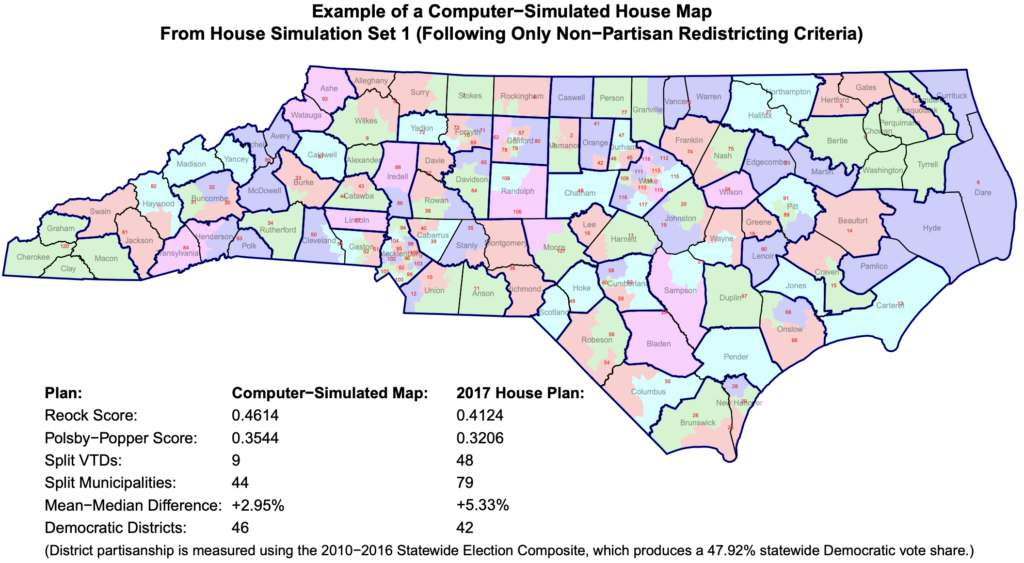
Jowei Chen developed a new way to analyze legislative districts and determine whether they have been unfairly gerrymandered for partisan reasons. Chen, an Associate Professor of Political Science and a Research Associate at the Center for Political Studies, used computer simulations to produce thousands of non-partisan districting plans that follow traditional districting criteria.
These simulated district maps formed the basis of Chen’s recent expert court testimony in Common Cause v. Lewis, a case in which plaintiffs argued that North Carolina state legislative district maps drawn in 2017 were unconstitutionally gerrymandered. By comparing the non-partisan simulated maps to the existing districts, Chen was able to show that the 2017 districts “cannot be explained by North Carolina’s political geography.”
The simulated maps ignored all partisan and racial considerations. North Carolina’s General Assembly adopted several traditional districting criteria for drawing districts, and Chen’s simulations followed only these neutral criteria, including: equalizing population, maximizing geographic compactness, and preserving political subdivisions such as county, municipal, and precinct boundaries. By holding constant all of these traditional redistricting criteria, Chen determined that the 2017 district maps could not be explained by factors other than the intentional pursuit of partisan advantage.
Specifically, when compared to the simulated maps, Chen found that the 2017 districts split far more precincts and municipalities than was reasonably necessary, and were significantly less geographically compact than the simulations.
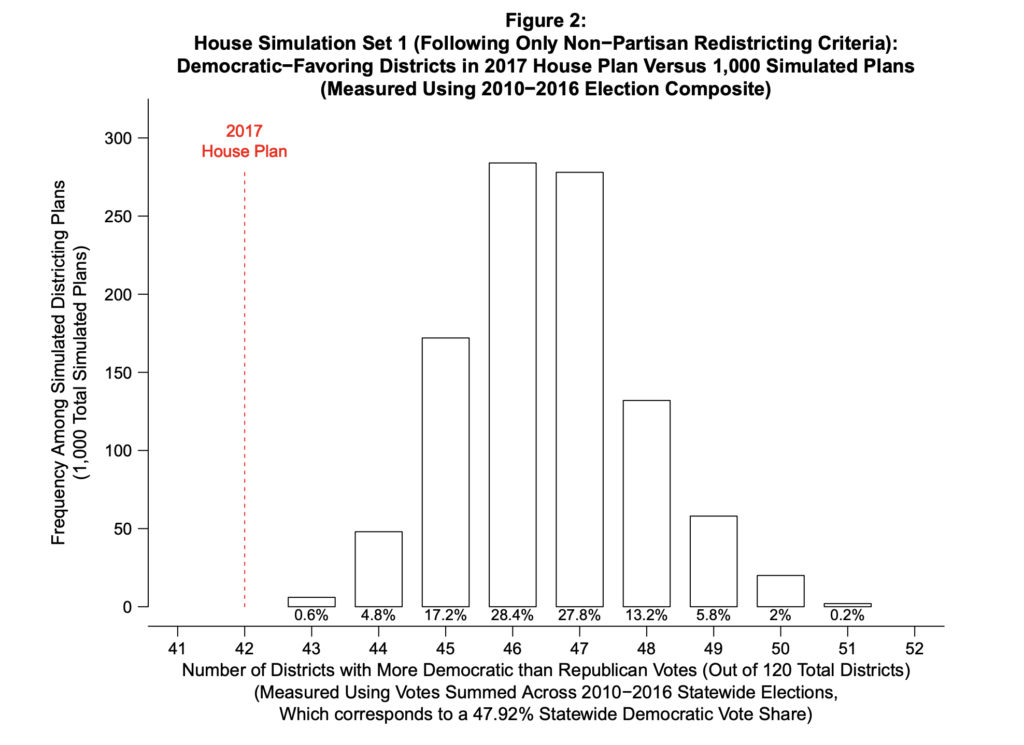
By disregarding these traditional standards, the 2017 House Plan was able to create 78 Republican-leaning districts out of 120 total; the Senate Plan created 32 Republican-leaning districts out of 50.
Using data from 10 recent elections in North Carolina, Chen compared the partisan leanings of the simulated districts to the actual ones. Every one of the simulated maps based on traditional criteria created fewer Republican-leaning districts. In fact, the 2017 House and Senate plans were extreme statistical outliers, demonstrating that partisanship predominated over the traditional criteria in those plans.
Determining whether legislative maps are fair will be an ongoing process involving courts and voters across different states. But in recent years, the simulation techniques developed by Chen have been repeatedly cited and relied upon by state and federal courts in Pennsylvania, Michigan, and elsewhere as a more scientific method for measuring how much districting maps are gerrymandered for partisan gain.