Mar 17, 2017 | Current Events, Foreign Affairs, International
by Christopher Fariss and Kristine Eck
Christopher Fariss, University of Michigan and Kristine Eck, Uppsala University
Debate persists inside and outside of Sweden regarding the relationship between immigrants and crime in Sweden. But what can the data actually tell us? Shouldn’t it be able to identify the pattern between the number of crimes committed in Sweden and the proportion of those crimes committed by immigrants? The answer is complicated by the manner in which the information about crime is collected and catalogued. This is not just an issue for Sweden but any country interested in providing security to its citizens. Ultimately though, there is no information that supports the claim that Sweden is experiencing an “epidemic.”
In a recent piece in the Washington Post, we addressed some common misconceptions about what the Swedish crime data can and cannot tell us. However, questions about the data persist. These questions are varied but are related to two core issues: (1) what kind of data policy makers need to inform their decisions and (2) what claims can be supported by the existing data.
Who Commits the Most Crime?
Policymakers need accurate data and analytical strategies for using and understanding that data. This is because these tools form the basis for decision-making about crime and security.
When considering the reports about Swedish crime, certain demographic groups are unquestionably overrepresented. In Sweden, men, for example, are four times more likely than women to commit violent crimes. This statistical pattern however has not awoken the same type of media attention or political response as other demographic groups related to ethnicity or migrant status.
Secret Police Data: Conspiracy or Fact?
In the past, the Swedish government has collected data on ethnicity in its crime reports. The most recent of these data were analyzed by the Swedish National Council for Crime Prevention’s (BRÅ) for the period 1997-2001. The Swedish police no longer collect data on the ethnicity, religion, or race of either perpetrators or victims of crime. There are accusations that these data exist but are being withheld. Such ideas are not entirely unfounded: in the past, the Swedish police have kept secret—and illegal—registers, for example about abused women or individuals with Roma background. Accusations about a police conspiracy to suppress immigrant crime numbers tend to center around the existence of a supposedly secret criminal code used to track this data. This code is not secret and, when considered, reveals no evidence for a crime epidemic.
For the period of November 11, 2015 through January 21, 2016 the Swedish police attempted to gauge the scope of newly arrived refugees involvement in crime, as victims, perpetrators, or witnesses. It did so by introducing a new criminal code—291—into its database. Using this code, police officers could add to reports in which an asylum seeker was involved in an interaction leading to a police report. Approximately 1% of police reports filed during this period contained this code. It is important to note here that only a fraction of these police incident reports actually lead to criminal charges being filed.
The data from these reports are problematic because there are over 400 criminal codes in the police’s STORM database, which leads to miscoding or inconsistent coding. Coding errors occur because the police officers themselves are responsible for determining which codes to enter in the system. The police note that there was variation in how the instructions for using this code were interpreted. The data show that 60% of the 3,287 police reports filed took place at asylum-seeker accommodation facilities, and that the majority of the incidents contained in these reports took place between asylum seekers. Are these numbers evidence of a crime epidemic?
Is there any Evidence for Crime Epidemic in Sweden?
If asylum-seekers are particularly crime-prone, then we would expect to see crime rates in which they are overrepresented relative to how many are living in Sweden. Sweden hosted approximately 180,000 asylum-seekers during this period and the population of Sweden is approximately 10 million. Therefore, asylum-seekers make up approximately 1.8% of the people living in Sweden, while 1% of the police reports filed in STORM were attributed to asylum-seekers.
While the Code 291 data are problematic because of issues discussed above, the data actually suggests that asylum seekers appear to be committing crime in lower numbers than the general population and does not provide support for claims of excessive criminal culpability. There were four rapes registered with code 291 for the 2.5 month period, which we find difficult to interpret as indicative of a “surge” in refugee rape. We in no way want to minimize the impact that these incidents had on the individual victims, but considering wider patterns, we consider a rate of four reports of rape over 76 days for a asylum-seeking population of 180,000 as not convincing evidence of an “epidemic” perpetrated by its members.
There is no doubt that crime occurs in Sweden. This is a problem for Swedish society and an important challenge for the government to address. It is a problem shared by all other countries. There is also no doubt that refugees and immigrants have committed crimes in Sweden, just as there is no doubt that Swedish-born citizens have committed crimes in Sweden as well. But if policy initiatives are to focus on particular demographic groups who are overrepresented in crime statistics, then it is essential that the analysis of the crimes committed by members of these groups be based on careful data analysis rather than anecdotes used for supporting political causes.
The Government of Sweden’s Facts about Migration and Crime in Sweden: http://www.government.se/articles/2017/02/facts-about-migration-and-crime-in-sweden/
Christopher Fariss is an Assistant Professor of Political Science and Faculty Associate at the Center for Political Studies at the University of Michigan. Kristine Eck is Associate Professor at the Department of Peace and Conflict Research at Uppsala University.
Sep 1, 2016 | APSA, Conflict, Current Events, Foreign Affairs, International
Post developed by Catherine Allen-West in coordination with Michael Robbins.
ICYMI (In Case You Missed It), the following work was presented at the 2016 Annual Meeting of the American Political Science Association (APSA). The presentation, titled “Passive Support for the Islamic State: Evidence from a Survey Experiment” was a part of the session “Survey and Laboratory Experiments in the Middle East and North Africa” on Thursday, September 1, 2016.
On Thursday morning at APSA 2016, Michael Robbins, Amaney Jamal and Mark Tessler presented work which explores levels of support for the Islamic State among Arabs, using new data from the Arab Barometer. The slide set used in their presentation can be viewed here: slides from Robbins/Jamal/Tessler presentation
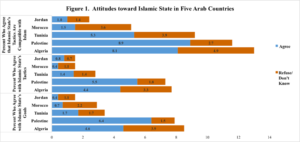
Their results show that among the five Arab countries studied (Jordan, Morocco, Tunisia, Palestine and Algeria) there is very little support for the tactics used by Islamic State.
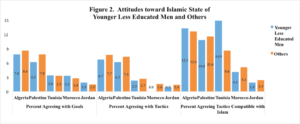
Furthermore, even among Islamic State’s key demographic – younger, less-educated males – support remains low.
For a more elaborate discussion of this work and the above figures, please see their recent post in the Washington Post’s Monkey Cage blog, “What do ordinary citizens in the Arab world really think about the Islamic State?”
Mark Tessler is the Samuel J. Eldersveld Collegiate Professor of Political Science at the University of Michigan. Michael Robbins is the director of the Arab Barometer. Amaney A. Jamal is the Edwards S. Sanford Professor of Politics at Princeton University and director of the Mamdouha S. Bobst Center for Peace and Justice.
Nov 3, 2015 | Conflict, Current Events, International, Uncategorized
Post developed by Yioryos Nardis in coordination with Yuri Zhukov.
In March and April 2014, angry mobs and armed men stormed administrative buildings and police stations in eastern Ukraine. Waving Russian flags and condemning the post-revolutionary government in Kyiv as an illegal junta, the rebels proclaimed the establishment of ‘Peoples’ Republics’ of Donetsk and Luhansk, and organized a referendum on independence. Despite initial fears that the uprising might spread to other provinces, the rebellion remained surprisingly contained. While 61% of municipalities in Donetsk and Luhansk fell under rebel control during the first year of the conflict, just 20% experienced any rebel violence. What explains these local differences in rebellion across eastern Ukraine? Why have some towns remained under government control while others slipped away? Why might two municipalities in the same region experience different levels of separatist activity?
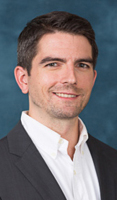
Yuri Zhukov
The latest research by Yuri Zhukov, faculty member in the Center for Political Studies and Assistant Professor of Political Science, uses new micro-level data on violence and economic activity in eastern Ukraine to examine these questions. In the paper “Trading hard hats for combat helmets: The economics of rebellion in eastern Ukraine” (forthcoming in the Journal of Comparative Economics) Zhukov evaluates two prominent explanations on the causes and dynamics of civil conflict in eastern Ukraine: ethnicity and economics.
Identity-based explanations expect conflict to be more likely and more intense in areas where ethnic groups are geographically concentrated. According to this view, the geographic concentration of an ethnolinguistic minority – in this case, Russians or Russian speaking Ukrainians – helps local rebels overcome collective action problems, while attracting an influx of fighters, weapons and economic aid from co-ethnics in neighboring states.
According to economic explanations, as real income from less risky legal activities declines relative to income from rebellious behavior, participation in the rebellion is expected to rise. This framework maintains that violence should be most pervasive in areas potentially harmed by trade openness with the EU, austerity and trade barriers with Russia.
Zhukov finds that local economic factors are much stronger predictors of rebel violence and territorial control than Russian ethnicity or language. Pro-Russian rebels in Ukraine are “pro-Russian” not because they speak Russian, but because their economic livelihood depends on trade with Russia.
The study uses new micro-level data on violence, ethnicity and economic activity in the Donbas region of eastern Ukraine, to understand how these two explanations are related to rebel violence and territorial control. The spatial units are 3037 municipalities (i.e. cities, towns, villages) in Donetsk and Luhansk provinces. For each municipality, Zhukov estimated the proportion of the local labor force employed in three industries: machine-building (which is heavily dependent on exports to Russia), metals (less dependent on Russia, and a potential beneficiary of increased trade with the European Union), and mining (vulnerable to International Monetary Fund-imposed austerity and cuts in state-subsidies). He also calculated the proportion of Russian speakers in each locality.
Rebel violence data are based on human-assisted machine coding of incident reports from multiple sources, including Ukrainian and Russian news agencies, government and rebel press releases, daily ‘conflict maps’ released by both sides, and social media news feeds. This yielded 10,567 unique violent events in the Donbas, at the municipality level, recorded between the departure of President Viktor Yanukovych in February 2014 and the second Minsk ceasefire agreement of February 2015. To determine territorial control, particularly whether a populated place was under rebel or government control on a given day, Zhukov used three sources: official daily situation maps publicly released by Ukraine’s National Security and Defense Council (RNBO), daily maps assembled by the pro-rebel bloggers ‘dragon_first_1’ and ‘kot_ivanov’, and Facebook posts on rebel checkpoint location.
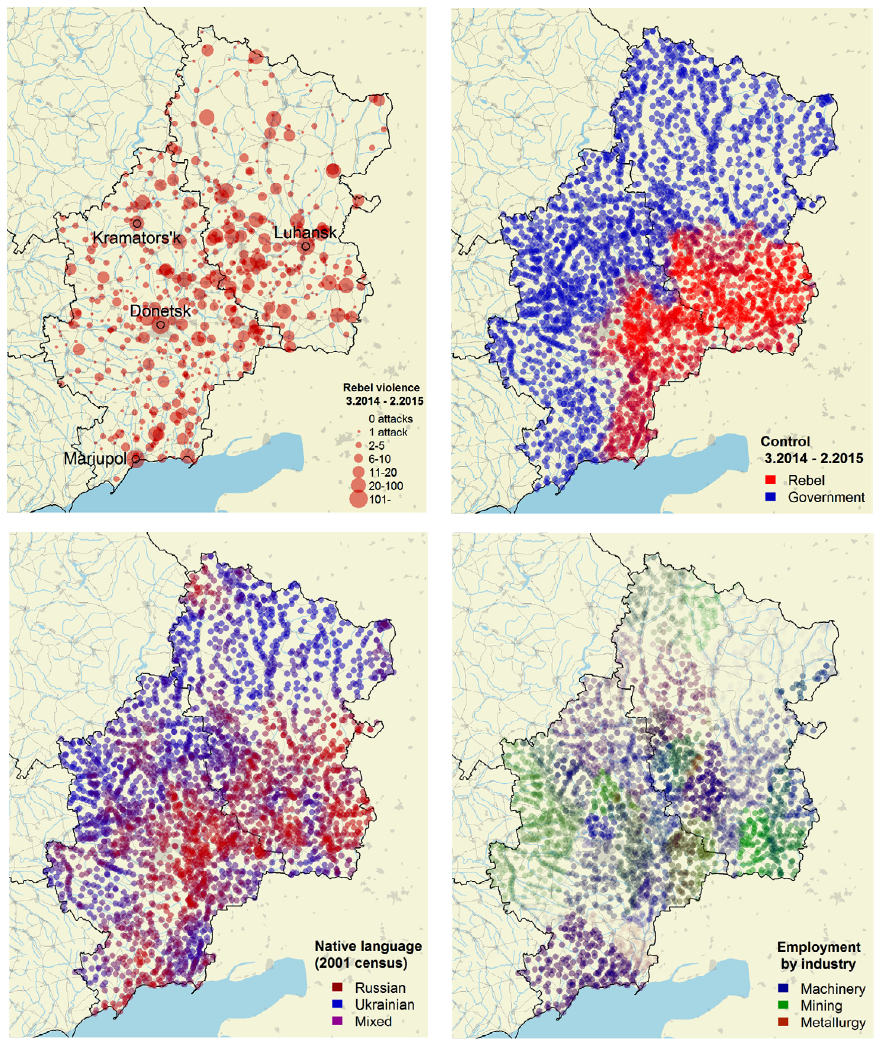 To evaluate the relative explanatory power of ethnic and economic explanations of violence in the Donbas, the study uses Bayesian Model Averaging. It finds that a municipality’s prewar employment mix is a better predictor of rebel activity than local ethnolinguistic composition. Municipalities more exposed to trade shocks with Russia experienced a higher intensity of rebel violence throughout the conflict. Municipalities where machine-building represented a small share of local employment (2%, the lowest in the data) were 38% less likely to experience violence than municipalities where the industry was more dominant — and the local population more vulnerable to trade disruptions with Russia. Such localities also fell under rebel control earlier – and took longer for the government to liberate – than municipalities where the labor force was less dependent on exports to Russia. On any given day, a municipality with higher-than-average employment in the beleaguered machine-building industry (26%) was about twice as likely to fall under rebel control as a municipality with below-average employment in the industry (4%).
By contrast, ethnicity and language had no discernible impact on rebel violence. Municipalities with large Russian-speaking populations were more likely to fall under rebel control, but only where economic dependence on Russia was relatively low. In other words, ethnicity only had an effect where economic incentives for rebellion were weak.
The seemingly rational economic self-interest at the heart of the conflict stands in sharp contrast with the staggering costs of war. In the twelve months since armed men began storming government buildings in the Donbas, over 6000 people have lost their lives, and over a million have been displaced. Regional industrial production fell by 49.9% in 2014, with machinery exports to Russia down by 82%.Suffering heavy damage from shelling, many factories have closed. With airports destroyed, railroad links severed and roads heavily mined, a previously export-oriented economy has found itself isolated from the outside world.
References:
2001 Ukrainian Census (State Committee on Statistics of Ukraine, 2001).
Bureau van Dijk’s Orbis database (Bureau van Dijk Electronic Publishing, 2015).
Segodnya, 2015. Ekonomika donetskoy oblasti v upadke iz-za voyny – gubernator kikhtenko. [Donetsk region’s economy in stagnation because of the war – Governor Kikhtenko]. Segodnya.
Stasenko, M., 2014. Novaya ekonomika ukrainy budet stroit’sya bez rossii i donbassa [Ukraine’s new economy will be built without Russia or the Donbas]. Delo.ua.
Feb 5, 2015 | Current Events
Post developed by Katie Brown and Stuart Soroka.
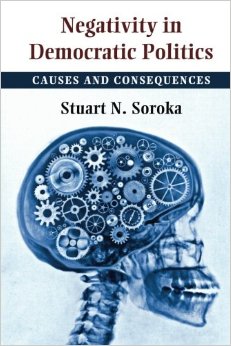 News content is dominated by negativity. Does this have negative consequences for political attitudes, or interest, or policymaking? Professor of Communication Studies and Center for Political Studies (CPS) researcher Stuart Soroka considers these questions in his book Negativity in Democratic Politics.
Drawing on a combination of survey data, lab experiments, and large-scale content analyses, Soroka finds strong evidence for both the predominance of negative information in political news, and the increased impact this negative information has on public attitudes (in contrast with positive information). He finds, for instance, that negative information has a stronger impact than positive information on individuals’ assessments of political candidates. He finds that individuals are more physiologically activated by negative news. At the aggregate level, Soroka also finds that negative magazine covers sell more copies than positive versions; and that negative shifts in the economy have a bigger impact on public opinion than do positive shifts. Interestingly, this holds true across many different countries, as Soroka’s analyses include most OECD countries. Negativity biases are not just an American peculiarity, then – they are evident around the world.
What are the consequences of all this negativity? Soroka suggests that a negativity bias may well be an efficient way of dealing with very complex information environments. There is just too much information about politics for us to keep track of it all, and selecting information based on negativity might be one useful way of focusing on the information that matters most. As a consequence, humans focus on negative information; and we seem to have designed institutions that focus on the negative as well. That said, there may be long-term consequences of a political information environment that is predominantly negative. So while assessing the long-term impact of negativity is difficult, it is probably an important step in both understanding political behavior and in developing objectives for the design of mass media and political institutions.
Jan 29, 2015 | Current Events, National
Post developed by Katie Brown and Cassandra Grafström.
 So-called “inflation truthers” have made recent news waves with claims that inflation is actually much higher than reported. Mainstream financial news organizations have debunked the inflation truthers charges with the simple math of averages. But what if the truthers are just looking in the wrong place? That is, is there systematic bias not in reported inflation but projected inflation?
Enter the work of Cassandra Grafström, a Ph.D. candidate in the Department of Political Science and affiliate of the Center for Political Studies (CPS) at the University of Michigan. Grafström, along with Christopher Gandrud of the Hertie School of Governance, conducted research to trace potential partisan biases of inflation estimates.
Grafström and Gandrud began with the widely accepted notion that under more liberal governments, the United States Federal Reserve tends to predict higher inflation. But why? Democratic administrations tend to try to lower unemployment, which causes higher inflation. Under more conservative governments, on the other hand, the Federal Reserve predicts lower inflation. Yet there exists little empirical support for these ideas. Instead, most work on inflation comes from the field of economics, with a focus on comparing Federal predictions with money market predictions.
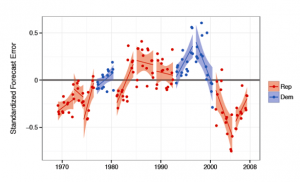
To test these commonly held ideas, Grafström and Gandrud looked at the Federal Reserve’s predictions across time. The authors took Presidential party and actual monetary and fiscal policies into account. They found that, regardless of actual monetary and fiscal policies, under more liberal presidents, the Federal Reserve over-estimates inflation while under more conservative presidents, the Federal Reserve under-estimates inflation.
In the graph below, perfect predictions would create an error of 0. Points above the line correspond to over-estimation and points below the line correspond to under-estimation. As we can see, when a Democrat is president, estimate errors tend to be above the line, while the average of Republican errors falls below the line.
Errors in Inflation Forecasts Across Time by Presidential Party
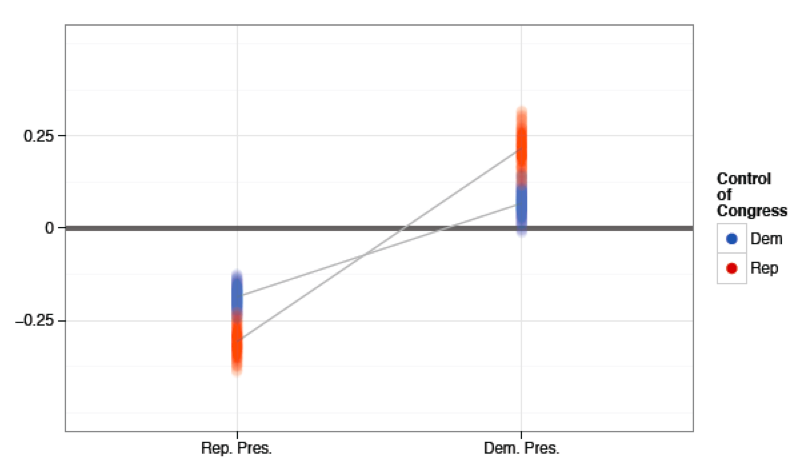
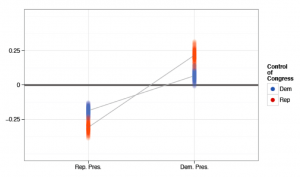
Grafström and Gandrud also wondered if control of Congress plays a role. To test this, they considered the joint influence of presidential party and the majority party in Congress. As the graph below shows, presidential party drives the trend. Interestingly, a Republican controlled Congress makes the original results stronger. That is, with a Democratic president and Republican congress, there is greater over-estimation of inflation. Likewise, with a Republican president and Republican congress, there is greater under-estimation of inflation. The graph below illustrates these findings (0 would again represent a match between predicted and actual inflation)
Errors in Inflation Forecasts Across Time by Presidential and Congress Majority Parties
Given the clear links between presidential partisanship and inflation forecasts, the authors worry that this likely translates into biased monetary and fiscal policies. That is, over-estimated inflation under Democratic presidents may lead to more restrictive monetary and fiscal policies. On the other hand, under-estimated inflation under Republican presidents may lead to more expansive monetary and fiscal policies. In both cases, the policy changes would be based on forecasts biased by flawed but accepted rules of thumb about inflation under Democrat vs. Republican presidents.
Nov 21, 2014 | Conflict, Current Events, Foreign Affairs, International
Written by William Foreman for Global Michigan. Reblogged here with permission.
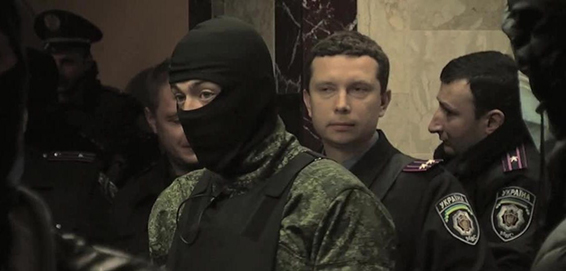
Pro-Russian militants in Eastern Ukraine. (Credit: VOA)
As the conflict grinds on in Ukraine, there are more questions about Russia’s intentions, the effectiveness of sanctions and what the West can do to end the fighting. These issues were discussed in a Global Michigan interview with Yuri Zhukov.
Zhukov is an assistant professor of political science at the University of Michigan and a faculty associate at the Center for Political Studies. His expertise is in international and civil conflicts.
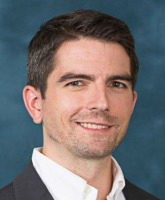
Yuri Zhukov
The scholar has several projects ongoing on the fighting in East Ukraine. He’s interested in rebel movements in the region, the economics behind the conflict, military operations and the “information war” in the Russian and Ukrainian media. He recently wrote a piece for Foreign Affairs.
What is Russia up to now?
Zhukov: Last week, NATO accused Russia of sending tanks and artillery into Ukraine, and the Organization for Security and Co-operation in Europe reported seeing a column of unmarked military trucks heading toward Donetsk. Russia denies these claims, and accuses Ukraine of concentrating its own forces near the front line. In fact, both sides of the conflict have been steadily ratcheting up tensions since elections this fall, in government and separatist-controlled areas of Ukraine. The outcome in each election simply reinforced the status quo, but both sides may now feel they have a stronger mandate to take bold steps.
Are the reported troop movements into Ukraine part of a plan to create a land bridge with Crimea or annex more of the country?
Zhukov: These troop movements are not large enough to take significant territory outside rebel-held areas in Donetsk and Luhansk. They are more likely reinforcements for rebel units fighting in Donetsk airport and other contested areas and a deterrent against sudden moves by Ukraine.
Are the sanctions helping or hurting Russian President Vladimir Putin?
Zhukov: In the short term, the sanctions may have created a “rally-around-the-flag” effect, which boosts Putin’s domestic popularity. But historically, Putin has owed much of his popularity to perceptions of sound economic management. Russian consumers are seeing higher food prices, and the ruble has lost over a third of its value since the crisis began. Putin’s poll numbers are still high, but beginning to fall.
If the fighting escalates, should the U.S. and EU provide arms to Ukraine?
Zhukov: Some countries have already provided military aid, on a bilateral basis, most of it nonlethal. The larger question is whether Western military aid can actually change the military balance of power on the ground. Russia will surely see such a policy as a major provocation and will respond in kind. This could trigger an arms race along the lines we have seen in Syria, with increasing flows of weapons and fighters to both sides. This is also a commitment that the West would need to sustain for some time. Major military aid may deter rebels from taking more ground but is unlikely to reverse existing rebel gains in the near future.
Should there be more sanctions?
Zhukov: It depends. Some types of sanctions—like freezing the assets of wealthy Russians in Europe—actually align with Putin’s policy goal of “de-offshorization.” Anything that makes it more difficult for powerful Russians to park their money abroad is a win for Putin. Some of the new measures currently on the table—like blocking Russian banks and businesses from the SWIFT financial transaction system—will have bigger impact.
Sanctions can and are already hurting Russia’s economy. Whether they can also change the course of the Ukrainian conflict is a different matter. There is no “magic switch” that Putin can press to stop the fighting. The rebel high command has been replaced by a cadre of more professional, manageable leaders, but the rebellion as a whole is still a diverse, fractious lot. Many rival militias are looking to carve a place for themselves in the new “Peoples’ Republics,” and quite a few locals feel betrayed that Russia did not intervene more forcefully. Sanctions are unlikely to change the decision calculus of these actors.
What more can the West do?
Zhukov: The West has limited options, and many of them—like military aid, alliance commitments to Ukraine, even sanctions—are more likely to escalate the conflict than stop it. Russia has made clear that it is ready to intervene if the tide of the war turns decisively against the rebels—as it did, temporarily, in August this year. Any future steps—in Kyiv or the West—will take place against the background of this latent threat of force. What’s worse, the terms of the current ceasefire agreement are suboptimal for all parties. Rebel leaders want to eliminate pockets of government forces and create a more contiguous, governable territory. The Ukrainian president is under pressure from hard line elements in the government to take bolder action. The best course of action for the U.S. is to tread carefully, and do everything possible to restrain both sides.