Sep 11, 2013 | ANES, National
Post developed by David Howell. Visuals prepared by Karina Kervin.
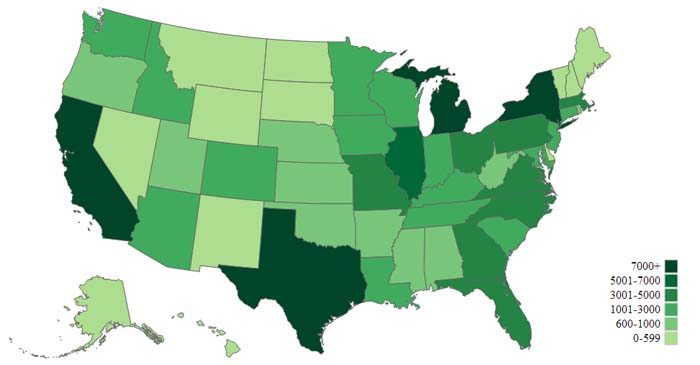
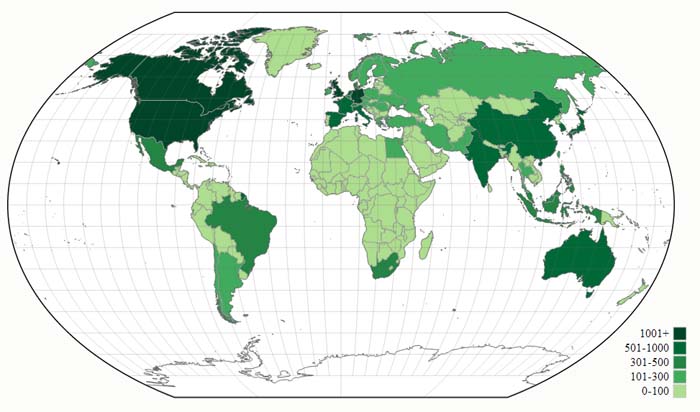
As we approach the sixty-fifth anniversary of the American National Election Studies (ANES) project, it is helpful to reflect on the continued and extensive interest in the project, both within the United States and globally. With that in mind, the following visuals convey the number of visitors to the ANES website by state and country, over the past two years.
If you click on either of the below images, you will be taken to a corresponding page where you can hover your mouse over the map to see the number of website visitors from specific states and countries. Note that users of Internet Explorer may have difficulty accessing the interactive version of the maps due to a browser compatibility issue (we are working on this).
Visits to the ANES website, September 2011 – August 2013
Sep 5, 2013 | Current Events, Elections, Innovative Methodology, National
Post developed by Katie Brown in coordination with Michael Traugott.
In the American presidential election of 2012, most polls predicted a narrow win for Democratic incumbent Barack Obama over Republican challenger Mitt Romney. But on November 5, 2012, Obama won both the popular vote (62,611,250 to 59,134,475) and the Electoral College (332 to 206) by a comfortable margin.
Most major polling organizations underestimated Obama’s votes, yet closely targeted Romney’s outcome. Gallup and Rasmussen, on the other hand, overestimated Romney’s vote share, projecting that he would win.
In order to understand its error and, more importantly, correct its estimation for future elections, Gallup called upon Professor of Communication Studies and Center for Political Studies (CPS) Research Professor Mike Traugott. Traugott studies public opinion, survey methodology, and voting technology, with more than 100 articles and book chapters and 12 books published.
Traugott’s connection to the project goes beyond his expertise. Early in his career, he worked for Gallup founder George Gallup. Traugott has also served as president of the American Association for Public Opinion Research (AAPOR). In 2008, he chaired an AAPOR committee to investigate the causes of an industry-wide estimation error in the New Hampshire primary. As a follow up, AAPOR launched an initiative to make polling practices more transparent. Though the initiative garnered initial support, it hasn’t matured as rapidly as hoped because many commercial firms are reluctant to expose their proprietary methods. Yet, given the widespread mispredictions of 2012, Gallup agreed to make its investigation transparent as a service to the public and the pre-election polling profession.
Gallup’s initial investigation, led by Traugott and published here, identifies several potential contributing factors to the errant projection. The main problem appears to lie in the sampling design. Gallup interviews potential voters using only a combination of listed landline and cell phones. Because listed landline users are more likely to be conservative, Gallup’s respondent pool skewed conservative. Other potential factors include giving more weight to past voting behavior than other polls, time zone issues, and the format of race and ethnicity questions. Further, Gallup, like other major polling organizations, does not take the candidates’ campaign effort into account. As this map illustrates, in 2012, the candidates focused most of their campaign spending in battleground states, which in turn impacted turnout and vote choice by state.
In response to the report, Gallup has brought in a team of researchers which will test the hypotheses derived from the initial report during the 2013 New Jersey and Virginia gubernatorial elections. Traugott is also leading a graduate seminar this fall at the University of Michigan that will allow students to participate in the design of the experiments and analyze data related to the inquiry. According to Traugott, this is a “very unusual, almost once in a lifetime chance to combine real world applications of conceptual and theoretical issues about survey design.”
Aug 22, 2013 | Innovative Methodology, National, Social Policy
Post developed by Katie Brown in coordination with Nicholas Valentino

Photo credit: Thinkstock
Since the attacks of September 11, 2001, airport security has become a grave and expensive endeavor, projected to cost $45 billion by 2018. News stories about airport security scares or the ridiculousness of airport security scares proliferate. Other stories concern the efficacy of racial profiling, particularly of Arab passengers. A new Transportation Security Administration (TSA) program called SPOT – Screening of Passengers by Observation Technique – targets suspicious behavior in security lines with in-depth questioning. This program alone has cost $878 million. And SPOT faces criticisms for propagating racial profiling.
Forthcoming research by Center for Political Studies researcher Nicholas Valentino, along with colleagues Cigdem Sirin and Jose Villalobos from the University of Texas El Paso, explore the factors that explain support for racial profiling. In particular these scholars wondered whether different racial groups, with their different experiences with discrimination, react distinctly to security policies that involve profiling.
Valentino and colleagues investigated this question in an experiment. The sample focused on three racial groups and included 221 whites, 193 blacks, and 207 Latinos. All participants read a vignette:
Recently, a passenger was flying from New York to Chicago when he was pulled out of a security line, searched, and questioned. The passenger was talking on his cell phone while waiting in line to board his flight. One of the airport security officers standing nearby said that he heard the passenger say, “It’s a go!” which qualifies as suspicious behavior according to the Transportation Security Administration (TSA) guidelines. In response, the airport security officer took the passenger aside for further screening. The passenger, however, claims that when it was his turn to board the plane, he had told the person on the phone, “I’ve got to go!” and hung up. Amid the controversy, the airport security officer said that he had a reasonable cause to search and question the passenger. The passenger, on the other hand, said that the additional screening was unwarranted.
The picture presented alongside the text varied, with participants randomized to see a suspect from one of four racial groups: black, white, Latino, or Arab. Pictures were pretested to ensure equality on all dimensions except ethnic identity. After reading the story, participants answered several questions, including, “Who are you more likely to agree with in this case—the airport security officer or the passenger?” and “What do you think about the response by the airport security officer—do you think he had a reasonable cause to search and question the passenger?”
The graph below displays the results for the Arab passenger scenario. Compared to whites, blacks and Latinos showed less support for extra airport security measures targeting an Arab passenger. Further, the likelihood of siding with the Arab passenger is about 36 percent higher for black respondents and about 26 percent higher for Latino respondents.
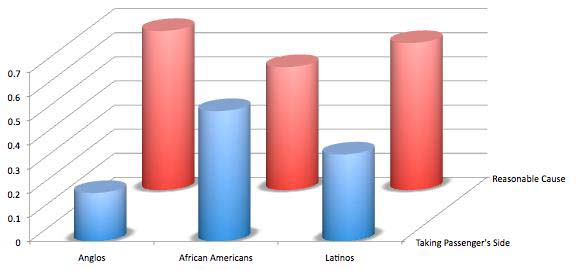
Yet, blacks and Latinos perceive themselves to be at higher risk of personal threat from terrorism. Valentino and colleagues suggest this pattern is consistent with Group Empathy Theory, which holds that empathy for one group by another, even when the two are in competition for the same resources, mitigates support for harsh security tactics.
Lawmakers and TSA programs should keep in mind, as Valentino states, “These results demonstrate that anti-Arab sentiment is not distributed uniformly throughout society, and support our theory that the power of existential threats on tolerance is moderated by group empathy.”
Aug 16, 2013 | Current Events, Foreign Affairs, International, National
Post developed by Katie Brown in coordination with Darrell Donakowski
Yesterday, The Washington Post released an internal report from the National Security Agency (NSA) revealing the agency broke its own privacy rules thousands of times per year since 2008. The source? Edward Snowden, former Central Intelligence Agency (CIA) employee and analyst at NSA contractor Booz Allen. The Post release is the latest chapter in the story of Snowden and government trust.

Photo credit: Thinkstock
In June and July of this year, UK’s The Guardian published a series of news articles revealing surveillance by NSA. The US charged Snowden with espionage and revoked his passport. On the lamb, Snowden flew to Hong Kong from Hawai’i. WikiLeaks founder Julian Assange worked to broker asylum for Snowden in Iceland to no avail. Snowden moved onto Russia, residing in the transit zone of Moscow’s Sheremetyevo airport for over a month. On August 1, Russia granted Snowden a one-year asylum. Snowden has an additional 20 applications out for asylum.
Snowden’s asylum prospects complicate US international relations. Obama canceled a summit with Russian Prime Minister Vladimir Putin. Senator Lindsey Graham (R) called for a boycott of the 2014 Olympics in Sochi, Russia, a plan rejected by Speaker of the House John Boehner. On July 2, Bolivian President Evo Morales’ plane was denied entry to several European nations’ airspace and airports amid rumors Snowden was on board, stressing European and US relations with several Latin American countries (Bolivia, Venezuela, and Nicaragua granted Snowden’s request for asylum).
In the wake of the story, questions turned into a debate in the media as to how to understand Snowden. Leaker? Traitor? Punk? The American public appears to see Snowden as a whistleblower. Further, the media linked the immediate fallout – plus the IRS scandal and Benghazi trials – with an 8 point drop in Obama’s approval rating. Hovering around 44%, Gallup shows Obama’s recent ratings below the presidential average of 54%.
But what about trust in the government in particular? The American National Election Studies offers a glimpse of trust in government across time. Asked how much of the time the government does what is right, respondents could choose between three answers: “just about always,” “most of the time,” and “some of the time,” with some respondents volunteering “none of the time.” The graph below displays the spread across time and across answers.
How much of the time do you think you can trust the government in Washington to do what is right?
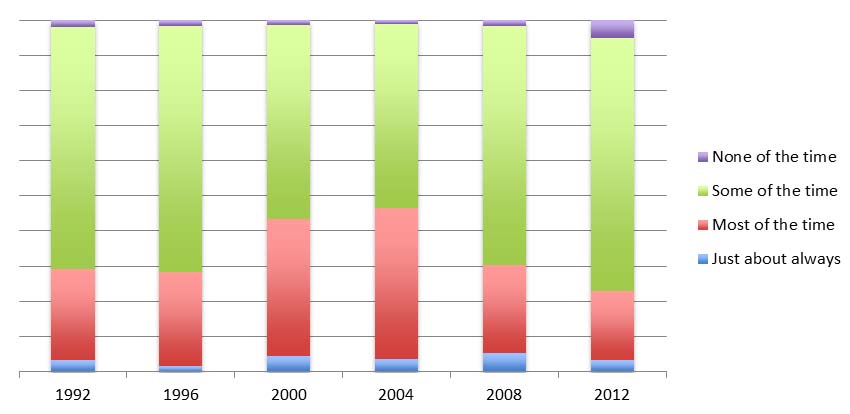
While this graph does not correspond to the Snowden event, it contextualizes the attributed decrease in trust across time. That is, the decrease in trust attributed to the leak would correspond to a generally decreasing trend.
Last week, Obama announced an overhaul of NSA surveillance. Though Obama refuses to acknowledge Snowden as a catalyst for the changes, Assange claims the move vindicates Snowden. The move suggests a push for transparency and restored trust in the government.
Aug 13, 2013 | Michigan, National, Social Policy
Post developed by Katie Brown in coordination with Rosemary Sarri
 Detroit makes headlines often: declining population, high crime rates, blocks of urban blight and, recently, the city’s declaration of bankruptcy. How does living in this bad news impact the city’s children? And, perhaps more importantly, how are we coping with the inevitable fallout this has on Detroit’s children?
Center for Political Studies, School of Social Work, and Women’s Studies Professor Emerita Rosemary Sarri studies the impact of social policy on children. In a forthcoming book chapter – “Juvenile Justice in a Changing Environment” – Sarri considers the developing approaches to juvenile offenders, focusing on Wayne County, Michigan, home of Detroit.
The concept of approaching juveniles in the justice system as distinct from their adult counterparts emerged just over a century ago. Two Supreme Court decisions – Roper v. Simmons in 1995 and Graham v. Florida in 2010 – reasserted the necessity of lesser sentences for youth offenders. Further, there is a large capital investment in the system. With 70,000 children in the justice system at an individual incarceration cost of $88,000 per year, the total exceeds $6 billion annually. This large amount of money coupled with the increasing emphasis on viewing children as in the midst of development shifted focus to rehabilitation over punishment. Wayne County, including Detroit, has paved the way.
In the 1990s, the state of Michigan controlled Wayne County’s youth offenders, punishing both serious and lesser crimes with long periods of detention, often out of state. U.S. Department of Justice threatened to close the in-county detention facility itself due to overcrowding and poor physical conditions, while the Michigan Auditor General issued a report criticizing the whole process. Without adequate mental health services and educational aid, recidivism – committing crimes again upon being released – topped 50%. The county and state spent $150 million per year on this ineffective program.
In the late 1990s, crime overall declined, but youth crimes associated with Detroit’s problems of homelessness, substance abuse, and gangs continued. Public outcry and political pressure to revamp the juvenile justice system was answered in 1997, when the system was overhauled.
The new mission, as Sarri writes, was to, “Treat each individual as a person in need of opportunities and resources rather than one with a societal disease that needed to be contained.” Wayne County spearheaded the initiative, which emphasized mental health care, education, and alternatives to incarceration, as summarized by the table below
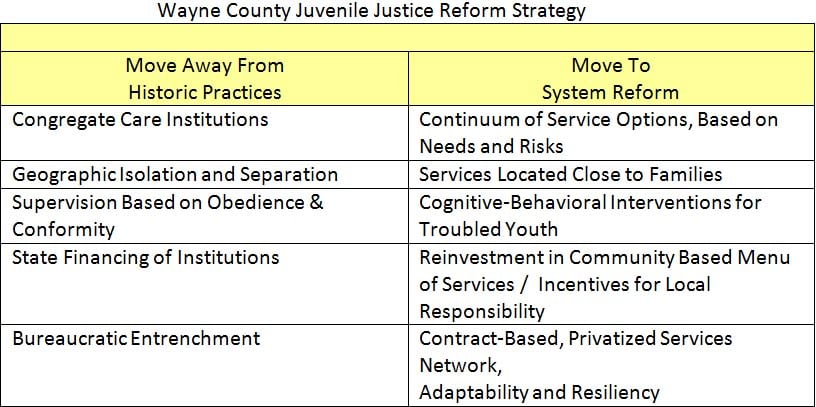
The information management also built into the new approach allows the effects to be quantified. In 1998, 731 youth were incarcerated. In 2012, there were six, with no juveniles placed out of state. From 2004 to 2012, the number of new delinquency cases dropped by 38.4%. Further, more children have access to diversion and prevention programs, totaling 9,319 in 2012. And recidivism dropped to 17.5%!
As Detroit’s woes deepen, the toll on Wayne County’s children will likely increase. But, as Sarri argues, the juvenile justice system initiated in the late 1990s is an investment in the community, rehabilitating youth instead of punishing them for their declining environment.
Jul 29, 2013 | Current Events, National
Post developed by Katie Brown in coordination with Michael Traugott and Ashley Jardina.
On February 26, 2012, George Zimmerman fatally shot unarmed African American teenager Trayvon Martin in a Florida gated community. Several weeks later, amid media hysteria and public outcry, Zimmerman was arrested and charged with second degree murder.
On July 13, 2013, a jury of six women found Zimmerman not guilty of murder or manslaughter.
Polls after the verdict show that while blacks generally disagree with the verdict, whites tend to support the ruling. A few days after the verdict, President Obama gave a twenty minute press conference. In his address, he said that, “Trayvon Martin could have been me 35 years ago.”
Obama’s comments also speak to suspicion he has faced as a black male in the United States. Has race figured into evaluations of Obama? In particular, how does race figure into beliefs that Obama was not born in the United States, a.k.a., the Birther movement?
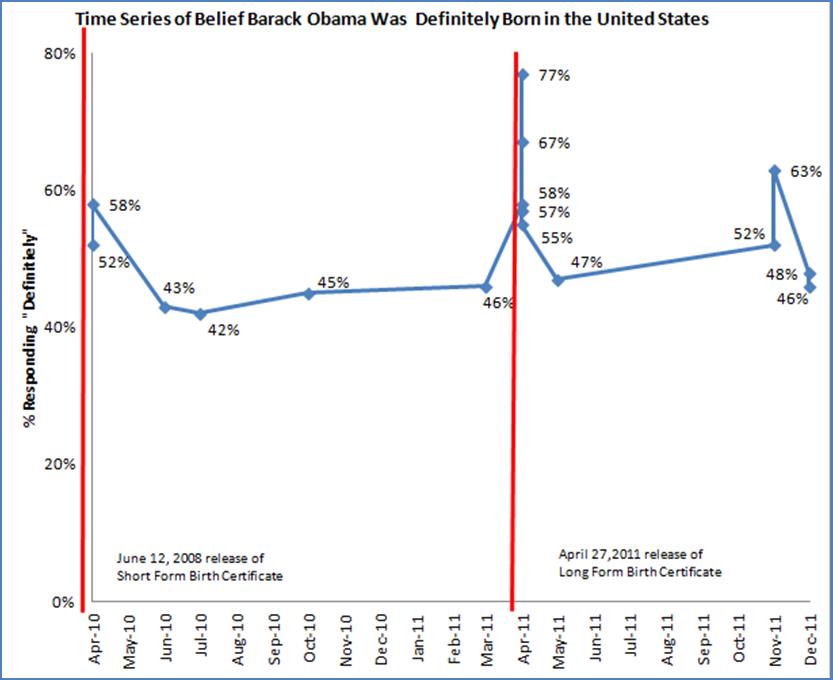
Center for Political Studies (CPS) researcher and Professor of Communication Mike Traugott, along with Political Science graduate student Ashley Jardina, conducted a study on Birtherism and its antecedents. Since Obama’s first White House campaign, speculation about his citizenship and origin has made headlines. Belief to the contrary has decreased only slightly, even though Obama’s birth certificate has been released twice: the short form in 2008 and the long form in 2011. The figure below presents the results of 17 different surveys to show this trend over time.
Traugott and Jardina administered a web survey with a stratified sample to include 300 white, black, and Latino Americans. The survey asked, “Was Barack Obama definitely born in the United States, probably born in the United States, probably born in another country, or definitely born in another country?” Comparing the results between white and black shows that whites are more likely than blacks to doubt Obama’s American origins. The graph below displays the answers by participant race.
The survey also suggests that a belief Obama was born outside the United States is also related to lower levels of political knowledge and education, and higher frequencies of forwarding political emails.
In his statements after the Zimmerman verdict, Obama called on the nation to do some soul searching on race. His statement that “Trayvon Martin could have been me 35 years ago” reverberates to today, when belief that he is American remains in question to some, more so among whites than blacks.