Jul 23, 2014 | ANES, Elections, National
Post developed by Vincent Hutchings, Hakeem Jefferson, and Katie Brown.
The following post elaborates on a presentation titled “Out of Options? Blacks and Support for the Democratic Party” that was delivered at the 2014 World Congress of the International Political Science Association (IPSA).

Photo credit: Thinkstock
In 2012, Barack Obama received 93% of the African American vote but just 39% of the White vote. This 55% disparity is bigger than vote gaps by education level (4%), gender (10%), age (16%), income (16%), and religion (28%). And this wasn’t about just the 2012 or 2008 elections, notable for the first appearance of a major ticket African American candidate, Barack Obama. Democratic candidates typically receive 85-95% of the Black vote in the United States. Why the near unanimity among Black voters?
Vincent Hutchings, Professor of Political Science and Research Professor in the Center for Political Studies (CPS), and Hakeem Jefferson, Ph.D. candidate in the department of Political Science and CPS affiliate, set out to answer this question.
Hutchings and Jefferson especially sought to shed light on the “Black Utility Heuristic.” First proposed by Michael Dawson, the Black Utility Heuristic holds that Blacks tend to assess what is in the best interests of their racial group as a proxy for judging what are the best political decisions for them individually. So, given the widespread perception that the Democratic Party is best for African Americans, many Blacks support this party even if – in the case of the middle-class and social conservatives – it might not be in their individual interests to do so. But despite the reliance on this theory by numerous scholars, there exists little empirical support that it can account for Blacks’ lopsided support for the Democratic Party.
Using American National Election Studies (ANES) data, Hutchings and Jefferson tested the Black Utility Heuristic against other potential explanations for the near-unanimous support among Blacks for the Democratic Party.
The 2012 ANES pre-election survey includes 511 Black respondents. Using this survey, the authors report that 90% of African Americans identify as Democrats and 55% strongly so, compared to 39% and 11% of Whites. Yet, when the authors looked at a 7-point measure of ideology, only 47% of Blacks identify as liberal while 45% identify as conservative in the United States.
Given the mismatch between political ideology (measured using the liberal-conservative continuum) and partisanship, the authors turned to other ways to measure political ideology: egalitarianism, moral traditionalism, and ideal role of government. On egalitarianism and size of government, Blacks were indeed considerably more liberal than Whites; there was not significant difference between the groups on morality.
Despite the ideological underpinnings of these questions, they only weakly correlate with the standard measure of political ideology. The strongest correlation was between egalitarianism and political ideology – at just 0.18 Among Blacks, this correlation jumps to 0.42 for Whites. (Correlation coefficients give a measure of fit between two variables. If the two variables move up and down in concert, this is a perfect correlation of 1; if there is no connection the correlation is 0.) Further, support for bigger government was the only ideological measure that was a statistically significant predictor of partisanship, which may suggest a need to rethink how we conceptualize and measure ideology as it pertains to African Americans.
So could the Black Utility Heuristic offer the best explanation of the overwhelming support for Democratic candidates among Black voters? To test this, the authors looked at the connection between believing that what happens to other African Americans affects the survey respondent’s own life and Democratic affiliation. This connection was not significant, directly countering Dawson’s Black Utility Heuristic. On the other hand, an alternative measure assessing the importance of in-group racial identity predicted identifying as a Democrat among Blacks.
Hutchings and Jefferson thus conclude that African Americans do not vote Democrat because of their ideological identity as liberals, or because of notions of linked fate. Instead, strong support for activist government and the importance of in-group racial identity seems to drive this trend.
Jul 2, 2014 | ANES, Elections, Innovative Methodology, International
Post developed by Katie Brown and Ioannis Andreadis.
Ioannis Andreadis, a member of the Political Science faculty at Aristotle University of Thessaloniki, studies elections in Europe. With a grant from the Fulbright Scholar Program, Andreadis was recently in residence at the University of Michigan’s Center for Political Studies (CPS) to learn more about the American National Elections Studies (ANES).
 Andreadis started his academic career in 2007, after working as a computer scientist in his hometown’s municipality. His research focuses on elections, but the lack of a centralized database of election history in Greece presents obstacles to his work. With this in mind, Andreadis is interested to create a Greek version of the ANES – not only for the benefit of his own work, but for the benefit of other political scientists. Andreadis also plans to develop a centralized repository so that the data themselves can be easily disseminated to researchers.
A Greek version of the ANES faces some special challenges. Funding is limited in light of the country’s recent financial crisis. But this challenge has led to methodological innovation. Instead of relying on traditional data collection methods such as phone surveys, Andreadis has been developing web-based questionnaires. In 2007, 2009, and 2012, Andreadis ran such a web-based survey for the Hellenic (Greek) Candidate Study, and in 2012 he used his web survey infrastructure to collect data for a voter study which was organized as a mixed mode survey.
Andreadis’ efforts are also part of the True European Voter project, a COST Action to track election data across time and across Europe. Participating countries include Austria, Belgium, Bulgaria, Croatia, Cyprus, Denmark, Estonia, Finland, France, Germany, Greece, Hungary, Iceland, Ireland, Italy, Lithuania, the Netherlands, Norway, Poland, Portugal, Romania, Slovenia, Spain, Sweden, Switzerland, and the United Kingdom.
In addition to his interests in adapting ANES to the Greek political realm, Andreadis also combines his computer programming skills and interest in elections. Anreadis both designs and studies Voting Advice Applications (web-based platforms that aim to inform citizens about the electoral process, with emphasis on the positions of candidates and parties on issues related to electoral competition). In particular, Andreadis created and oversees the Voting Advice Application HelpMeVote, which was used by more than 480,000 voters during the May 2012 Greek Parliamentary Elections. HelpMeVote has also been used in Albania, Iceland, and during the 2014 elections for the European Parliament.
CPS and ANES are thrilled to have have had Andreadis visit, and look forward to the progress of his initiatives in support of election studies and political science research in Greece and beyond.
Jun 24, 2014 | ANES, Elections, National
Post developed by Katie Brown and Spencer Piston.
The 2008 election in the United States featured the first black major party presidential candidate in U.S. history – Barack Obama. Obama won in a historic election. But was his victory margin narrower than it could have been? In particular, did racial prejudice erode Obama’s vote share among those whites expected to vote for him: strong Democrats?
Photo credit: Thinkstock
Center for Political Studies (CPS) affiliate and Ph.D. Candidate in Political Science at the University of Michigan Spencer Piston explored this question with co-author Yanna Krupnikov (Northwestern University) in a recent article published in Political Behavior.
The researchers identify a gap in the field. Where previous work focuses on the connection between prejudice and vote choice, few studies have considered the relationship between prejudice and turnout on Election Day.
The researchers evaluate the relationship between racial prejudice, strength of party identification, and turnout. They are especially interested in a situation in which a white voter, high in racial prejudice, is faced with a black candidate from her party. How will the voter vote? In this scenario, racial prejudice is pitted against party identification.
Examining 2008 data from the American National Election Studies and replicating their analyses with survey data from a wave of a 2007-2008 Associated Press-Yahoo! News-Stanford University study, the authors find that highly partisan and prejudiced voters often address the tension embodied in a black candidate from their party by not turning out to vote. Interestingly, the authors also test if this group would instead vote for the white Republican presidential candidate John McCain. They would not. This is because they cannot compromise on race or partisanship. Unable to compromise, they instead choose not to vote.
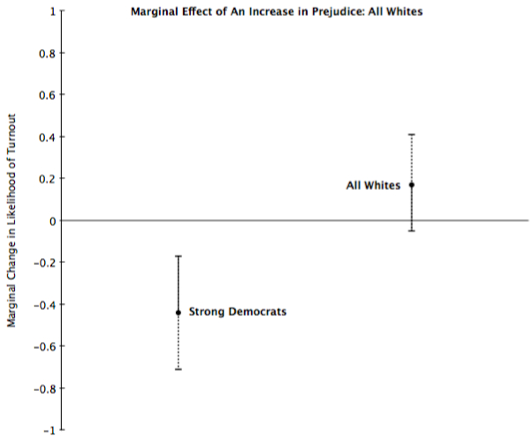
These findings have significant implications for American elections. The authors conclude, “Racial prejudice undermines black candidates’ efforts to mobilize strong partisans.”
Spencer Piston will join Syracuse University in the fall as an Assistant Professor of Political Science.
May 22, 2014 | ANES, Elections, Innovative Methodology, International
Post developed by Katie Brown and Ioannis Andreadis.
Voting Advice Applications (VAAs) are web platforms that help voters determine the candidate or the political party that best matches their own political ideology. Visitors answer a series of questions to gauge their political positions. The VAA platform then estimates the similarity or dissimilarity of these positions to those of candidates or parties.
There are various ways to present these estimates. One option is to display a list of the candidates or parties along with a number indicating the similarity or dissimilarity of each. Another option is a graph like the one below from Greece, where issues from the election are represented on each axis, and users can visualize their ideological position relative to that of the parties.
-
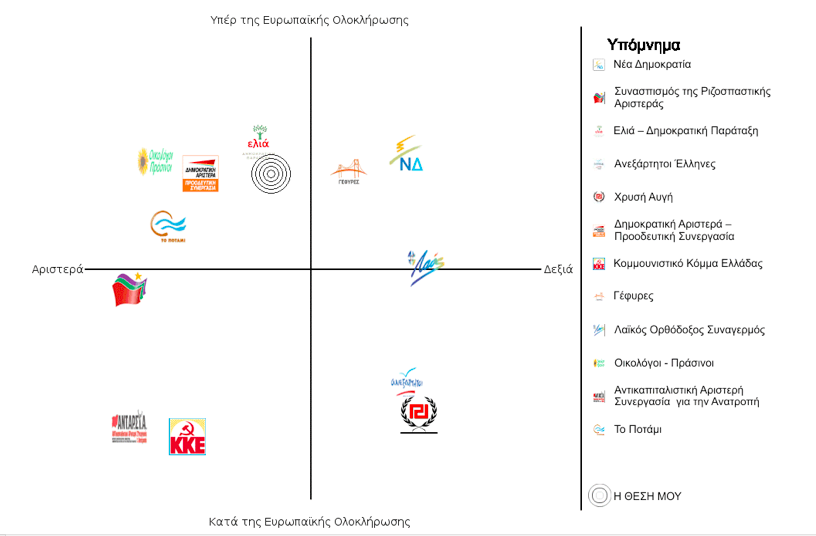
Example of diagram from the Greek VAA www.votematch.gr from the elections for the European Parliament. Left/Right is represented by the horizontal axis and Pro-Europeanism/Euroscepticism is represented by the vertical axis. The political party logos indicate their ideological position and the center of the concentric circles indicates the position of the user.
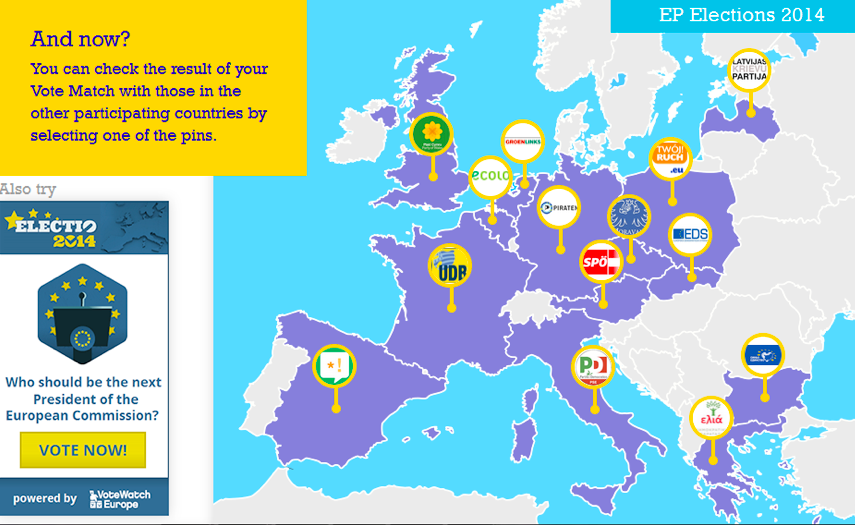
Another example of VAAs in action is Vote Match Europe, an international network of VAAs for the 2014 European Parliament elections across fourteen EU countries. The Vote Match Europe website allows users to see the parties closest to them across all of the countries in the network, and to learn more about the parties and their policies. A goal of the Vote Match Europe website is to promote European citizenship and better inform citizens about the elections for the European Parliament at large.
Ioannis Andreadis is Assistant Professor of Quantitative Methods in the Department of Political Sciences at Aristotle University Thessaloniki. This semester, he is a scholar in residence at the Center for Political Studies (CPS), seeking to learn more about the American National Elections Studies (ANES) and the Comparative Study of Electoral Systems (CSES) under a grant from the Fulbright Program.
In his capacity as a researcher, Andreadis has studied and written about VAAs, and he also both designs and studies VAAs. In particular, he created and oversees the Voting Advice Application HelpMeVote. HelpMeVote was used by more than 480,000 voters during the May 2012 Greek Parliamentary Elections. The application was also used in Iceland and Albania, and is currently being used for the 2014 European Parliament election.
In a recent paper, Andreadis tackles the question of utility of VAAs. He suggest that VAAs must be built to high academic standards, and realize the following benefits:
- VAAs help voters should become more knowledgeable about party positions, allowing the voters to make better choices.
- VAAs help political parties not covered in traditional media to connect with voters who agree with their values.
- VAAs generate data that researchers can use to better understand voting behavior.
VAAs are growing in popularity in places with multi-party systems and high Internet availability – for example, in Western Europe.
In electoral systems with only two parties, VAAs may be less useful given the limited choice set. If a VAA had been used for the 2009 Greek elections or earlier – when two major Greek political parties dominated national politics – it probably would not have been as popularly used. But in the 2012 elections, the Greek parliament featured seven parties, making way for a new VAA market.
With this in mind, adaptation to America’s two party system poses challenges. VAAs could be used in American primaries, where many candidates from the same party compete against each other, but only if candidates running in the same primary have very different positions on enough issues.
May 13, 2014 | Elections, Innovative Methodology, International
Post developed by Katie Brown in coordination with Brian Min.
With six weeks of phased voting, 80% of potential voters are expected to cast ballots in India, making it the world’s largest election. Already marked by political posturing and violence, the elections also include the politics of light.
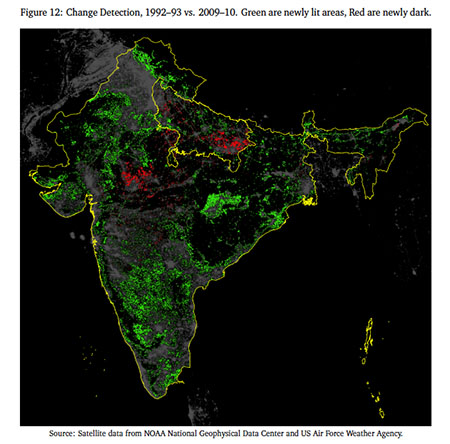 CPS researcher Brian Min developed an innovative way to track energy emissions. Min tracks images from the Defense Meteorological Satellite Program’s Operational Linescan System (DMSP-OLS). In orbit since 1970, these satellites record high resolution images of light on Earth every night. Min uses these images to track energy consumption over time.
In a recent paper, Min applied this methodology to elections in India. Some of the country remains isolated from a consistent supply of electricity. Using data from 1992 to 2010, Min finds that otherwise dark villages are often illuminated during election cycles. When elections come around, politicians promise light and often deliver power leading up to votes. These areas are then returned to darkness as election promises literally fade from the spotlight.
It remains to be seen if the 2014 election will change power grids. Min will be ready to measure using the satellite images. Look out for future posts about Min’s state-of-the-art research based on the same satellite imaging in other areas.
Apr 9, 2014 | Current Events, Elections, Innovative Methodology, National
Post developed by Katie Brown and Timothy Ryan.
There are political issues and then there are moral political issues. Often cited examples of the latter include abortion and same sex marriage. But what makes a political issue moral?
Timothy Ryan, a Ph.D. candidate in the department of Political Science and affiliate of the Center for Political Studies (CPS), explored this question in a recent article in The Journal of Politics. An extensive literature already asserts a moral vs. not moral issue distinction. Yet, there is no consensus in how to distinguish between moral and non-moral political issues. Further, trying to sort issues into these categories proves challenging. Many people assume that same-sex marriage is a moral issue, but does everyone see the issue in moral terms? Do people vary in terms of whether they see economic issues, such as Social Security reform and collective bargaining, with morality at stake?
In an attempt to define the divide between moral and non-moral, Ryan turned to the psychology literature. In particular, Ryan applies moral conviction to morality in politics. Moral conviction refers to topics that tap into an individual’s sense of right and wrong. According to the psychology literature, moral conviction leads to a different type of information processing. Moral conviction involves negative emotions, hostile opinions, and potential punitive actions.
Ryan then tests this concept as it relates to political issues with two studies. In both studies, he measures the emotions stimulated by moral conviction. He finds that moral conviction evokes negative emotions toward political disagreement. He also finds that both traditionally moral issues (like abortion or same sex marriage) and traditionally non-moral issues (like labor relations or Social Security) can both illicit moral conviction.
The graph below displays the mean (the squares), the middle 50% (the bars), and the middle 80% (the dots) of moral conviction for five different political issues. As we can see, moral conviction varies a lot for both economic and non-economic issues. Of course many people see same-sex marriage as a matter of right and wrong, Yet, many also see Social Security reform in the same way. The upshot is that, when it comes to deciding which issues are moral, an important part of the answer depends on the individual.
Distribution of Moral Conviction Variable
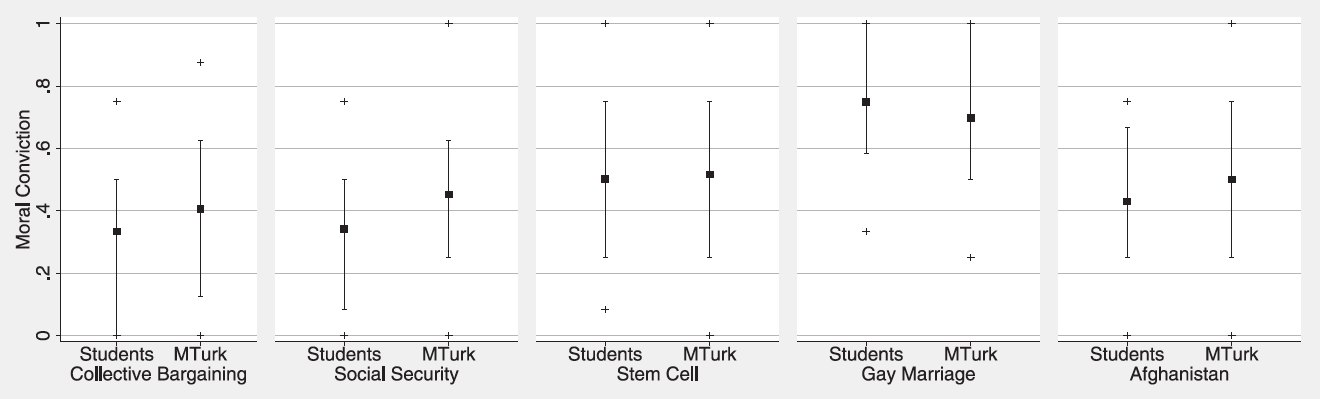
Ryan’s article also challenges a common assumption: the assumption that moral fervor in politics comes more from the right than the left. In the article, he examines propensity to moralize several political issues. The result? Liberals and conservatives moralize in equal measure. The figure below illustrates this with three separate samples: students, Amazon’s Mechanical Turk respondents, and Evaluations of Government and Society Study (EGSS) respondents.
Moral Conviction by Partisanship
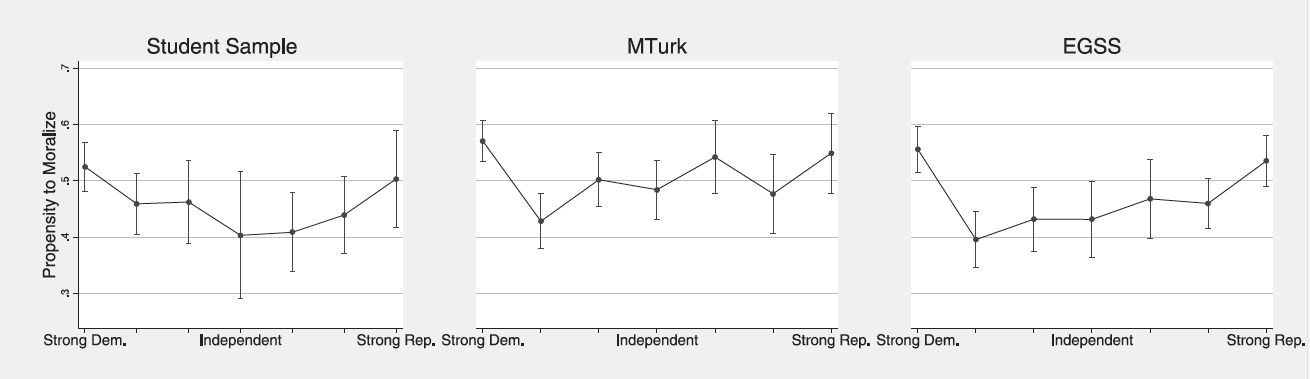
Taken together, Ryan’s findings suggest that the response of moral conviction may be more important than distinguishing between inherently moral and non-moral political issues. Rather, all issues can produce a moral conviction response, depending on the person. Ryan concludes that, “in terms of the underlying psychology, Social Security is just as moralized for some people as Abortion is. Morality is in the eye of the beholder.”
In the fall, Ryan will continue his research on morality in politics when he joins the faculty at the University of North Carolina at Chapel Hill as Assistant Professor of Political Science.