Nov 21, 2014 | Conflict, Current Events, Foreign Affairs, International
Written by William Foreman for Global Michigan. Reblogged here with permission.
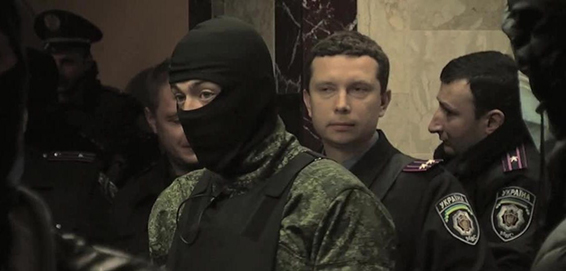
Pro-Russian militants in Eastern Ukraine. (Credit: VOA)
As the conflict grinds on in Ukraine, there are more questions about Russia’s intentions, the effectiveness of sanctions and what the West can do to end the fighting. These issues were discussed in a Global Michigan interview with Yuri Zhukov.
Zhukov is an assistant professor of political science at the University of Michigan and a faculty associate at the Center for Political Studies. His expertise is in international and civil conflicts.
Yuri Zhukov
The scholar has several projects ongoing on the fighting in East Ukraine. He’s interested in rebel movements in the region, the economics behind the conflict, military operations and the “information war” in the Russian and Ukrainian media. He recently wrote a piece for Foreign Affairs.
What is Russia up to now?
Zhukov: Last week, NATO accused Russia of sending tanks and artillery into Ukraine, and the Organization for Security and Co-operation in Europe reported seeing a column of unmarked military trucks heading toward Donetsk. Russia denies these claims, and accuses Ukraine of concentrating its own forces near the front line. In fact, both sides of the conflict have been steadily ratcheting up tensions since elections this fall, in government and separatist-controlled areas of Ukraine. The outcome in each election simply reinforced the status quo, but both sides may now feel they have a stronger mandate to take bold steps.
Are the reported troop movements into Ukraine part of a plan to create a land bridge with Crimea or annex more of the country?
Zhukov: These troop movements are not large enough to take significant territory outside rebel-held areas in Donetsk and Luhansk. They are more likely reinforcements for rebel units fighting in Donetsk airport and other contested areas and a deterrent against sudden moves by Ukraine.
Are the sanctions helping or hurting Russian President Vladimir Putin?
Zhukov: In the short term, the sanctions may have created a “rally-around-the-flag” effect, which boosts Putin’s domestic popularity. But historically, Putin has owed much of his popularity to perceptions of sound economic management. Russian consumers are seeing higher food prices, and the ruble has lost over a third of its value since the crisis began. Putin’s poll numbers are still high, but beginning to fall.
If the fighting escalates, should the U.S. and EU provide arms to Ukraine?
Zhukov: Some countries have already provided military aid, on a bilateral basis, most of it nonlethal. The larger question is whether Western military aid can actually change the military balance of power on the ground. Russia will surely see such a policy as a major provocation and will respond in kind. This could trigger an arms race along the lines we have seen in Syria, with increasing flows of weapons and fighters to both sides. This is also a commitment that the West would need to sustain for some time. Major military aid may deter rebels from taking more ground but is unlikely to reverse existing rebel gains in the near future.
Should there be more sanctions?
Zhukov: It depends. Some types of sanctions—like freezing the assets of wealthy Russians in Europe—actually align with Putin’s policy goal of “de-offshorization.” Anything that makes it more difficult for powerful Russians to park their money abroad is a win for Putin. Some of the new measures currently on the table—like blocking Russian banks and businesses from the SWIFT financial transaction system—will have bigger impact.
Sanctions can and are already hurting Russia’s economy. Whether they can also change the course of the Ukrainian conflict is a different matter. There is no “magic switch” that Putin can press to stop the fighting. The rebel high command has been replaced by a cadre of more professional, manageable leaders, but the rebellion as a whole is still a diverse, fractious lot. Many rival militias are looking to carve a place for themselves in the new “Peoples’ Republics,” and quite a few locals feel betrayed that Russia did not intervene more forcefully. Sanctions are unlikely to change the decision calculus of these actors.
What more can the West do?
Zhukov: The West has limited options, and many of them—like military aid, alliance commitments to Ukraine, even sanctions—are more likely to escalate the conflict than stop it. Russia has made clear that it is ready to intervene if the tide of the war turns decisively against the rebels—as it did, temporarily, in August this year. Any future steps—in Kyiv or the West—will take place against the background of this latent threat of force. What’s worse, the terms of the current ceasefire agreement are suboptimal for all parties. Rebel leaders want to eliminate pockets of government forces and create a more contiguous, governable territory. The Ukrainian president is under pressure from hard line elements in the government to take bolder action. The best course of action for the U.S. is to tread carefully, and do everything possible to restrain both sides.
Nov 19, 2014 | Conflict, Current Events, Foreign Affairs, International
Post developed by Katie Brown and David A. Lake.
ISIL (a.k.a. ISIS, a.k.a. Da’ish) in Syria and Iraq. Al-Shabaab in Somalia. Boko Haram in Nigeria. Al-Qaeda in Pakistan and Afghanistan. All of these insurgent groups have risen to power in failed states, or “ungoverned spaces.” Can we fix these failed spaces?
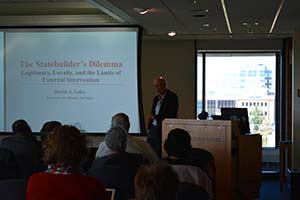 David A. Lake, Distinguished Professor of Political Science at the University of California San Diego and Director of the Yankelovich Center for Social Science Research, addressed this question in a talk titled “The Statebuilder’s Dilemma: Legitimacy, Loyalty, and the Limits of External Intervention” at the annual Harold Jacobson Lecture in International Law which was held on October 23rd, 2014.
Statebuilding seeks to bring stability to unstable regions. Typically, an outside political power, e.g., the United States, will create a new government in a volatile region. In doing so, they attempt to bring a monopoly to legitimate violence. Usually this means supporting a political leader who can build a political coalition to overcome the conflicts. Often, the statebuilder marches in, plants a stake in the ground, and declares a new order. They guarantee this order as long as the different factions honor the new regime.
Statebuilding presents challenges. First, it is very expensive, with the bulk of the cost falling on the failed state. The key to success is balancing legitimacy and loyalty, which proves to be a delicate balance. That is, the new leader must remain loyal to the statebuilder but also seem legitimate to the local population. The more interest the statebuilder has in the region, the more they will require loyalty. Statebuilding fails when the new leader balks at the loyalty. Instead, money meant to be invested in building infrastructure is diverted into building his political coalition.
With the exception of Japan and Germany post-World War II, statebuilding tends to fail. The opening examples exemplify this. So Lake poses the important question: What can be done?
Lake facetiously suggests not engaging in statebuilding as the best solution. Recognizing abstention to be unlikely, he offers a few other guidelines. First, better strategy and implementation is needed, especially around election timing and monitoring. Second, an international coalition should monitor statebuilding and the process of transferring power completely to the new state.
Nov 10, 2014 | Innovative Methodology, International, Law
Post developed by Katie Brown and Ugo Troiano.
In Italy, would be tax evaders hide money in houses. In response, the Italian government developed a “Ghost Buildings” program which used technology to identify and monitor buildings otherwise hidden from tax authorities. In total, the Italian government identified two million houses that were hidden for tax purposes.
How do voters respond to anti-tax evasion policy? Answering this question has been a challenge because tax evasion is illegal and is typically very hard to measure. However, the Ghost Buildings program offers a unique opportunity to investigate the issue. Center for Political Studies (CPS) Faculty Associate and Department of Economics Assistant Professor Ugo Troiano seized this chance in a working paper along with his co-author Lorenzo Casaburi who is a Postdoctoral Fellow at the Stanford Institute for Economic Policy Research (SIEPR).
The authors approached the research knowing that anti-tax evasion programs like the Ghost Building program hurt tax evaders while benefiting tax payers. Usually, one assumes evaders to be the minority and payers to be the majority. If this is the case, a program like Italy’s Ghost Buildings one should boost public opinion in support of incumbents as payers support the crackdown on evaders.
To test the effect in Italy, the authors mapped the identified Ghost Buildings to calculate a town-by-town concentration, as illustrated by the graph below.
Ghost Building Concentration
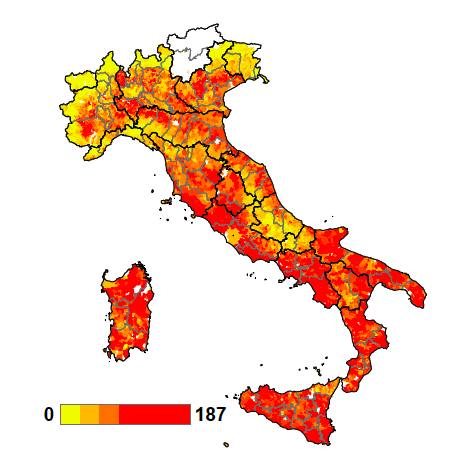
The authors also collected geographic and socio-economic data for the same towns. They found tax evasion to be more prevalent in cities, possibly because cities offer more opportunity to to buy houses from a larger stock. Tax evasion was also found to have an inverse relationship with social capital and income.
Troiano and Casaburi then looked at the impact of the Ghost Buildings program on vote choice. Specifically, they were interested in change in support for incumbent politicians. The graph below displays the results:
Difference in Reelection Rates Pre- to Post- Ghost Buildings Program
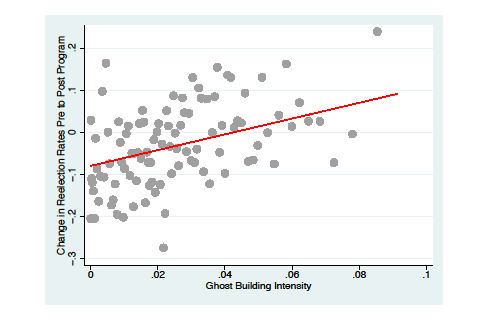
The positive trend-line shows that the higher the proportion of Ghost Buildings in a given town, the more that vote support for the incumbent increases. The authors therefore concluded that, “Local incumbents are shown to obtain positive political returns, namely, an increase in their reelection likelihood, from the Ghost Building program.”
The authors found that fighting tax evasion allowed politicians to increase public good provision, thereby creating material benefits to society. Second, support for the incumbent who fights tax evasion was found to be stronger in regions with attitudes more hostile to evaders. The authors also looked at responses to the World Values Survey question “Do you think tax evasion is justifiable?” and what they found suggests that tax enforcement and attitudes toward evasion have a complementary relationship.
Oct 28, 2014 | Foreign Affairs, Innovative Methodology, International
Post developed by Katie Brown in coordination with Khalil Shikaki.
Can measurement promote democratization in the Arab world? Khalil Shikaki, visiting scholar at the Center for Political Studies (CPS), believes the answer is “yes.” In 2006, he set out to create an instrument to measure both the direction and sustainability of the transitional process. The resulting Arab Democracy Index is a joint project between the Palestinian Center for Policy and Survey Research (PCPSR), the Arab Reform Initiative, and the Arab Barometer.
The Arab Democracy Index is unique in that it comes from within the Arab world to reflect local experiences. It also pulls from three main sources: data on government actions, reviews of legal and constitutional text, and public opinion data. Local teams in nine to twelve countries collect this data, tailoring the standardized process based on their local expertise. Together, these sources offer insight into 40 indicators of democracy.
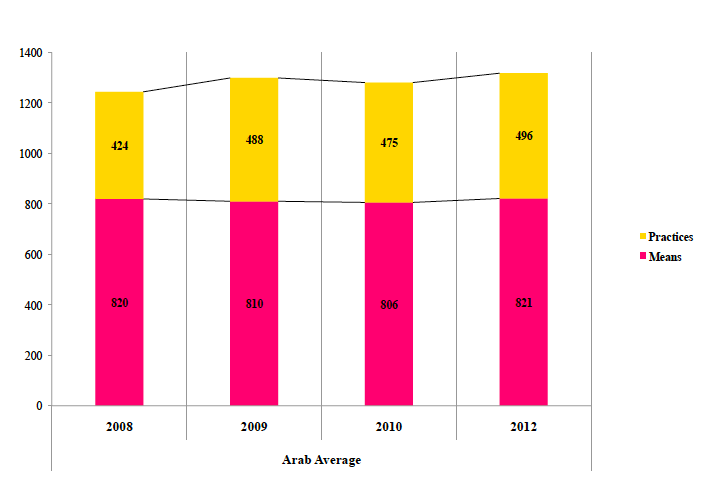
The Arab Democracy Index indicators break down into two types. First, there are Means, e.g., legislation, which speak to democracy de jure. Second, there are Practices, e.g., elections, which speak to democracy de facto. Data in each category tally to a total. Scores below 400 constitute an undemocratic state, 400 to 699 indicate early signs of transition, 700 to 1,000 highlight visible progress toward democracy, and scores above 1,000 pertain to already democratic nations. The graph below displays the results for all Arab countries. Overall, Means remain relatively constant while Practices show signs of improvement.
The data can also be broken down by country, as in the graph below. As we can see, some nations are driving this positive trend while others are moving away from democracy during this period.
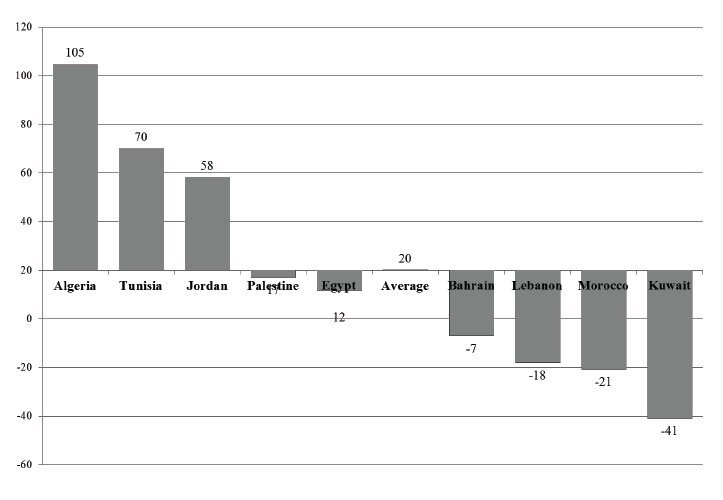
The results led to reports, issued in 2008, 2009, and 2010, that not only document opinion but offer policy recommendations for policy change tailored to each country. Shikaki notes that while political and civil rights have improved, more must be done. Specifically, he recommends a focus on reforming education, social justice, and socio-economic reforms. The Arab Democracy Index also underscores an important larger point: external pressure from the U.S. Department of State can help change democracy in theory, but change in practice must come from within.
Oct 21, 2014 | Conflict, Innovative Methodology, International
Post developed by Katie Brown and Christian Davenport.
 Who did what to whom in 1994 Rwanda? This is the central question driving the GenoDynamics project directed by Center for Political Studies Faculty Associate and Professor of Political Science, Christian Davenport, and former CPS affiliate and current Dean of the Frank Batten School of Leadership and Public Policy at the University of Virginia, Allan Stam.
Last week, Davenport updated the associated website to provide new, unreleased data that the project collected, documents that can no longer be found on the topic, and new visualizations and animations of collected data.
Also added to the website was a page specifically dedicated to a recent BBC documentary, Rwanda’s Untold Story, that features the research. The documentary premiered on October 1, 2014 in Europe and is now available for viewing on the Internet. The film itself has prompted some controversy. The most vocal critics call those involved with the documentary “genocide deniers,” which by Rwanda law classifies as anyone who completely denies or seeks to “trivialize” or reduce the number of Tutsi victims declared by the government. Others have protested outside the BBC headquarters in London. Still others have praised the film for bringing forward a story that they felt was long overdue.
The GenoDynamics website features all of this criticism. But it also offers a glimpse into what the researchers found and how they found it.
Davenport and Stam knew that Rwanda 1994 was a time of wide-spread violence when they began investigating in depth in 2000. But they did not know “who was engaged in what activity at what time and at what place.” With funding from the National Science Foundation (NSF), the researchers content analyzed and compiled data from the Rwandan government, the International Criminal Tribunal on Rwanda (ICTR), Human Rights Watch, African Rights, and Ibuka. These sources were used to create a Bayes estimation of the number of people killed in each commune of the country for the 100 days of the genocide, civil war, reprisal killings and random violence. Davenport and Stam interviewed victims and survivors as well as perpetrators in Rwanda, and they surveyed citizens in the town of Butare. Finally, through a triangulation of information from the Central Intelligence Agency (CIA), a Canadian Military Satellite image, and Hutu and Tutsi military informants through the ICTR, they created variables concerning troop movement and zone of control. This allowed them to see who was responsible for killings in the different locations.
The work is controversial in many respects – including the degree of transparency involved, as Davenport and Stam are the only project that has made all relevant data publicly available – but the biggest controversy concerns how they challenge popular understanding. At present, the official story is that one million people were killed by the extremist Hutu government and the militias associated with them, with most of (and in some stories all of) the victims being Tutsi (upwards of 800,000 in some estimations). But Davenport and Stam found that in 1991 (according to the Rwandan census as well as from population projections back from the 1950s) only 500,000 Tutsis lived in Rwanda. Davenport and Stam further concluded that approximately 200,000 Tutsis were killed, as it was reported by a survivors organization that 300,000 Tutsi survived. While this number is less than the official number, it still represents the partial annihilation of the Tutsi population, which includes genocide but likely other crimes against humanity and human rights violations as well. But the estimation also changes the official story: the results of this research suggest that the majority of those killed in 1994 were in fact Hutu.
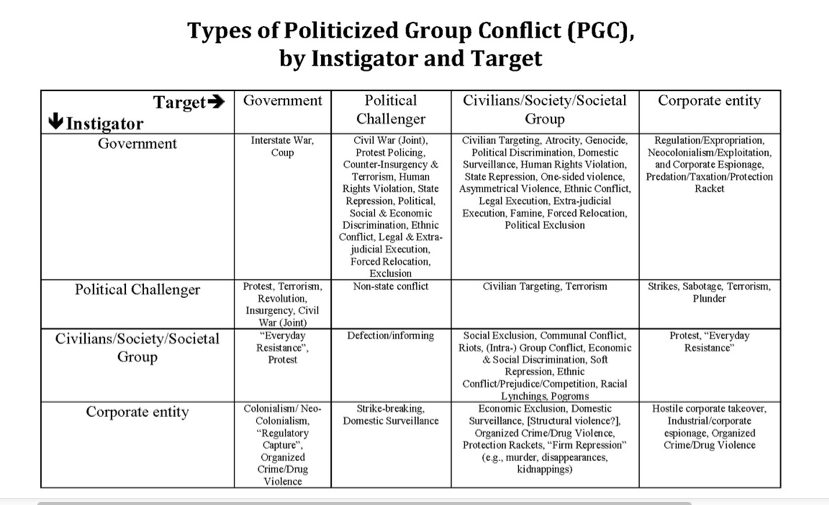
After 14 years of research, Davenport and Stam believe that there were several types of political violence occurring in Rwanda in 1994. The table below summarizes the different types of violence that were potentially involved (by perpetrator and victim). The larger project is trying to sort Rwandan political violence into each cell, which is incredibly difficult but useful for understanding exactly what happened.
The current controversy is not a new one. When Davenport and Stam presented their findings to the Rwandan government, they were told that they would not be welcome to return. When they presented their findings at the 10th and 15th anniversaries, they received more criticism. At no point was any new evidence or data provided which countered their narrative. In addition to the documentary, Davenport and Stam are working on a peer reviewed journal article and a book for a broader audience.
Oct 17, 2014 | Elections, International, Uncategorized
Post developed by David Howell and André Blais.
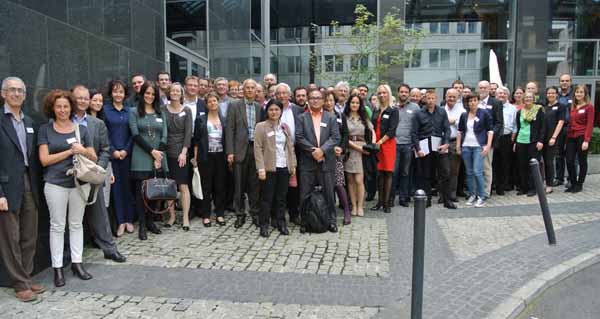
The Comparative Study of Electoral Systems (CSES) project recently celebrated its 20th anniversary during a Plenary Session of collaborators in Berlin, Germany, with thanks to the Wissenschaftszentrum Berlin für Sozialforschung (WZB) for their generous organizational and financial support of the event.
At the event, 31 election studies from around the world made presentations about their research designs, plans, challenges, and data availability, with most of their slide sets being available for viewing at the Plenary Session website.
It was especially appropriate to return to Berlin this year, the city having hosted the initial planning meeting for the project 20 years previously. The original event was sponsored by the International Committee for Research into Elections and Representative Democracy (ICORE). Originally anticipated as an outgrowth of ICORE, the CSES grew and eventually replaced it.
A CSES module consists of a 10-15 minute questionnaire that is inserted into post-election surveys from around the world. The project includes collaborators from more than 60 countries, with 50 election studies from 41 countries having appeared in the CSES Module 3 dataset. The CSES design is such that each module has a different theme which is intended to address a new “big question” in science. The project combines all of these surveys for each module, along with macro data about each country’s electoral system and context, into a single dataset for comparative analysis. There is no cost to download the data, and there is no embargo or preferential access. Every citizen in the world is able to download the data from the project’s website at the very same time as any of the project’s collaborators.
The recent Berlin meeting involved the first public presentation and discussion of content proposals submitted for CSES Module 5, for which data collection will be conducted during 2016-2021. After a public call, 20 proposals in total were received – a record number. Interested persons can view a presentation about the proposals, on topics ranging from corruption to populism to personality traits to electoral integrity. The theme for Module 5 will be selected, and the questionnaire developed and pretested, over the next one-and-a-half years. Prior modules have had as their themes: the performance of democracy, accountability and representation, political choices, and distributional politics and social protection.
As of the Berlin meeting in 2014, André Blais and the CSES Module 4 Planning Committee have handed over their role to a new CSES Module 5 Planning Committee, with John Aldrich as chair. John is an outstanding scholar who, in addition to having held leadership positions in many professional associations, has a long association with both the American National Election Studies and CSES.
While at its core CSES is a data gathering and disseminating organization, it has produced many other benefits as well. CSES considers an important part of its mission to be to create a community for electoral researchers, and to encourage election studies and local research capacity building around the world. CSES enables scholarship not just in political science, but other related disciplines – over 700 entries now appear in the CSES Bibliography on the project website.
The majority of funds for the CSES project are provided by the many organizations that fund the participating post-election studies. The central operations of the project are supported by the American National Science Foundation and the GESIS – Leibniz Institute for the Social Sciences.
We’d like to thank our many collaborators, funding organizations, and users for their support of the CSES, and we look forward to developing an engaging CSES Module 5!