Aug 30, 2019 | APSA, Current Events, Elections, Innovative Methodology
Post developed by Dory Knight-Ingram
ICYMI (In Case You Missed It), the following work was presented at the 2019 Annual Meeting of the American Political Science Association (APSA). The presentation, titled “Using Neural Networks to Classify Based on Combined Text and Image Content: An Application to Election Incident Observation” was a part of the session “Deep Learning in Political Science” on Friday, August 30, 2019.
A new election forensics process developed by Walter Mebane and Alejandro Pineda uses machine-learning to examine not just text, but images, too, for Twitter posts that are considered reports of “incidents” from the 2016 US Presidential Election.
Mebane and Pineda show how to combine text and images into a single supervised learner for prediction in US politics using a multi-layer perceptron. The paper notes that in election forensics, polls are useful, but social media data may offer more extensive and granular coverage.
The research team gathered individual observation data from Twitter in the months leading up to the 2016 US Presidential Election. Between Oct. 1-Nov. 8, 2016, the team used Twitter APIs to collect millions of tweets, arriving at more than 315,180 tweets that apparently reported one or more election “incidents” – an individual’s report of their personal experience with some aspect of the election process.
At first, the research team used only text associated with tweets. But the researchers note that sometimes, images in a tweet are informative, while the text is not. It’s possible for the text alone to not make a tweet a report of an election incident, while the image may indeed show an incident.
To solve this problem, the research team implemented some “deep neural network classifier methods that use both text and images associated with tweets. The network is constructed such that its text-focused parts learn from the image inputs, and its image-focused parts learn from the text inputs. Using such a dual-mode classifier ought to improve performance. In principle our architecture should improve performance classifying tweets that do not include images as well as tweets that do,” they wrote.
“Automating analysis for digital content proves difficult because the form of data takes so many different shapes. This paper offers a solution: a method for the automated classification of multi-modal content.” The research team’s model “takes image and text as input and outputs a single classification decision for each tweet – two inputs, one output.”
The paper describes in detail how the research team processed and analyzed tweet-images, which included loading image files in batches, restricting image types to .jpeg or .png., and using small image sizes for better data processing results.
The results were mixed.
The researchers trained two models using a sample of 1,278 tweets. One model combined text and images, the other focused only on text. In the text-only model, accuracy steadily increases until it achieves top accuracy at 99%. “Such high performance is testimony to the power of transfer learning,” the authors wrote.
However, the team was surprised that including the images substantially worsened performance. “Our proof-of-concept combined classifier works. But the model structure and hyperparameter details need to be adjusted to enhance performance. And it’s time to mobilize hardware superior to what we’ve used for this paper. New issues will arise as we do that.”
Aug 30, 2019 | APSA, Current Events, Policy
Post developed by Erin Cikanek, Nicholas Valentino, and Katherine Pearson
ICYMI (In Case You Missed It), the following work was presented at the 2019 Annual Meeting of the American Political Science Association (APSA). The presentation, titled “The Politicization of Policies to Address Climate Change” was a part of the session “The Dynamics of Climate Policy Support in the US” on Friday, August 30, 2019.
Climate change is a truly polarizing issue. Partisans on either side of the issue have such deeply entrenched beliefs that there is little that can change minds. But this wasn’t always the case. For example, in 1988 Democrats and Republicans were in close agreement about the amount of money the government should spend on environmental protection. More recently, partisans have become more polarized in their level of concern about climate change.
How do scientific policy issues become so polarized, and how quickly does this happen? New research by Nicholas Valentino and Erin Cikanek measures public awareness of Carbon Dioxide Removal (CDR) polices, and explores whether attitudes toward these policies are as politicized as climate change overall.
Valentino and Cikanek conducted two studies to examine political polarization of CDR. First, they surveyed a large, nationally representative sample of people to measure how much they knew about climate change. The questions covered a broad set of issues and strategies for dealing with the problem. This survey revealed that the public has a high level of knowledge about climate change.
The study also demonstrates that partisanship is highly predictive of knowledge about climate change. Democrats responded with significantly more accuracy than Republicans did. When respondents were asked specifically about technologies to remove carbon dioxide from the atmosphere, overall knowledge was lower, but Democrats and Republicans answered questions with the same level of accuracy, as shown in the figure below. Valentino and Cikanek note that “this pattern is consistent with the possibility that elite rhetoric has come to suppress accuracy on general climate change knowledge among Republicans, but this has not yet occurred for knowledge in this newer domain (CDR).”
The second study experimentally tested whether CDR policies are sensitive to partisan cues. CDR policies have not been debated as much or as publicly as climate change in general. Are these policies as susceptible to political polarization?
Survey respondents were randomly assigned to one of three groups. A control group was asked about current climate change policies, as well as carbon reduction policies. The first treatment group received information that applied partisan stereotypes to the CDR policies: Republican hesitation about CDR because it might hinder business, and Democratic encouragement to save the environment. The second treatment group received information that ran counter to those stereotypes: Republican support for a pro-business solution to climate change, and Democratic concern that the solution may encourage businesses to pollute.
The partisan cues had very little effect on the response to CDR policies. Interestingly, the counter-intuitive partisan cues backfired: when Republican respondents read the treatment showing Republican support for CDR, they opposed it slightly more. The very weak effect of partisan cues on support for CDR may show that CDR policies may be more resistant to polarization.
The more politicians discuss scientific policy issues, the more polarized the discussion tends to become. However, Valentino and Cikanek see reason to hope that compromises remain possible for issues like carbon removal, which have not yet been subjected to partisan rhetoric.
Aug 30, 2019 | APSA, Current Events, Law, National, Policy, Race, Social Policy
Post developed by Nicole Yadon, Kiela Crabtree, and Katherine Pearson
ICYMI (In Case You Missed It), the following work was presented at the 2019 Annual Meeting of the American Political Science Association (APSA). The presentation, titled “Breeding Contempt: Whites’ Reactions to Police Violence against Men & Dogs” was a part of the session “Race and Politics: New Theoretical and Methodical Insights v. Old Paradigms” on Thursday, August 29, 2019.
Of 987 individuals killed by police officers’ use of fatal force in 2018, 209 were black, and, of those, 200 were black men. The targeting and killing of unarmed black men has become a point of interest for news cycles and social movement organizations alike and is indicative of a fraught relationship between communities of color and police. With increasing press coverage over the past decade, academics have also begun to focus on the intertwining relationship between police use of force and race, complementing a long-standing literature which links blacks to perceptions of criminality, violence, and hostility. One area that is not well-developed, however, is how news coverage of police shootings influences attitudes towards police and policies related to policing for white Americans.
Building from research on race, media coverage, and policing, new research by Nicole Yadon and Kiela Crabtree examines reactions to police and policing by white people after they read about a police officer shooting a white man, a black man, or a dog. They find that news reports about police shootings change attitudes about police, but the strength of the reaction varies depending on who the victim is.
Specifically, Yadon and Crabtree’s study examines white individuals’ feelings towards police following exposure to news of a fatal police shooting. They designed a survey that presents participants with a fictional but realistic news report about a fatal police shooting. In one version the shooting victim is a black man, another reports that the victim is a white man, and in the third version the victim is a dog. Key information about the shooting remains the same across all three versions. A control story, unrelated to race or police shootings, was given to a control group for purposes of comparison with the three treatment groups. This experiment was conducted via Amazon’s Mechanical Turk (MTurk) platform, with 802 white participants. After reading one of the news reports, participants were asked a series of questions about their perceptions of the events in the article and about their attitudes towards police more broadly.
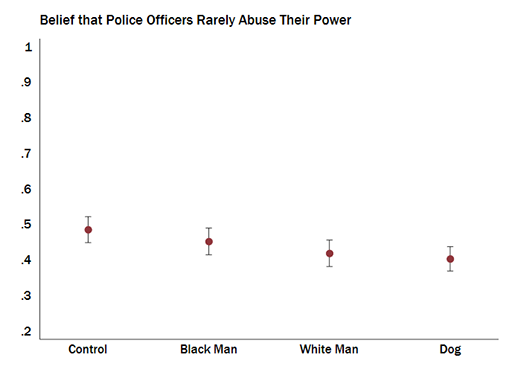
When asked whether they agree or disagree that police officers rarely abuse their power, the control group who had not read about a police shooting had a neutral response — about 0.49 on the 0 to 1 scale. Respondents who read about a white man or a dog being shot by police had a markedly different reaction. Participants who read an article about a white man shot by police had a 7 percentage point decrease in belief that police rarely abuse their power while those who read about a dog shot by a police officer had an 8 percentage point decrease. This is equivalent to survey respondents moving from feeling neutral about whether police abuse their power to a slight disagreement that abuse of power is rare after reading about either a White victim or dog victim.
Importantly, when white survey participants read about a black victim of a police shooting, it did not change their perception of abuse of power by police officers. Put differently, those who read about a black victim held views abuse police abuse of power that were indistinguishable from those who read the control story. The evidence suggests, then, that white respondents react more strongly to a police shooting if the victim is a dog than a black man.
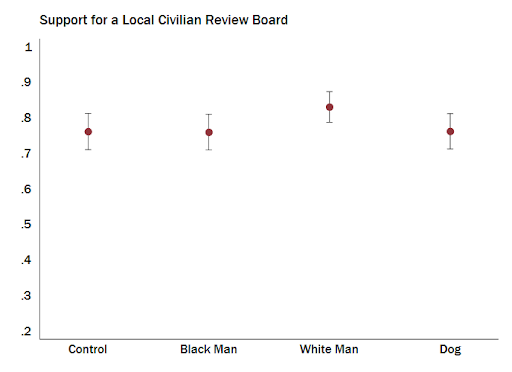
A separate set of questions focused on interest in varying forms of political participation following exposure to the news story. Do white people feel moved toward political participation in response to a story about a police shooting? First, the survey asked whether respondents would support a civilian review board to oversee the police department in their community. Those who read about a police officer shooting a black man or a dog were no more likely to support a civilian review board than the control group. However, those who read about the shooting of a white man were more than 7 percentage points likely to support civilian review in their community.
A second question asked about interest in signing a petition urging Congress to take action towards reducing excessive use of force by police. In contrast to the civilian review board question, levels of support for signing a petition were very low across all groups. In fact, white participants do not appear increasingly motivated to urge Congress to take action against excessive police force regardless of the victim’s identity.
Taken together, Yadon and Crabtree’s results suggest that exposure to a news story about a police shooting draws strong reactions from white people. Of concern, however, is that such reactions are largely limited to viewing either a white man or a dog victim. Indeed, across most of the items which measure attitudes towards police, there are no statistically significant differences when comparing the control condition with the black victim treatment. Such connections are increasingly important to study as cities move toward tightening oversight of police forces and many such initiatives are presented to citizens at the ballot box. Thus, the attitudes citizens hold about police are not only their own. The public’s opinion has potentially lasting effects for the future of policing in local communities.
Aug 29, 2019 | APSA, Elections, International
Post developed by Allen Hicken and Katherine Pearson
ICYMI (In Case You Missed It), the following work was presented at the 2019 Annual Meeting of the American Political Science Association (APSA). The presentation, titled “Presidents and/or Prime Ministers: A Historical Dataset” was a part of the session “Legislatures and Leaders: New Perspectives on Political Institutions” on Thursday, August 29, 2019.
Classifying systems of government is a challenge for political scientists comparing regimes over time and across countries. A new historical dataset developed by Fabricio Vasselai, Samuel Baltz, and Allen Hicken addresses this challenge with a simplified classification scheme that presents data on four broad variables: whether there is an elected prime minister, whether there is an elected president, whether there is a non-elected prime minister, and whether there is a non-elected president. The dataset includes a yearly assessment for almost all sovereign countries since 1789, which amounts to 16,910 country-years.
The simplicity of this classification system allows researchers to examine other characteristics separately, including the level of democracy or the powers of elected leaders. While the majority of country-years fit a neat definition, this dataset allows a clearer analysis of complex cases.
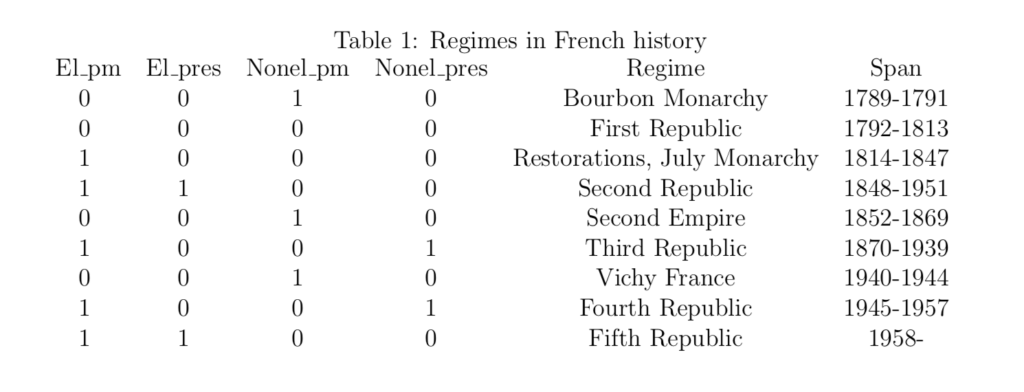
The authors present France as an interesting test case. In the years included in this dataset, France had (1) only an unelected prime minister, (2) no elected or unelected prime minister or president, (3) only an elected prime minister, (4) an elected prime minister and an elected president, or (5) an elected prime minister and unelected president, with several of these states repeating multiple times throughout France’s history. The dataset presents this complicated historical narrative in the simplified manner below.
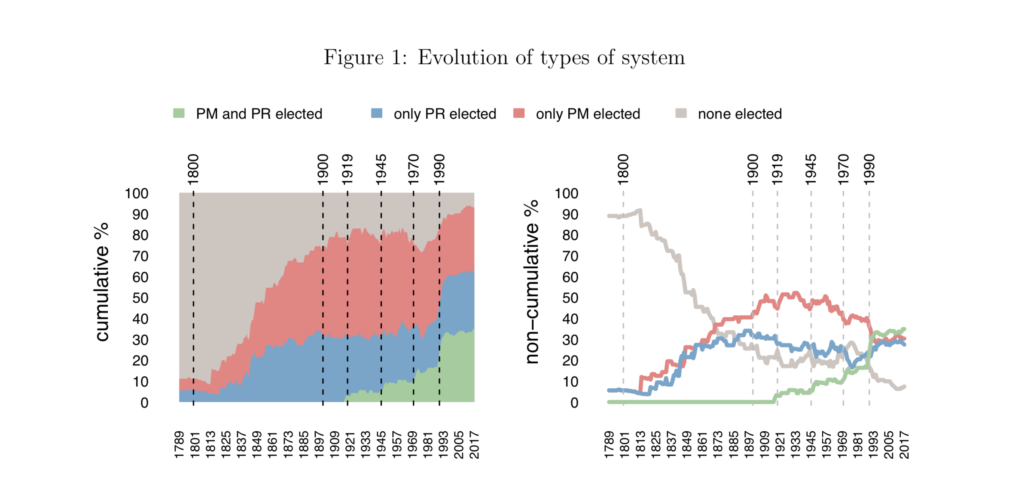
This classification system also allows researchers to explore the evolution of different systems of government over longer periods of time. The authors show that an explosion of elections took place in the 19th century. Beginning in the 20th century, the share of countries electing only a prime minister takes a slight lead; by 1945 almost twice as many countries elected only a prime minister compared to those electing only a president. The share of countries electing either leader climbs through the second half of the 20th century, with only about 10 percent of country-years lacking an elected leader by 2017.
By developing a simple, comprehensive dataset, Vasselai, Baltz, and Hicken have given researchers a resource that allows them to analyze regimes consistently and layer on additional information as needed.
Sep 1, 2018 | APSA, Elections, Race
By Nicholas Valentino, James Newburg and Fabian Neuner
ICYMI (In Case You Missed It), the following work was presented at the 2018 Annual Meeting of the American Political Science Association (APSA). The presentation, titled “Dog Whistles to Bullhorns: Racial Rhetoric in Presidential Campaigns, 1984-2016” was a part of the session “Framing Politics: The Importance of Tone and Racial Rhetoric for Framing Effects” on Friday, August 31, 2018.
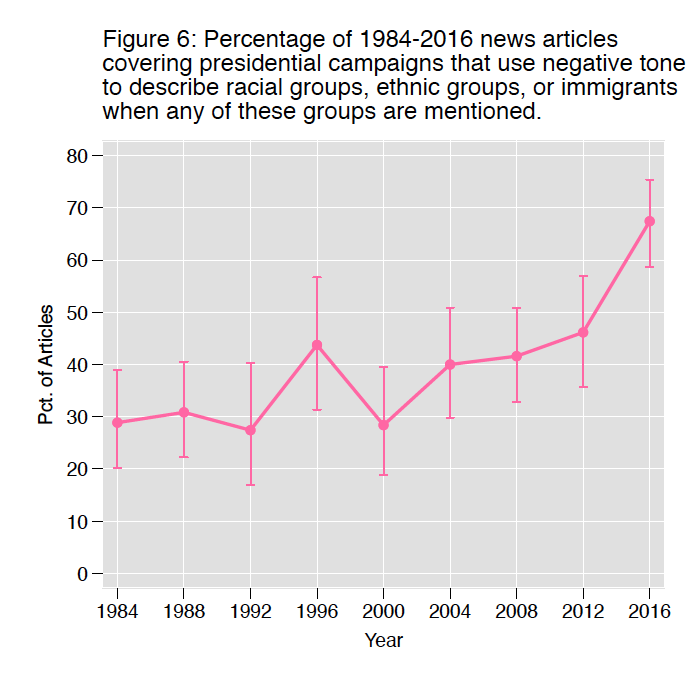
Political candidates’ use of coded language to express controversial attitudes on race is nothing new – but is it more common than in the past? Nicholas Valentino, James Newburg, and Fabian Neuner analyzed data from 1984 to the present that showed campaign rhetoric in 2016 included more racial rhetoric, negative racial group outreach, and negative mentions of racial groups than any other campaign they studied.
Beginning in 1968 through the late 1990s, the expression of explicitly racist attitudes seemed to be in decline, although racially charged imagery was still used in the news and media. While the rhetoric became subtler, prejudicial attitudes were still expressed through “racially coded” language. Over time, issues like crime, welfare, and immigration evoked negative racial stereotypes that could impact political choices without explicitly mentioning race.
The shift to less directly rhetoric is important because implicit references to race and racial stereotypes may have a greater impact on perceptions than explicit ones do. The authors of this study note that previous research shows that people may dismiss obvious appeals to racial bias, while actually being influenced by more subtle or coded language. They note that the strength of this effect is uncertain, and that recent studies show respondents more likely to accept explicit racial rhetoric.
After Barack Obama’s election in 2008, racially charged discourse became more explicit, shocking some Americans. It was impossible not to notice the change in the tone of racial language in the election of 2016. But when exactly did this shift occur? Did it happen gradually or all at once?
To answer these questions, the authors examine trends in racial rhetoric reported in the news between 1984 and 2016. They set out a hypothesis: If changes in rhetoric happened more gradually over time as a result of partisan realignment, they should see trends in the use of explicit racial rhetoric that predate the 2016 campaign, and perhaps even prior to 2008. If, on the other hand, the 2016 election and the candidacy of Donald Trump is the major cause of shifts in discussions of race and ethnicity in mainstream American politics, they would expect explicit group mentions, especially hostile ones, to spike in 2016.
The researchers conducted a rigorous analysis of thousands of articles published in the New York Times and Washington Post between September 1 and Election Day during every presidential election year from 1984 to 2016. They found that while mentions of race were high throughout the study period, racial rhetoric spiked in 2016, especially with regard to immigrants and immigration.
Significant moments of presidential campaigns track with the rise and fall of explicit mentions of race in the news. As Republicans made electoral gains among Southern Whites, racial language reached a peak; during the more moderate campaigns of Bill Clinton and George W. Bush, racial language declined. Race became more prominent with the historic election of Barack Obama in 2008, but declined when Obama avoided discussions of race during his reelection campaign. The authors find that 2016 was unique in the high number of explicitly negative racial statements, but that partisan realignment had been causing this change had also been driving up the acceptability of these types of messages over several years.
They found that while the total amount of group coverage did not rise sharply until 2016, the coverage that was dedicated to groups got more negative gradually over time. Notably, an important factor in the secular increase of racial rhetoric was negative language describing Arab Americans, Latinos, and Immigrants in recent years. As American demographics continue to change and non-white groups grow in numbers and political strength, these trends in political language will grow even more significant.
Aug 31, 2018 | APSA, Foreign Affairs, International
ICYMI (In Case You Missed It), the following work was presented at the 2018 Annual Meeting of the American Political Science Association (APSA). The presentation, titled “When Does Online Censorship Move Toward Real-World Repression?” was a part of the Chinese Politics Mini-Conference on Thursday, August 30, 2018.
The Chinese government asserts power and control through strict management of online information. Often, this comes in the form of censorship of online content, which is handled by private internet content producers, large companies like Sina Weibo and Tencent. However, in certain cases these companies report users and content back to the government rather than simply censoring it.
 What content, and which users, are being targeted for handling by the state? Researchers Mary Gallagher and Blake Miller analyzed leaked documents from Sina Weibo, a popular Twitter-like social networking site, to find out why certain cases were moved back to government handling.
Control dynamics over time
Throughout the 1990s, the Chinese government became more tolerant of people protesting the socio-economic effects of market reforms. The government became more selective about its tactics, focusing on preempting major challenges, while allowing reasonable grievances to be aired, especially those aimed at lower-level local officials.
Gallagher and Miller point out that this apparent rise in tolerance does not mean that repression has disappeared. Rather, the state has moved into a period of “responsive authoritarianism” in which repression is harder to detect, more pre-emptive, and more sophisticated.
An evolving approach to censorship
The rise of social media has been a game-changer for both the state and social movements. As technology makes it easier to share information and express grievances, the government is able to track and repress public opinion and outcry in a more precise way. Discussions of topics such as environmental degradation, food safety, or lapses in public safety can be shared more widely, building support for reforms.
As online groups gain popularity, there has been a shift in government behavior to shutting down these groups, not necessarily because they are expressing subversive ideas, but because they may develop the power to persuade. The state uses a “scalpel, not a hammer” to censor, targeting groups that may become influential. This gives the perception that speech is more free, while quashing groups before they can influence public opinion, potentially disrupting order.
Managing influencers and controversies
By analyzing a leaked dataset of internal censorship logs from Sina Weibo, Gallagher and Miller were able to explore patterns in the types of content and users reported back to the security bureaus.
They found that the party is primarily concerned with limiting alternative voices and influence, and they do that by inhabiting and dominating social media platforms. The government is intolerant of topics once they go viral. To prevent sensitive topics from going viral in the first place, the party looks closely at influential opinion leaders. As Gallagher and Miller note, “the content of the post is less important than who is posting it.” The state seeks to head off the threat of the “butterfly effect” by containing a small incident quickly before it can grow in influence over time.
Online opinion leaders are seen as a threat to the government that must be handled carefully. because they stand between the mass media and the public. Most often, the state response to these influencers is not to censor them immediately, but to report them back to the government. This way, the party cultivates opinion leaders to identify with the party, so that they may be able to shape public opinion favorably in the event of a “public opinion emergency.”
Censors allow a great deal of online discussion to take place, while at the same time targeting users who are believed to have enough influence to cause real damage. By allowing more speech, the state gains a window into public opinion. However, when discussions pick up momentum, or begin to criticize the government, censors will work to guide discussions and report users and content back to the state.