May 29, 2014 | ANES, Current Events, Innovative Methodology, National
Post developed by Katie Brown and Spencer Piston.
The gap between the rich and poor in the United States is growing. Occupy Wall Street, fast food worker strikes, and other manifestations of this gap make headlines often. And just a few weeks ago, President Obama visited the University of Michigan to champion raising the minimum wage.
Photo credit: Thinkstock
Despite these movements, previous academic work suggests Americans look down on the poor. The news media perpetuate this message. The Economist claims, “Americans want to join the rich, not soak them,” while The New York Times published an article with the headline, “New Resentment of the Poor.”
But what if previous research and the mainstream media are wrong? What if anti-rich movements better capture the American ethos? Center for Political Studies (CPS) affiliate and Ph.D. candidate in Political Science at the University of Michigan Spencer Piston investigated this issue.
Piston addresses this question with an innovative approach. Previous scholarship measures attitudes with questions about “economic inequality” and “government-led redistribution.” But these are terms that survey respondents rarely use without prompting, and Piston finds reason to believe that many Americans don’t understand what these terms mean.
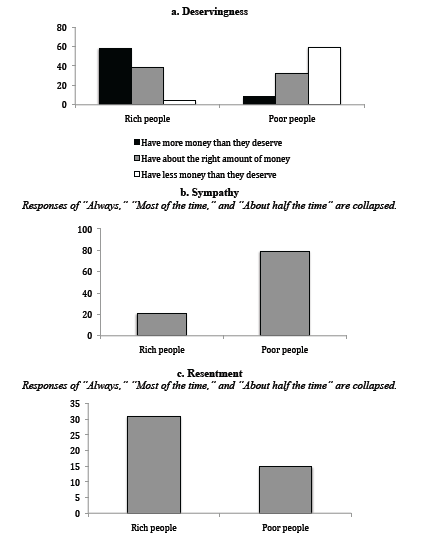
Piston therefore begins with a straightforward but rarely-used survey technique: he asks people how they feel about the poor and the rich. Piston examines answers to these questions using an original survey, and supplemented with American National Election Studies (ANES) data. The graphs below depict feelings of (a) deservingness, (b) sympathy, and (c) resentment toward and the rich and the poor. As we can see, people tend to see the rich as deserving less and the poor deserving more. They also see the poor as more sympathetic than the rich, and the rich as objects of more resentment than the poor.
Feelings toward the Rich and Poor
a. Do the (rich, poor) have more or less money than they deserve?
b. How often have you felt sympathy for (rich, poor) people?
c. How often have you felt resentment toward (rich, poor) people?
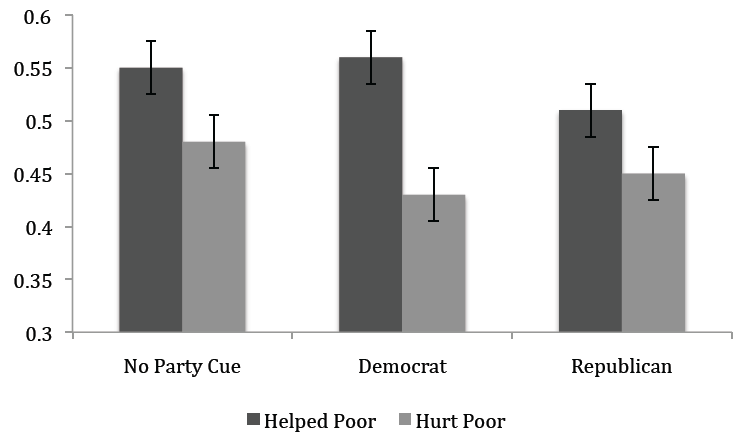
What effect might these Robin Hood attitudes have on elections? Piston tested this with several survey experiments. He finds that that a candidate who supports the poor garners more support among voters than an otherwise identical candidate who hurts the poor, regardless of the candidate’s party.
Effects of Candidate’s Record on Mean Support for the Candidate
Taken together, these results suggest that previous research has overestimated public support for economic inequality and public opposition to downward redistribution. When survey questions are worded using terms that survey respondents more commonly use, it appears that many Americans want government to give more to the poor – and to take from the rich.
Spencer Piston will join Syracuse University in the fall as an Assistant Professor of Political Science.
May 15, 2014 | Current Events, Foreign Affairs, International
Post developed by Katie Brown and William Zimmerman.
Photo credit: Thinkstock
Russian President Vladimir Putin often makes headlines. This week, U.S. sanctions against Putin in the wake of the Ukraine crisis dominated the news, while Putin’s rewrite of recent music history appeared in popular culture news. Why is Putin such an interesting figure in America? Is it because he challenges our notions of “normal”?
On April 27, Princeton University Press released Ruling Russia: Authoritarianism from the revolution to Putin, the latest book by Center for Political Studies (CPS) Professor Emeritus William Zimmerman. Ruling Russia traces Russia’s history over the last century. The definition of normalcy varied with Russia’s leaders. Gorbachev and Yeltsin for all their differences conceived normalcy to correspond with Western political systems while the leaders of the failed coup against Gorbachev in 1991 and Putin more recently have defined normal to equate with stability, security, and absence of change.
Zimmerman argues that there have been plural Soviet systems and plural Russian political systems and provides a typology to encompass the government types across the century from the revolution to today which distinguishes among democratic, competitive authoritarian, full authoritarian, and totalitarian regimes.
With that as background we can consider the last two decades to better understand current politics in Russia. From 1996 to 2008, after a brief move toward democracy, Russian elections became less open, less competitive, and more meaningless. This time period witnessed Putin’s first (2000) and second (2004) election to President. With Putin unable to run for a third consecutive term in 2008, Dmitry Medvedev ran for President and Putin became Prime Minister.
Then, Medvedev and Putin “castled” in 2012, with Putin running again for President and Medvedev being named Premier. While some believe this move was agreed upon between Putin and Medvedev back in 2008, there is no evidence of this. Zimmerman believes Putin put forth the idea in 2011. Regardless, and interestingly, the 2011-2012 election cycle was more competitive and less predictable than its predecessors. Putin ran a campaign supporting the status quo, stability, and nationalism – a return to normalcy.
The book’s historical analysis ends in 2013. Zimmerman sees full authoritarianism as the most likely near term evolution. This would map onto recent events, including the crackdown on homosexuality during the Sochi-hosted Olympics and military aggression in Ukraine.
From an American vantage point, each move away from democracy was a move away from normal. But for Russia, the idea of “normal” moved toward authoritarianism.
Zimmerman dedicates the book to his students, stating that insights from their dissertations inspired multiple parts of the book.
May 8, 2014 | ANES, Current Events, National, Social Policy
Post developed by Katie Brown and Ashley Jardina.

Photo credit: Thinkstock
This month, Nevada rancher Cliven Bundy made headlines. What started as a battle against the U.S. Federal Government for his cattle and land turned into daily press conferences. As part of the Sovereign Movement, Bundy used the attention to propagate an anti-government agenda and racist ideas. Across the country at Princeton University, freshman Tal Fortgang also made headlines with his essay, “Checking my Privilege.” His championing of white privilege garnered backlash in the press. What do Bundy and Fortgang have in common? Both demonstrate reactions to a perceived status threat to whites.
Center for Political Studies (CPS) affiliate and Ph.D. Candidate in Political Science at the University of Michigan Ashley Jardina studies white identification. In particular, she argues that threats to dominant status make racial identity salient. Does this in turn influence support for political policies that could eliminate such status threats?
To answer this question, Jardina analyzed data from the American National Election Studies (ANES). Especially relevant is a measure of racial identity importance available for the first time in the 2012 ANES. This measure let Jardina gauge the extent to which white Americans feel that being white is important to their identity. She looks at whether this white identity relates attitudes toward policies (e.g., immigration) and candidates (e.g., Barack Obama) that exacerbate threats to white dominance. Immigration especially threatens whites’ dominance, because it drives demographic changes whereby whites are being displaced as the majority racial group in the nation. Likewise, as the country’s first African American president, Obama also represents a status threat.
Previous work has argued that out-group attitudes, either toward Hispanics or blacks, primarily drive whites’ attitudes toward immigration policy and support for Obama. But Jardina constructs models to explicitly test the relationship between in-group / out-group feelings. She finds in-group identity to be a more powerful and consistent predictor of restrictive immigration policies than out-group attitudes, including evaluations of Hispanics. Furthermore, whites who identified with their racial group were significantly less likely to vote for Obama, even after controlling for racial prejudice or resentment. Her results are replicated using two other datasets. Jardina concludes, “These results lend support for the notion that, in some important cases, a desire to protect the in-group, rather than dislike for the out-group, primarily drives opinion.”
Ashley Jardina will join Duke University in the fall as an Assistant Professor of Political Science.
Apr 16, 2014 | ANES, Current Events, National
Post developed by Katie Brown and Timothy Ryan

Photo credit: Thinkstock
Partisanship gets in the way of political progress. Hillary Clinton made this common claim last week. The lack of compromise inherent to partisanship is worth investigating. What causes such non-cooperation?
Timothy Ryan, a Ph.D. candidate in the University of Michigan’s Department of Political Science and affiliate of the Center for Political Studies (CPS), seeks to answer this question. In a paper presented at the 2013 meeting of the American Political Science Association – “No Compromise: Political Consequences of Moralized Attitudes” – Ryan ran four studies to understand non-cooperation.
Ryan’s overarching hypothesis boils non-compromise down to morals: a moral mindset orients citizens to oppose political compromises and punish compromising politicians. There are all kinds of issues for which some citizens seem resistant to compromises: tax reform, same-sex marriage, collective bargaining, etc. But who is resistant? Ryan shows that part of the answer has to do with who sees these issues through a moral lens.
Ryan tests moral conviction’s effect on compromise. Data come from the American National Elections Studies (ANES), as well as surveys of undergraduates, participants on Amazon’s Mechanical Turk, and citizens found via GfK Research (his work was made possible by a grant from the National Science Foundation (NSF)). Ryan also considers several types of compromises: hypothetical, actual, positions citizens want their elected officials to adopt, and a willingness to accept a monetary reward only if a disliked group (the Tea Party or the Progressive Change Campaign Committee) also receives a donation.
Participants with moral conviction around an issue are less likely to compromise. Hypothetical and real world compromises were hindered. Compromising politicians received less support. Personal gain was sacrificed to avoid the gain of the Tea Party (if a political adversary). As Ryan concludes, “Different attitude characteristics relate to compromise in different ways, with moral conviction being a particularly potent obstacle to compromise.”
In the fall, Ryan will continue his work on morality when he joins the faculty at the University of North Carolina at Chapel Hill as Assistant Professor of Political Science.
Apr 9, 2014 | Current Events, Elections, Innovative Methodology, National
Post developed by Katie Brown and Timothy Ryan.
There are political issues and then there are moral political issues. Often cited examples of the latter include abortion and same sex marriage. But what makes a political issue moral?
Timothy Ryan, a Ph.D. candidate in the department of Political Science and affiliate of the Center for Political Studies (CPS), explored this question in a recent article in The Journal of Politics. An extensive literature already asserts a moral vs. not moral issue distinction. Yet, there is no consensus in how to distinguish between moral and non-moral political issues. Further, trying to sort issues into these categories proves challenging. Many people assume that same-sex marriage is a moral issue, but does everyone see the issue in moral terms? Do people vary in terms of whether they see economic issues, such as Social Security reform and collective bargaining, with morality at stake?
In an attempt to define the divide between moral and non-moral, Ryan turned to the psychology literature. In particular, Ryan applies moral conviction to morality in politics. Moral conviction refers to topics that tap into an individual’s sense of right and wrong. According to the psychology literature, moral conviction leads to a different type of information processing. Moral conviction involves negative emotions, hostile opinions, and potential punitive actions.
Ryan then tests this concept as it relates to political issues with two studies. In both studies, he measures the emotions stimulated by moral conviction. He finds that moral conviction evokes negative emotions toward political disagreement. He also finds that both traditionally moral issues (like abortion or same sex marriage) and traditionally non-moral issues (like labor relations or Social Security) can both illicit moral conviction.
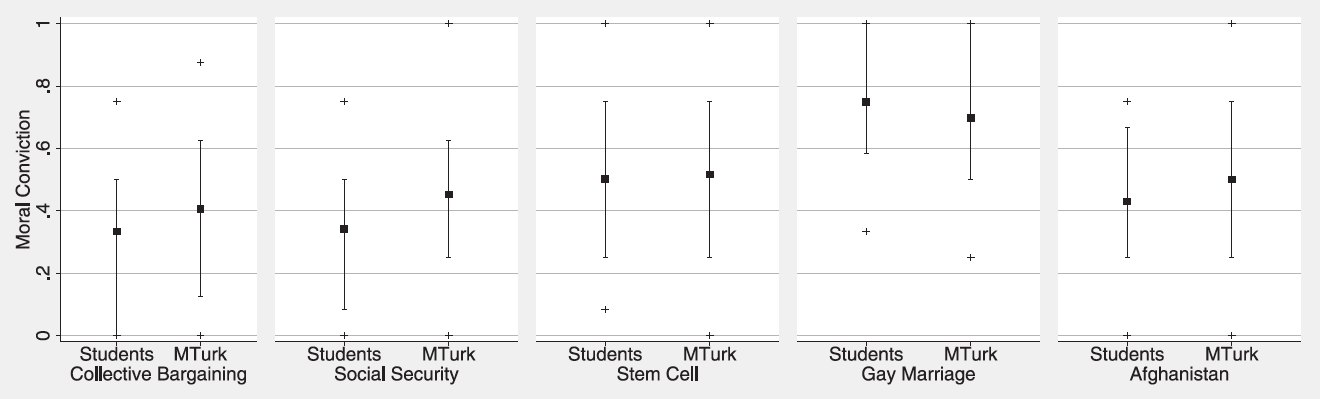
The graph below displays the mean (the squares), the middle 50% (the bars), and the middle 80% (the dots) of moral conviction for five different political issues. As we can see, moral conviction varies a lot for both economic and non-economic issues. Of course many people see same-sex marriage as a matter of right and wrong, Yet, many also see Social Security reform in the same way. The upshot is that, when it comes to deciding which issues are moral, an important part of the answer depends on the individual.
Distribution of Moral Conviction Variable
Ryan’s article also challenges a common assumption: the assumption that moral fervor in politics comes more from the right than the left. In the article, he examines propensity to moralize several political issues. The result? Liberals and conservatives moralize in equal measure. The figure below illustrates this with three separate samples: students, Amazon’s Mechanical Turk respondents, and Evaluations of Government and Society Study (EGSS) respondents.
Moral Conviction by Partisanship
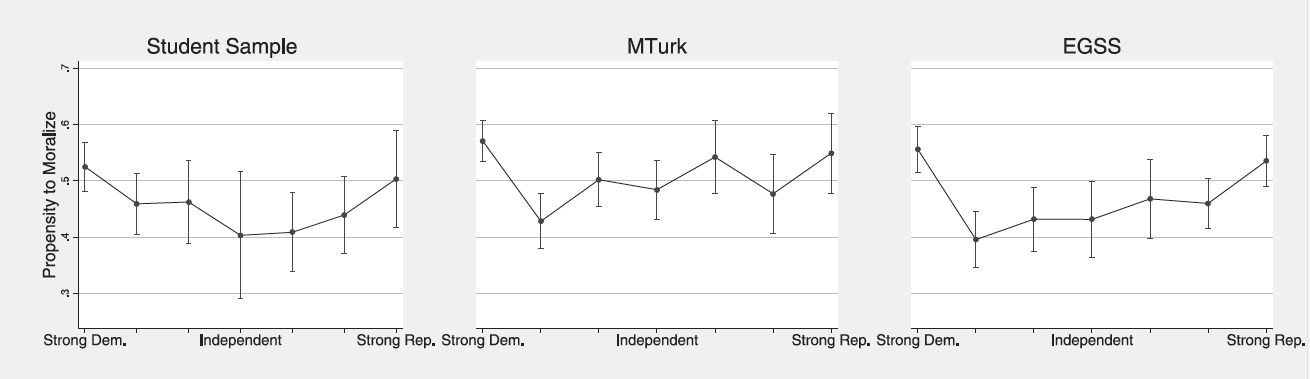
Taken together, Ryan’s findings suggest that the response of moral conviction may be more important than distinguishing between inherently moral and non-moral political issues. Rather, all issues can produce a moral conviction response, depending on the person. Ryan concludes that, “in terms of the underlying psychology, Social Security is just as moralized for some people as Abortion is. Morality is in the eye of the beholder.”
In the fall, Ryan will continue his research on morality in politics when he joins the faculty at the University of North Carolina at Chapel Hill as Assistant Professor of Political Science.
Apr 8, 2014 | Current Events, International, Law
Post developed by Katie Brown in coordination with Yuen Yuen Ang.
The fairness of China’s court system made the news this week. Apple supplier Knowles, which makes microphones and hearing-aid pieces for iPhones, asserted it was blocked from testifying in a trial with a rival of Apple. How can we understand this?
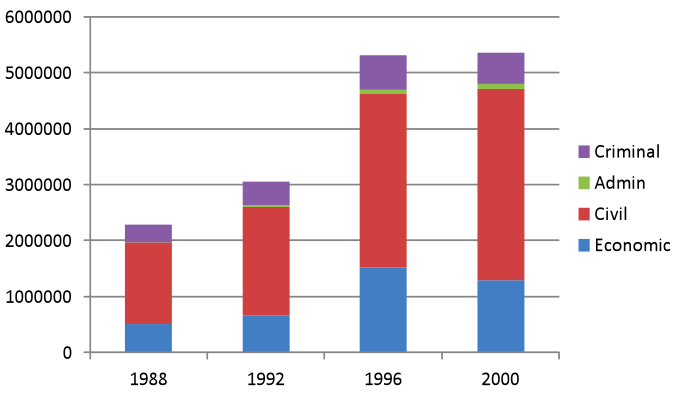
Court cases are on the rise in China, with the number of commercial cases growing steadily, second only to civil disputes. The expansion of courts should mean the rise of the rule of law and a more level playing field for firms, right? Not exactly.
Center for Political Studies (CPS) faculty associate, assistant professor of political science, and Center for Chinese Studies faculty associate Yuen Yuen Ang studies this trend. In a recent article, forthcoming in The Journal of Politics, Ang and Nan Jia find that politically connected firms are actually more likely to use courts than non-connected firms. These connected firms are congressional delegates and/or former party-state officials.
Political connections among private firms in China shape not only their access to resources and profitability, but even their willingness to use courts for dispute resolution.
Number of Court Cases by Type over Time
However, the fact that politically connected firms use courts more may not signal the subversion of law. Besides having access to officeholders (“know who”), politically connected firms also tend to have more knowledge about and confidence in navigating the legal system (“know how”). So do politically connected firms use courts more because of “know who” or “know how?”
By analyzing survey data of over 3,900 private firms in China, Ang and Jia finds that “know who” dominates “know how” in inducing politically connected firms to use courts more.
Findings from the study challenge the assumption in Western-based theories that as law and courts expand, connections will diminish in influence. As the authors write:
“The substitutive view of formal laws and informal networks is premised on the substantial passage of time and absence of a strong authoritarian state in legal development. The edifices of law can be quickly built, but one cannot assume that norms and practices of impartiality will follow, particularly when courts are subordinated to politics by design. In institutional landscapes such as those of China, we can expect a fusion of legality with politics and the informal with the formal.”