Apr 9, 2014 | Current Events, Elections, Innovative Methodology, National
Post developed by Katie Brown and Timothy Ryan.
There are political issues and then there are moral political issues. Often cited examples of the latter include abortion and same sex marriage. But what makes a political issue moral?
Timothy Ryan, a Ph.D. candidate in the department of Political Science and affiliate of the Center for Political Studies (CPS), explored this question in a recent article in The Journal of Politics. An extensive literature already asserts a moral vs. not moral issue distinction. Yet, there is no consensus in how to distinguish between moral and non-moral political issues. Further, trying to sort issues into these categories proves challenging. Many people assume that same-sex marriage is a moral issue, but does everyone see the issue in moral terms? Do people vary in terms of whether they see economic issues, such as Social Security reform and collective bargaining, with morality at stake?
In an attempt to define the divide between moral and non-moral, Ryan turned to the psychology literature. In particular, Ryan applies moral conviction to morality in politics. Moral conviction refers to topics that tap into an individual’s sense of right and wrong. According to the psychology literature, moral conviction leads to a different type of information processing. Moral conviction involves negative emotions, hostile opinions, and potential punitive actions.
Ryan then tests this concept as it relates to political issues with two studies. In both studies, he measures the emotions stimulated by moral conviction. He finds that moral conviction evokes negative emotions toward political disagreement. He also finds that both traditionally moral issues (like abortion or same sex marriage) and traditionally non-moral issues (like labor relations or Social Security) can both illicit moral conviction.
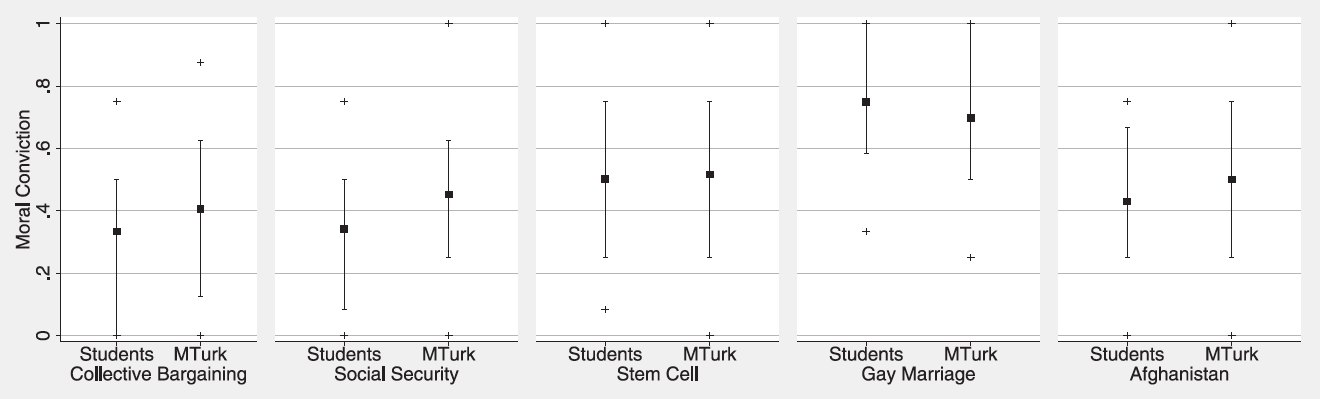
The graph below displays the mean (the squares), the middle 50% (the bars), and the middle 80% (the dots) of moral conviction for five different political issues. As we can see, moral conviction varies a lot for both economic and non-economic issues. Of course many people see same-sex marriage as a matter of right and wrong, Yet, many also see Social Security reform in the same way. The upshot is that, when it comes to deciding which issues are moral, an important part of the answer depends on the individual.
Distribution of Moral Conviction Variable
Ryan’s article also challenges a common assumption: the assumption that moral fervor in politics comes more from the right than the left. In the article, he examines propensity to moralize several political issues. The result? Liberals and conservatives moralize in equal measure. The figure below illustrates this with three separate samples: students, Amazon’s Mechanical Turk respondents, and Evaluations of Government and Society Study (EGSS) respondents.
Moral Conviction by Partisanship
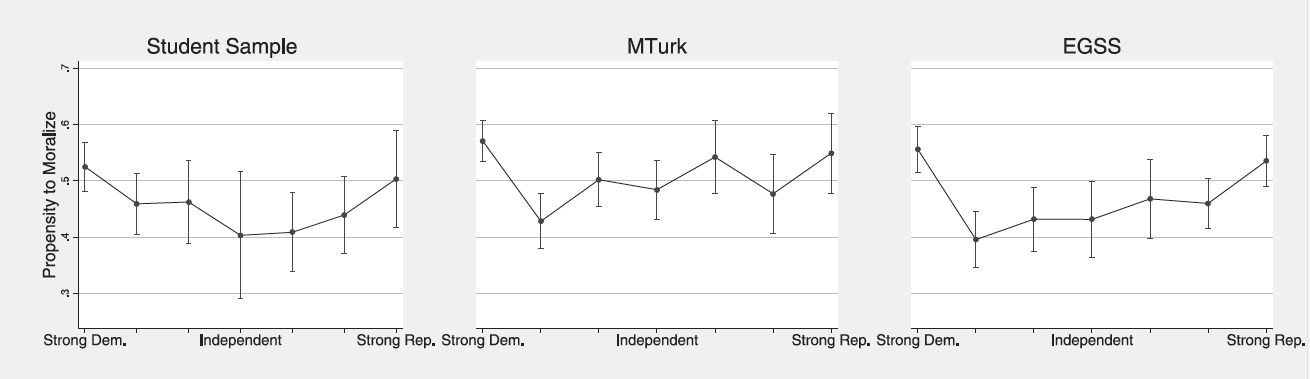
Taken together, Ryan’s findings suggest that the response of moral conviction may be more important than distinguishing between inherently moral and non-moral political issues. Rather, all issues can produce a moral conviction response, depending on the person. Ryan concludes that, “in terms of the underlying psychology, Social Security is just as moralized for some people as Abortion is. Morality is in the eye of the beholder.”
In the fall, Ryan will continue his research on morality in politics when he joins the faculty at the University of North Carolina at Chapel Hill as Assistant Professor of Political Science.
Mar 24, 2014 | ANES, ANES 65th Anniversary, Elections, Innovative Methodology, National
This is a guest post written by W. Phillips Shively, Professor of Political Science at the University of Minnesota.
 This post is part of a series celebrating the 65th anniversary of the American National Election Studies (ANES). The posts will seek to highlight some of the many ways in which the ANES has benefited scholarship, the public, and the advancement of science. Do you have ideas for additional posts? Please contact us by email ([email protected]) or Twitter (@umisrcps).
First and foremost, I can’t really separate ANES, especially in its earliest and most exciting time, from Philip Converse, Donald Stokes, and Warren Miller. Though the large, ongoing dataset is seen as their legacy, it was actually a byproduct of their greatest contribution (after all, there were other large surveys being done at the time, but only theirs became institutionalized like ANES). Their real contribution was research that was breathtakingly creative and rigorous for its time. In the 1960s, when I was in graduate school, they were my gods; if he had ever had a poster, Phil Converse would have been on my dormitory room wall. They pioneered considering the interaction of data from different levels of social organization, analyzing the interplay of historical change and individual behaviors, and applying data analysis to democratic theory. The ANES data set came to be of such importance in the field because they demonstrated the beautiful things that could be done with it.
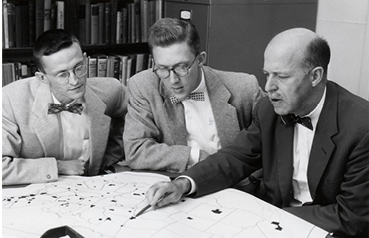
Converse, Miller, and Campbell developing ANES predecessor the Michigan Election Studies
The high point of my graduate studies was a secondary analysis of the 1956 and 1960 national election studies, to test for various processes by which individuals were influenced in their voting by their community (i.e., an early and very primitive study of contextual effects.) This was pre-computer, so I did it all with IBM cards and a card sorter. It was the most exciting thing I did in graduate school, yet all I was doing was imitating Miller, Converse, and Stokes.
In more recent years, ANES made a huge contribution when Steven Rosenstone took the lead in setting up the ambitious Comparative Study of Electoral Systems (CSES), a cooperative study involving roughly fifty national election studies. He was able to build on years of cooperation between the ANES and international scholars, started especially by Stokes and Converse.
While the Inter-University Consortium for Political and Social Research (ICPSR) now serves a broad inter-disciplinary audience, it was initially a spin-off of the ANES. I attended the summer program in its second year, 1965. It consisted of a single class, co-taught by Stokes and Converse. Each day they opened some exciting new window for us. One day, Stokes introduced us to the problem of cross-level inference, which he had just started work on; I had never heard of it before, and it would become an important part of my work over the next fifty years. Another day they invited a young sociology graduate student, Gudmund Iversen, to come in and talk to us about an interesting new kind of statistics he had just learned of – Bayesian statistics.
Feb 13, 2014 | Michigan, National, Social Policy
Post developed by Katie Brown in coordination with Rosemary Sarri.

Photo credit: Thinkstock
400,000 youth are placed out of home in residential treatment institutions in the United States because they were abused or neglected their family. Just 2% of these youth placed out of home in institutions will run away each year, compared to the annual runaway rate of of 6-8% for American youth overall. But the ramifications for the institutionalized runaway youth are grave, including homelessness, poverty, substance abuse, exploitation, and crime.
Center for Political Studies (CPS), School of Social Work, and Women’s Studies Professor Emerita Rosemary Sarri studies the impact of social policy on children. A forthcoming paper with her colleagues Joseph P. Ryan and Elizabeth Stoffregen, who are also of the Institute for Social Research (ISR), considers the serious risks for these youth running away from the child welfare system. The article asks: Does running away from these institutional placements pose an increased risk of future involvement with the juvenile and/or adult justice systems?
Focusing on Wayne County, Michigan, home of the city of Detroit, the study includes 371 children aged twelve or older from the child welfare system that ran away at least once in 2003, matched against similar children in the system that did not run away. The data trace involvement of the youth from the two groups in the justice system over eight years.
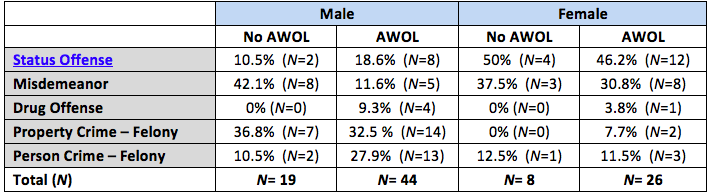
Sarri finds that running away is indeed associated with negative outcomes. Overall, youth who run away from institutional placements have a 40% chance of ending up in the adult justice system. For males, this increases to 71.5%. The table below breaks down the most serious offenses by status and gender for the youth who ran away from institutions. Indeed, youth who run away from institutions commit more serious crimes, especially males.
Most Serious Juvenile Justice Offense by Gender and Runaway Status (the term “AWOL” identifies youth who ran away from institutions)
Given these staggering results, what can be done? Most of the youth are neglected, often with deep issues relating to substance abuse, mental health, homelessness, and crime. As such, Sarri calls for a positive, restorative approach that sets goals and offers resources to help youth achieve them. The Annie E. Casey Foundation and the Center for Juvenile Justice Reform have developed an inter-agency collaborative proposal to provide more effective treatment for these “crossover” youth who are at high risk when they drift to the justice system.
Feb 3, 2014 | ANES, Conflict, Current Events, National, Social Policy
Developed by Katie Brown in coordination with Darrell Donakowski.

Source: Thinkstock
On September 16, 2013, a former reservist killed 12 people in a Washington, D.C. Navy Yard. This latest high profile mass American shooting prompted President Obama to urge another push for stronger gun control. Obama first marked the issue as a national priority after a gunman shot and killed 20 first graders and six educators in a Newtown, Connecticut elementary school in December 2013. Obama promised to do everything in his power to prevent another such tragedy. In a Newtown vigil, and referencing the Aurora, Colorado movie theater shooting of the previous summer that killed 12 and injured 70, Obama declared enough.
Obama’s post-Newtown proposals included tougher background checks to purchase arms and the ban of military-style assault weapons used in several high profile mass shooting. But the package stalled in Congress. After the Navy Yard shooting, Obama urged the electorate not to accept mass shootings as a new normal, instead to demand common sense gun laws.
How do the American people feel about gun control?
For 65 years, the American National Election Studies (ANES) have interviewed a representative sample of voting age Americans on a variety of topics, including but not limited to voting and turnout, public policy support, societal values, and demographics. As ANES describes, the resulting data “inform the nation about itself.” Data from the 2012 survey were released at the end of June 2013.
One question in particular from the ANES sheds light on national attitudes toward gun control. The question was asked in 2000, 2004, 2008, and 2012, allowing us to trace responses over time. The graph below displays these trends (leaving out the small fractions who did not know or refused to answer).
Do you think the federal government should make it more difficult for people to buy a gun than it is now, make it easier for people to buy a gun, or keep these rules about the same as they are now?
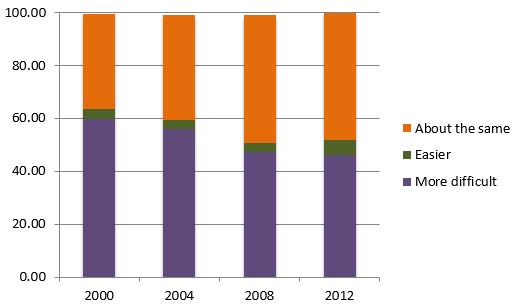
As we can see, the proportion of the public supporting tougher regulation is shrinking over the time period, while satisfaction with current regulations increased. Yet, support for tougher gun laws is the most popular choice in all included years. It is important to note that these data were collected before Aurora, Newtown, and the Navy Yard shootings. The 2016 ANES study will no doubt add more insight into this contentious, important issue.
Jan 23, 2014 | Current Events, International, National
Post developed by Katie Brown in coordination with Ronald Inglehart.
Time Magazine’s 2013 cover story by Joel Stein labeled Millennials – the generation born between the early 1980s and the early 2000s – as self-entitled narcissists. That story is one in a slew of articles berating Millennials for a host of issues. But the Time story in particular caused quite a stir, spawning both similar critiques and rebuttals in the mainstream press.
But what are Millenials really about? Center for Political Studies Research Professor Ronald Inglehart is the Founding President of the World Values Survey (WVS). Conducted in waves, the WVS traces values and cultural exchange over time and across the world. WVS data offer insight into the world’s Millenials generation.
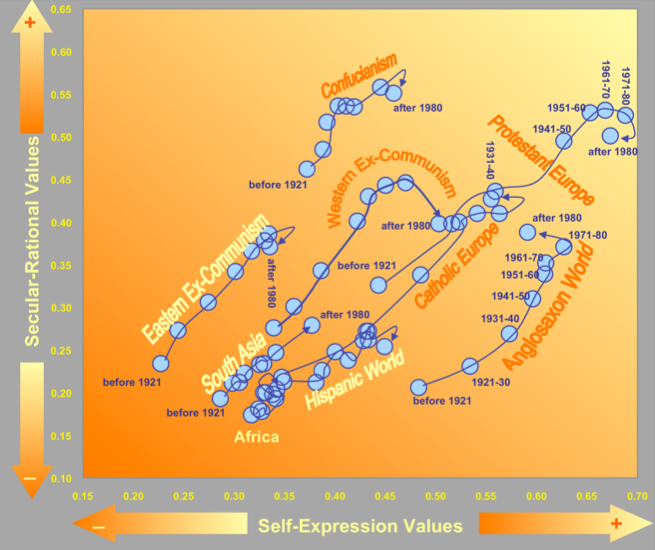
The graph above shows where WVS respondents fell on two values scales by birth year, within various groups. Within each group, Millenials are represented by the blue dots for those born after 1980. This evidence from the WVS suggests that the Millennials generation demonstrates higher self-expression than most of the other generations within each group. Greater self-expression values means having more action resources – both material and cognitive. The chart below highlights the chain reaction set off by these action resources.
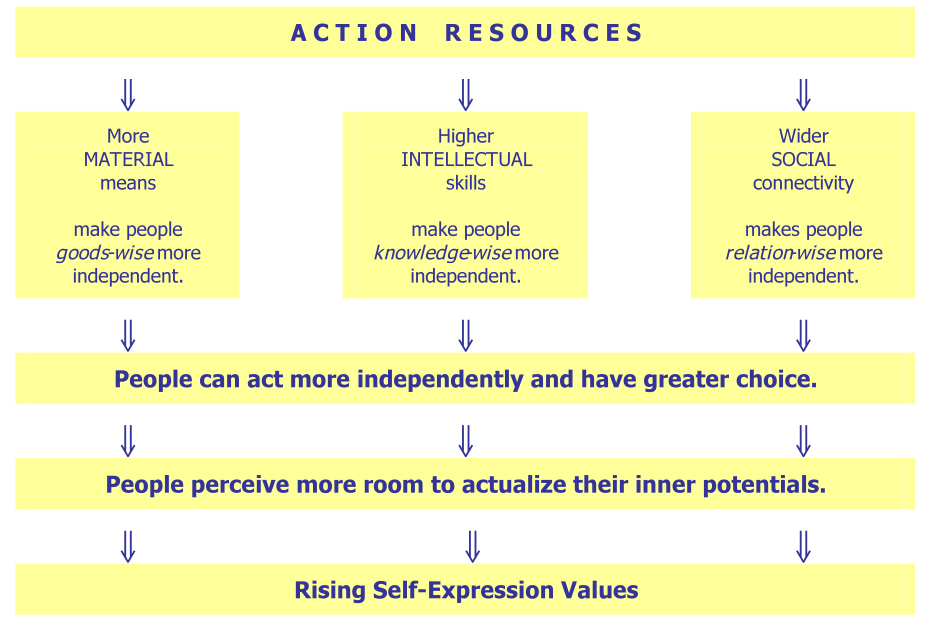
How can we see this enhanced self-expression in action? In support for environmental protection, tolerance of diversity and out-groups like foreigners and LGBT populations. In valuing political and economic participation. And in emphasizing imagination and tolerance when rearing children. Also accompanying higher self-expression values are a greater sense of subjective well-being and interpersonal trust. These trends bring hope for the future led by the often vilified Millennial generation.
Jan 15, 2014 | Elections, Innovative Methodology, Michigan, National
Developed by Katie Brown in coordination with Arthur Lupia.

Photo credit: Thinkstock
Voters are ignorant and we must fix them. This belief has spawned much political science research and many efforts to inform the “ignorant. ” But what if this premise is false?
In a forthcoming book – The trouble with voters and those who try to fix them – Center for Political Studies (CPS) researcher and professor of political science Arthur Lupia suggests that voters aren’t as ignorant as many fear.
First, it is impossible to know all potentially relevant political information. Lupia presents his own position as a citizen as a case study. To be informed about all legislation that could affect him, Lupia should know about the more than 2,000 laws passed by the United States Senate and signed by the President. He should also know about the 40,000 additional proposed bills. As a resident of Michigan, Lupia should know about the 1,239 proposed bills, 42 concurrent resolutions, 26 joint resolutions, and 174 resolutions from the Michigan House of Representatives, as well as the 884 bills, 25 continuing resolutions, and 19 joint resolutions from the Michigan Senate in 2011 alone. Living in Ann Arbor, Lupia should also know about the many city ordinances passed in recent years. Does he know the gist, let alone the details, of each of these? No. Does he or anyone need to? No.
Second, even if you could know all potentially relevant political information, shortcuts can get you there faster. That is, voters without certain knowledge tend to vote the same as if they possessed that knowledge. Lupia likens this to traffics signals. It is impossible for a driver to know the traffic flows and locations of all vehicles in all directions when approaching an intersection. A traffic light signals the optimal time to go and stop. Voters can therefore seek out signals in a saturated, sometimes chaotic political environment to make informed choices.
So, voters are not crippled by ignorance. What then of those who try to fix voters? Lupia sees fixers as playing an integral role in civic society. But these fixers would benefit from changing their baseline assumption. Voters are not broken. With this paradigm shift in place, fixers could appeal to this group with precision and tact. To this end, Lupia offers the latest from biology and brain science, strategic communication, and marketing to help fixers better deliver their messages.
Lupia summarizes his argument in succinct terms: “From these facts alone, we can draw an important conclusion. When it comes to political information there are two groups of people. One group is almost completely ignorant of almost every detail of almost every law and policy under which they live. The other group is delusional. There is no third group.”